

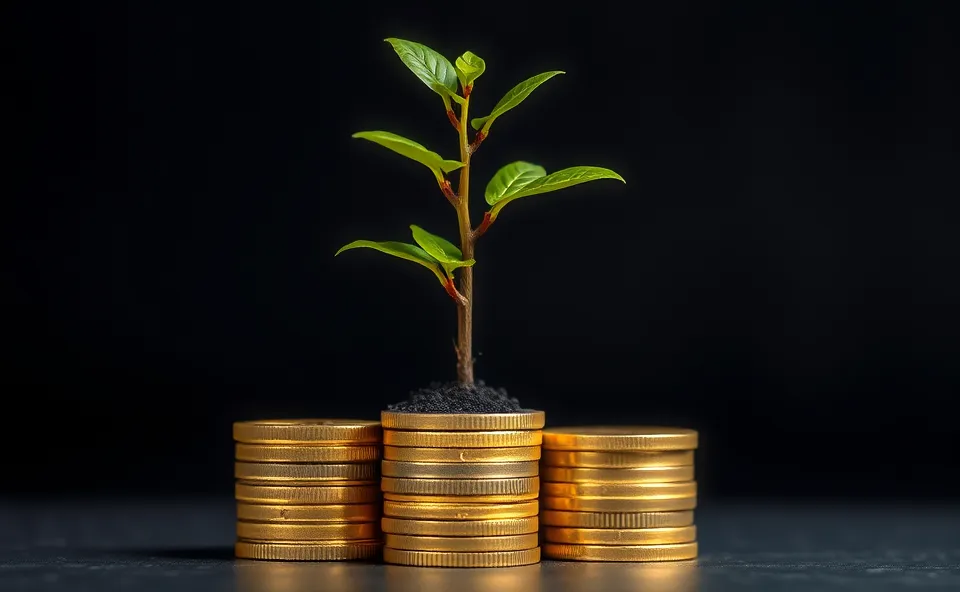
The Magic Behind Your Money Growing on Its Own
Imagine your money having babies. Not literal babies, of course, but little money babies that then grow up and have their own babies. Sounds pretty neat, right? That’s essentially what compound interest is all about, and it’s one of the most powerful concepts in investing basics. It’s how your savings can grow and grow over time, almost on autopilot. We’re going to break down this incredible tool that helps with wealth accumulation and makes your money work harder for you.
Why Everyone’s Talking About Compound Interest Right Now
You might be wondering why compound interest is suddenly on everyone’s radar. It’s always been around, a fundamental principle of finance. But lately, with people focusing more on financial planning and building a secure future, especially for retirement savings, the power of letting your money compound has become a hot topic. In a world where quick fixes are often sought, understanding something that builds wealth slowly but surely is incredibly appealing. It’s a core part of smart investment growth and a key to unlocking significant passive income down the road.
A Little History: Where Did This Money-Growing Idea Come From?
While the concept of earning interest on your money isn’t new, the idea of compounding interest – earning interest on your interest – has been understood for centuries. Think back to early forms of lending. When you lent someone money, they paid you back with a little extra, the interest. Compound interest takes that a step further. Instead of just earning interest on your original loan amount, you start earning interest on the original amount PLUS the interest you’ve already earned. It’s like a snowball rolling down a hill, picking up more snow and getting bigger and faster. This concept has been crucial for everything from early banking to modern-day investment growth.
What Compound Interest Means for Your Financial Future
So, what does this mean for you? Compound interest is a game changer for anyone looking to build wealth. It’s the engine that drives long-term investing. The earlier you start, the more time your money has to work its magic. Even small amounts saved consistently can grow into substantial sums thanks to compounding. It’s how many people achieve their retirement savings goals and build significant passive income without needing to actively manage a lot of assets.
Let’s break down how it works with a simple example.
Imagine you have $1,000 to invest. You find an investment that offers a 5% annual percentage yield (APY).
- Year 1: You earn 5% on your $1,000, which is $50. Your total is now $1,050.
- Year 2: Now, you earn 5% on $1,050. That’s $52.50. Your total is $1,102.50.
- Year 3: You earn 5% on $1,102.50, which is $55.13. Your total is $1,157.63.
See how the amount of interest you earn each year goes up? That’s compound interest in action! It might seem small at first, but over 10, 20, or even 30 years, that growth becomes astonishing.
The compound interest formula is often written as:
A = P(1 + r/n)^(nt)
Where:
- A is the future value of the investment/loan, including interest
- P is the principal investment amount (the initial deposit or loan amount)
- r is the annual interest rate (as a decimal)
- n is the number of times that interest is compounded per year
- t is the number of years the money is invested or borrowed for
For our example above, if interest is compounded annually (n=1), for 3 years (t=3) at 5% (r=0.05) on $1000 (P):
A = 1000(1 + 0.05/1)^(1*3)
A = 1000(1.05)^3
A = 1000 * 1.157625
A = 1157.63
This formula quantifies that powerful snowball effect we talked about. Understanding this is a fundamental step in financial planning. It illustrates the benefit of long-term investing and how it contributes to wealth accumulation.
The real secret weapon here is time. Starting early means your initial investment has more periods to grow and earn compound interest. The difference between starting at 25 versus starting at 45 can be tens of thousands, or even hundreds of thousands, of dollars by retirement. This is why financial experts always emphasize starting your retirement savings as soon as possible. It’s not just about how much you save, but when you start saving.
What the Future Holds for Your Money’s Growth
Looking ahead, the principles of compound interest will remain a cornerstone of personal finance and investment growth. As financial technologies evolve, we might see even more innovative ways to harness compounding, perhaps through micro investing platforms or personalized financial planning tools. However, the core concept remains the same: consistency and time are your greatest allies. The importance of understanding and utilizing compound interest for wealth accumulation, achieving financial planning goals, and securing a comfortable retirement savings will only grow. It’s the silent partner in your journey towards financial freedom and the foundation of building passive income streams.
Frequently Asked Questions About Compound Interest
What is the most important thing to know about compound interest?
The most crucial aspect of compound interest is the power of time and consistency. Starting early with your investments allows compound interest to work its magic over longer periods, leading to significantly greater wealth accumulation than starting later, even with larger initial contributions. It’s a key principle for understanding investing basics.
How does compound interest help with retirement savings?
Compound interest is fundamental to successful retirement savings. By reinvesting earnings, your money grows exponentially over decades, helping you build a substantial nest egg that can provide passive income during your retirement years. It makes long-term investing incredibly effective.
Can compound interest be used for passive income?
Absolutely. When your investments generate earnings that are then reinvested to generate more earnings, you are essentially creating a cycle of passive income. Over time, these compounded earnings can become a significant source of income that doesn’t require your constant active management.
Is compound interest the same as annual percentage yield?
Annual percentage yield (APY) is a way to express the total amount of interest you will earn on an investment over a year, taking into account the effect of compounding. While APY reflects the outcome of compounding, compound interest is the underlying mechanism that makes your money grow faster than simple interest.
What is the easiest way to understand the compound interest formula for beginners?
For beginners, the easiest way to grasp the compound interest formula is to focus on the idea of “interest on interest.” Every time interest is calculated, it’s added to your principal, and the next calculation includes that new, larger principal. This leads to accelerating investment growth, which is the core benefit for wealth accumulation.











