

Our Sun’s Future A Cosmic Drama
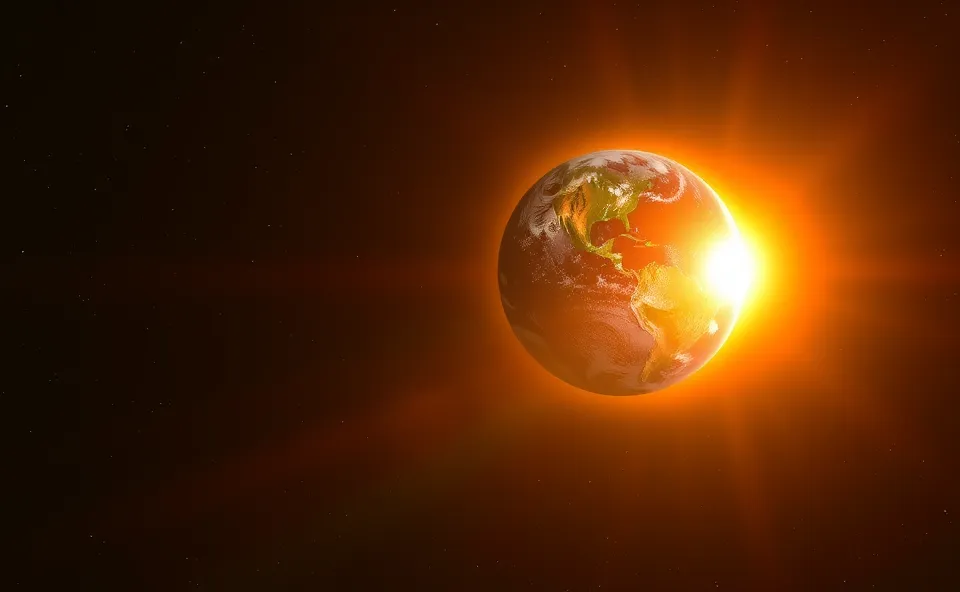
Imagine our Sun, a star we’ve always seen as steady and life-giving, going through some serious aging. Scientists have been looking into what happens when stars like ours get really old, and the latest astronomical research is painting a picture that’s a bit different than we used to think. For a long time, the story was that when our Sun ages, it will puff up into a red giant, getting so big and hot that it would definitely swallow up Earth. But, new studies are hinting that maybe, just maybe, our little planet might actually dodge that fiery fate. It’s like finding out your childhood home might not be demolished after all, just… moved slightly. This is fascinating stuff for anyone interested in Earth survival and the grand dance of solar evolution.
Why the Buzz About Our Sun’s Expansion Now?
You’re probably hearing about this now because stellar physics is getting more sophisticated, and our tools for observing the cosmos are incredibly powerful. Astronomers are able to run super detailed computer simulations of how stars like our Sun evolve over billions of years. These aren’t just guesses anymore; they’re based on a deep understanding of gravity, nuclear fusion, and the intricate mechanics of planetary orbits. The idea of planetary engulfment by a red giant Sun has been a staple of science fiction and a grim prediction for Earth’s long term. But these new insights are stirring up excitement and re-examining those predictions. It’s a shift from a definitive end to a potential escape, which naturally catches everyone’s attention, especially when we think about Earth survival.
A Look Back at the Cosmic Timeline
For ages, our understanding of stellar evolution has been pretty consistent. Our Sun, being a medium-sized star, is expected to live out its main sequence life for billions more years. After that, it’s supposed to run out of hydrogen fuel in its core, start fusing helium, and begin to expand dramatically. This red giant phase is where things get dicey for inner planets. The Sun would swell, its outer layers reaching far beyond its current size, engulfing Mercury and Venus, and potentially Earth. This was the long-held scientific consensus. Think of it like a balloon being inflated beyond its normal size; anything too close gets caught. This understanding set a clear, albeit distant, endpoint for life on Earth. The concept of the habitable zone, that sweet spot where liquid water can exist, has always been tied to the Sun’s stable output, but the eventual red giant expansion changes that equation dramatically.
What This Means for Us and Our Tech
While we’re talking about timescales that are mind-bogglingly long, the implications of this new astronomical research are profound. For us, as humans, it offers a different perspective on the ultimate fate of our planet. It’s not about immediate survival, of course, but about the grand cosmic narrative. For technology and science, it’s a massive win. It means our models of solar evolution are becoming more accurate, and our understanding of orbital dynamics in extreme scenarios is deepening. This kind of research pushes the boundaries of computational astrophysics and our ability to simulate complex systems. It also makes us rethink what we mean by the “life span of the sun” and how it might affect potential future civilizations or even hypothetical interstellar colonization efforts. If Earth might survive the Sun’s expansion, it changes the calculus for very, very long-term planning, even if that’s purely theoretical at this point.
Looking Ahead: A Future Beyond Red Giant Ruin?
So, what could happen next? The key lies in something called orbital migration. As the Sun expands, it loses mass. This mass loss, according to the new research, could actually cause the gravitational pull on the planets to weaken slightly. This might sound counterintuitive, but it’s a known effect in celestial mechanics. As the Sun loses mass, its gravitational grip loosens, and planets might actually drift outward in their orbits. If Earth drifts outward enough, it could move beyond the zone where the Sun’s expanded atmosphere would engulf it. It’s not guaranteed, and the exact amount of mass loss and subsequent orbital drift is still being studied intensely. But this opens up a scenario where Earth, and perhaps other planets, might not face the dreaded planetary engulfment. It’s a more nuanced and potentially hopeful outcome than the simple doom we’ve often considered. The ongoing astronomical research will continue to refine these models, looking at every factor involved in solar physics and planetary motion.
Frequently Asked Questions About Earth Survival and Our Sun
Could Earth really survive the Sun expansion?
Recent astronomical research suggests that Earth might escape being engulfed by the Sun during its red giant phase. This is due to complex factors involving the Sun losing mass as it ages, which could cause Earth’s orbit to shift outwards, potentially moving it out of the Sun’s fiery embrace. This redefines our understanding of Earth survival in the very long term.
What is the red giant phase of solar evolution?
The red giant phase is a stage in the solar evolution of stars like our Sun. It occurs after the star has exhausted the hydrogen fuel in its core. The Sun will begin to fuse helium, causing it to expand dramatically and cool down, becoming much larger and redder. This phase is critical for considering planetary engulfment.
How does orbital migration relate to Earth survival?
Orbital migration could be the key to Earth survival. As the Sun expands into a red giant, it sheds mass. This loss of mass weakens its gravitational pull, potentially causing planets like Earth to drift into wider orbits. If this outward drift is significant enough, Earth could move beyond the Sun’s destructive expanded atmosphere.
What is the habitable zone and will it disappear?
The habitable zone is the region around a star where conditions might be right for liquid water to exist on a planet’s surface, making it potentially suitable for life. During the Sun’s red giant phase, the habitable zone will shift outwards. However, if Earth’s orbit also shifts outwards sufficiently due to orbital migration, it could potentially remain within a habitable zone, though the conditions would be vastly different.
When will the Sun start its expansion?
The Sun is expected to begin its expansion into a red giant in about 5 billion years. This is a very distant future event, so it does not pose any immediate threat to life on Earth. The current focus of astronomical research is on understanding the precise dynamics of this future stellar physics event and its potential impact on planetary orbits.











