

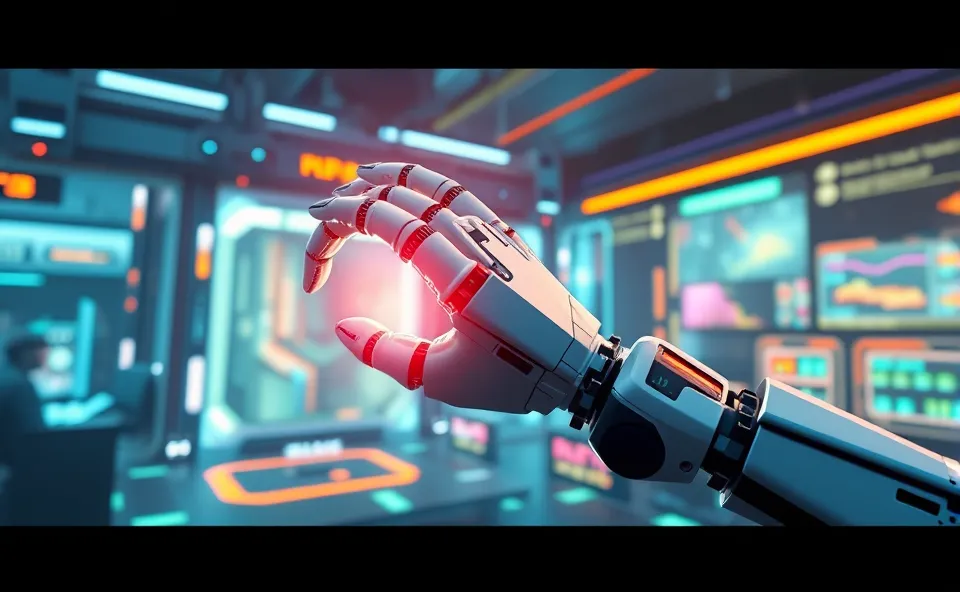
Gaming for the real world
For years, we have been waiting for the moment when robots finally move beyond rigid, factory-bound tasks. We want machines that can handle the unpredictability of a messy kitchen, a crowded warehouse, or a tricky repair job. Recently, a company called General Intuition has pulled back the curtain on a fascinating approach to solving this. They are using video game data to train foundation models for physical AI. Think of it as teaching a robot how to navigate the real world by letting it play through thousands of hours of high-fidelity simulations first.
This is a massive shift in how we think about machine learning. Instead of manually coding every single movement, General Intuition is letting models learn the physics of our world through virtual experiences. By feeding these models data from gaming environments, they are creating a shortcut to intelligence that robots have been missing for decades.
Why everyone is talking about robot autonomy right now
You might wonder why this is hitting the headlines today. The truth is that we have hit a wall with traditional robotics. We have great hardware, but the software controlling it has been fragile. If a robot encounters a slightly different light, a new object, or a shifted surface, it often freezes or fails. People are searching for answers because we are finally seeing the potential for a breakthrough that feels like the equivalent of a ChatGPT moment for the physical world.
Business leaders and tech enthusiasts realize that if we can bridge the gap between digital intelligence and physical movement, the economy changes overnight. We are moving away from robots that just repeat a script and toward autonomous systems that can observe, react, and learn. This shift toward physical AI is the missing link to making robots useful in everyday life.
The struggle of teaching robots the laws of physics
To understand why this is a breakthrough, we have to look at the old way of doing things. Traditionally, robot training involved intensive, manual programming or countless hours of trial and error in expensive physical testing labs. This was slow, dangerous, and incredibly expensive. If you wanted a robot to pick up a coffee cup, you had to define every coordinate and angle. If the cup moved an inch, the whole plan failed.
Then came the rise of neural networks and synthetic data. Scientists started realizing that if a machine could understand the underlying rules of movement—how things fall, how objects collide, and how force works—it wouldn’t need to be told what to do in every situation. However, generating that much high-quality data was a nightmare. This is where General Intuition saw an opportunity. They tapped into the vast world of video game engines, which are already built to simulate gravity, light, and friction perfectly. By using games as a training ground, they are teaching AI to “feel” the world before it even touches a physical object.
What this means for the future of work and machines
The impact of this technology is going to be felt in how businesses operate and how we interact with technology. When you use foundation models to govern physical AI, you are essentially giving a robot a “brain” that can generalize. Instead of teaching a robot to stack a specific box, you teach it the concept of picking things up.
- Increased adaptability: Robots will soon be able to handle cluttered, unpredictable environments without needing a human to reprogram them.
- Faster deployment: Because the heavy lifting is done in simulations, moving a robot into a new task becomes a matter of days rather than months.
- Safer interaction: These models can better anticipate the movement of people, making it safer for robots to work alongside humans in offices or homes.
- Lower costs: By replacing physical prototypes with synthetic data training, the barrier to entry for building smarter robots drops significantly.
For businesses, this means the dream of a truly automated supply chain or a home assistant robot is finally becoming a technical reality rather than a science fiction concept. It is not just about making machines faster; it is about making them versatile enough to handle the chaos of our world.
The road ahead for autonomous systems
So, where do we go from here? We are likely to see a gradual rollout of this technology. First, we will see it in controlled industrial environments where the stakes for failure are lower. From there, as these models become more reliable at interpreting sensory data, they will move into more complex settings. We are not going to wake up tomorrow to a world filled with human-like droids, but we will see machines becoming significantly more helpful in the next few years.
The next step is refining how these foundation models interpret real-world video feeds to match what they learned in the gaming simulations. When the “game-trained” brain finally meets the physical camera input of a robot, that is when we will see the true power of physical AI. It is an evolutionary process, but the foundation is finally being poured.
Common questions about physical AI and robotics
What exactly is physical AI?
Physical AI refers to autonomous systems that can interact with the real world using sensors and actuators. Unlike traditional software that just processes data, physical AI uses machine learning to navigate spaces, manipulate objects, and react to changing environments in real time.
Why is synthetic data so important for robot training?
Collecting data in the real world is slow and dangerous. Synthetic data, often pulled from video games or high-end simulations, allows developers to generate millions of scenarios quickly. This helps robots learn from a vast library of “experiences” without ever risking damage to the machine or the environment.
How do foundation models help in robotics?
Foundation models act as a central brain for a robot. Instead of coding every specific movement, developers train these large neural networks on broad patterns of behavior. This allows the robot to handle new situations it has never seen before by applying the general knowledge it learned during training.
Why did General Intuition choose video games as a data source?
Video games are built on sophisticated physics engines that perfectly mirror how objects interact in the real world. By leveraging this existing technology, General Intuition can train AI in a virtual environment where gravity, friction, and collision detection are already perfectly defined, making the training process much faster and more accurate.
Will this technology lead to robots replacing humans?
The goal of this technology is to augment human capabilities, not necessarily replace them. By automating repetitive, dangerous, or physically taxing work, these autonomous systems allow humans to focus on higher-level creative and decision-making tasks. It is about shifting the nature of work rather than removing the human element entirely.











