

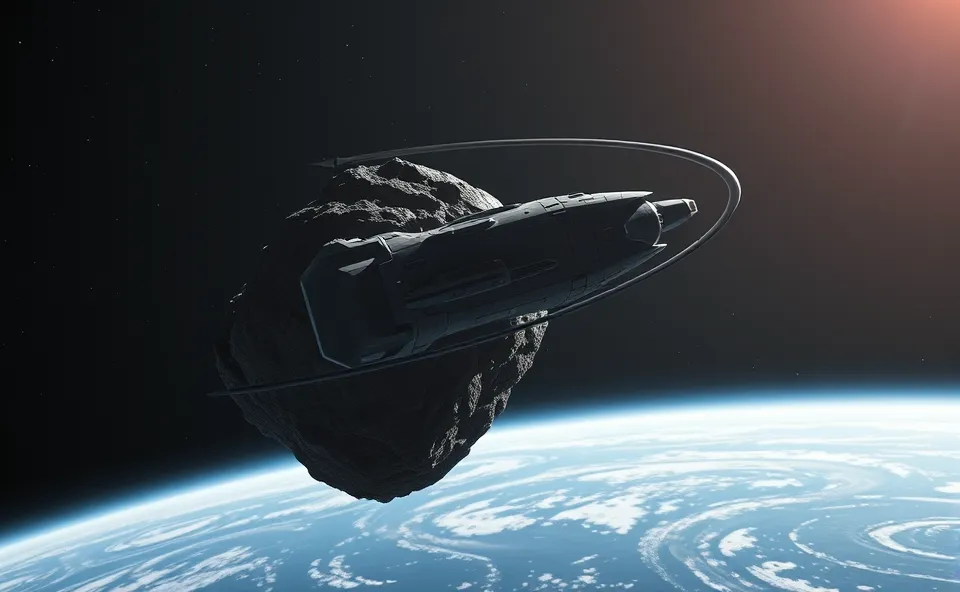
China’s Tianwen-2 Probe Gets Up Close With a ‘Quasi-Moon’
Imagine a tiny celestial body, not quite a moon but always hanging around a much larger one, like a loyal sidekick. That’s essentially what China’s Tianwen-2 space probe has just found itself face-to-face with. This mission has successfully reached a near-Earth asteroid named Kamo’oalewa, and we’re finally getting our first incredible glimpses of this peculiar space rock. This isn’t just a flyby; Tianwen-2 is there to study Kamo’oalewa up close, with plans for something even more ambitious: bringing a piece of it back to Earth.
Why All the Buzz About Kamo’oalewa?
The reason Kamo’oalewa is capturing so much attention right now is its unique status and the groundbreaking nature of this mission. This asteroid is classified as a “quasi-satellite” of Earth, meaning it orbits the Sun but its path keeps it closely tethered to our planet, almost like a temporary companion. These kinds of objects are incredibly rare and offer a unique window into the early solar system. Plus, China’s Tianwen-2 mission is aiming for a sample return, a complex feat in asteroid exploration that always sparks excitement in the planetary science community. It’s a blend of fascinating celestial mechanics and cutting-edge space technology that makes this a hot topic.
A Peek Back: Understanding the ‘Quasi-Moon’ Concept
To really appreciate what Tianwen-2 is doing, we need to understand what a ‘quasi-moon asteroid’ like Kamo’oalewa is. Unlike true moons that orbit a planet directly, quasi-satellites have a more complicated orbital dance. They orbit the Sun, but their trajectory is such that they stay relatively close to Earth for extended periods. It’s like a complex gravitational ballet. Kamo’oalewa was first discovered back in 2016, and astronomers quickly realized its special relationship with our planet. Studying such objects helps scientists understand how asteroids can become temporarily captured by planets, providing clues about planetary system evolution and the distribution of materials in our cosmic neighborhood. This knowledge is crucial for planetary science and our broader understanding of space discovery.
What This Means for Space Exploration and Beyond
The arrival of Tianwen-2 at Kamo’oalewa and the images it’s sending back are significant for several reasons. Firstly, it showcases China’s rapidly advancing space capabilities. Successfully reaching and studying a near-Earth asteroid like this demonstrates a high level of sophistication in space technology and mission planning. For planetary science, Kamo’oalewa is a treasure trove. Its composition could hold clues about the early solar system, potentially even materials that were present when Earth and the Moon formed. This information could refine our understanding of planetary formation and the history of our solar system.
Furthermore, the planned sample return mission is a huge step. Bringing back material from a quasi-satellite asteroid is incredibly challenging. If successful, it would allow scientists on Earth to analyze the asteroid’s makeup in detail, complementing remote observations and offering unprecedented insights. This is akin to a mini lunar mission but with a much more distant and peculiar target. The data gathered will contribute to our overall knowledge of space discovery and the potential resources that might exist in near-Earth objects.
What’s Next for Tianwen-2 and Kamo’oalewa?
The journey for Tianwen-2 is far from over. After its initial close-up observations and the stunning first images, the probe is preparing for the next crucial phase: collecting samples. This involves a delicate operation where the spacecraft will attempt to gather material from the asteroid’s surface. Once the samples are secured, Tianwen-2 will embark on its long voyage back to Earth, aiming for a precise landing. This return trip is just as complex as the outbound journey, requiring accurate navigation and a robust reentry system.
The success of this sample return mission could pave the way for future missions to other near-Earth asteroids, potentially for resource utilization or further scientific study. It also adds another chapter to our ongoing quest for space discovery, pushing the boundaries of what we can achieve in exploring our solar system. The data collected will undoubtedly fuel years of research in planetary science, orbital mechanics, and the fundamental questions about where we came from in the universe.
Frequently Asked Questions About Tianwen-2 and Kamo’oalewa
- What is the primary goal of the Tianwen-2 mission regarding the quasi-moon asteroid Kamo’oalewa?
- How does Kamo’oalewa’s status as a quasi-moon asteroid make it scientifically interesting for planetary science?
- What are the key challenges associated with China’s Tianwen-2 sample return mission to this near-Earth asteroid?
- What kind of space discovery can we expect from analyzing samples from Kamo’oalewa?
- What does the success of Tianwen-2 achieving this lunar mission milestone imply for future asteroid exploration?











