

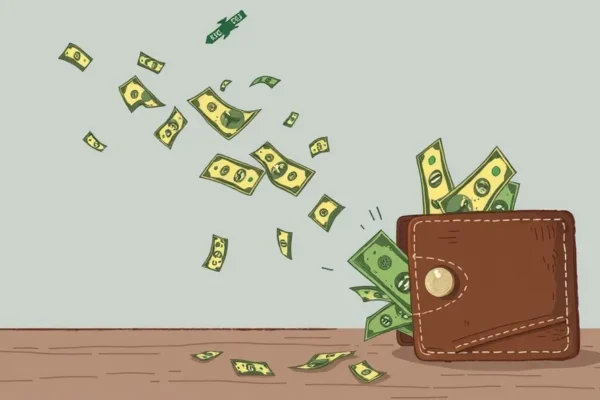
Understanding inflation is crucial for navigating the modern world and safeguarding your financial well-being. It’s a concept that touches nearly every aspect of our lives, from the groceries you buy to the value of your hard-earned money. This explainer will break down what inflation is, how it works, and why it’s so important for your personal finances and financial literacy.
Why Understanding Inflation Matters So Much
Imagine you have a favorite candy bar that costs $1 today. What if, next year, that same candy bar costs $1.10? That small increase might seem insignificant, but it’s a tiny example of a much larger economic force at play: inflation. Inflation affects how much your money is worth, how far your paycheck stretches, and how effectively you can save for the future.
If you don’t understand inflation, you might find your savings aren’t growing as fast as you thought, or that your regular income buys less than it used to. This can lead to financial stress and missed opportunities. By learning about inflation, you’ll gain the knowledge to make smarter financial decisions, protect your purchasing power, and build a more secure financial future.
In this article, you’ll learn:
- The simplest definition of inflation.
- The basic building blocks needed to understand it.
- How inflation actually happens in an economy.
- Why it behaves the way it does.
- Common misunderstandings about inflation.
- Real-world examples of its impact.
- How inflation connects to other financial concepts.
- The big picture of why this economic indicator is so important.
The Simplest Explanation of Inflation
At its core, inflation is the general increase in prices and the fall in the purchasing power of money over time.
Think of it like this: imagine you have a magic shopping cart that can hold exactly 10 apples. Today, you can fill that cart with $10 worth of groceries. If inflation happens, next month, those same 10 apples might cost you $11. Your money can now buy fewer apples than it could before. The apples themselves haven’t changed, but the value of your $1 has decreased.
Building the Foundation: Understanding Money’s Value
To grasp inflation, we first need a clear picture of what money is and how its value works. Money, in its simplest form, is a medium of exchange – a tool we use to trade for goods and services. But money isn’t just pieces of paper or numbers in a bank account; it represents a certain amount of value.
The key concept here is purchasing power. Purchasing power refers to the quantity of goods or services that can be bought with a unit of currency. If you have $100, your purchasing power is the total value of all the things you can buy with that $100.
Let’s use a concrete example: Suppose you love buying pizza. Today, a large pizza costs $10. With $50, you can buy 5 pizzas. This $50 has a certain purchasing power: it can get you 5 pizzas.
Now, imagine the price of that same large pizza increases to $12. If you still have $50, you can now only buy about 4 pizzas ($50 divided by $12 is approximately 4.17 pizzas). Your $50 still exists, but its purchasing power has decreased because the price of pizza went up. This is the fundamental idea behind inflation.
How Inflation Actually Works
Inflation isn’t usually caused by a single event but rather a combination of factors that increase the overall demand for goods and services or decrease the overall supply, leading to higher prices across the economy.
One major driver is demand-pull inflation. Picture a popular new video game console being released. Everyone wants one! If there aren’t enough consoles for everyone who wants to buy them, companies can raise the price because they know people are willing to pay more to get one. When this happens across many different goods and services simultaneously, it leads to inflation. More money chasing fewer goods means prices go up.
Another driver is cost-push inflation. Imagine the cost of flour, a key ingredient for bread and pizza, suddenly doubles due to a bad harvest or increased transportation costs. Bakeries and pizza shops will have to pay more for their ingredients. To maintain their profits, they will likely raise the prices of their bread and pizzas. If this happens for many businesses in different industries, the overall price level rises.
A third factor can be related to the money supply. If a government prints a lot more money or makes it very easy to borrow money (lowering interest rates), there’s more money circulating in the economy. When there’s more money available, its value can decrease, leading to higher prices for goods and services as businesses and individuals have more money to spend.
Let’s look at a simplified example. Imagine a small island economy with only 100 residents and a total of $1,000 in circulation. If there are 100 loaves of bread available, each costing $1 ($1,000 / 100 loaves). Now, imagine the government gives every resident an extra $5, bringing the total money supply to $1,500. If the number of bread loaves stays the same at 100, and people now have more money to spend, they might be willing to pay more for bread. The bakery might then raise the price of bread to $15 per loaf ($1,500 / 100 loaves). The money supply increased, and so did the price of bread, illustrating inflation.
Why Inflation Behaves That Way
The underlying logic of inflation is rooted in basic economics: supply and demand. When demand for goods and services outstrips supply, prices tend to rise. Conversely, when supply exceeds demand, prices usually fall.
Historically, periods of significant inflation have often been linked to large increases in the money supply, such as during wartime when governments print money to fund military efforts, or when central banks implement policies to stimulate the economy. For example, after World War I, Germany experienced hyperinflation where prices rose so rapidly that money became virtually worthless. This was largely due to the government printing vast amounts of money to pay off war debts.
Economists and central bankers monitor inflation closely. A common economic indicator used to measure inflation is the Consumer Price Index (CPI). The CPI tracks the average change over time in the prices paid by urban consumers for a market basket of consumer goods and services. When the CPI rises, it signifies that the cost of living has increased.
There’s a general consensus among economists that a low, stable rate of inflation (often around 2%) is generally healthy for an economy. It encourages spending and investment rather than hoarding cash, as people expect prices to rise slightly in the future. However, high or unpredictable inflation can be very damaging.
Common Misconceptions About Inflation
One of the most common misunderstandings is that inflation means all prices are going up by the same amount. In reality, inflation is a general trend. Some prices might rise faster than others, and some might even fall. For instance, while the cost of groceries might increase, the price of electronics might decrease due to technological advancements.
Another misconception is that inflation is always a bad thing. As mentioned, a small, stable level of inflation is often considered desirable by policymakers because it can encourage economic activity. It’s the high or unpredictable inflation that causes significant problems.
People also sometimes confuse inflation with a general increase in wages. While wages might rise in response to inflation, they don’t always keep pace. If wages rise slower than prices, people’s real return on their labor decreases, meaning they can buy less with their income. This is why the purchasing power of your savings is so critical.
Finally, some people believe that inflation is solely caused by greedy businesses raising prices. While businesses do pass on increased costs and can influence prices, sustained, widespread inflation is usually driven by broader macroeconomic factors like the money supply or overall economic demand, as explained earlier.
Real-World Applications and Examples
Inflation impacts nearly every financial decision you make. Let’s look at a few examples:
Savings Accounts: Imagine you have $1,000 saved in a savings account that earns 1% interest per year. If inflation is 3% per year, your money is actually losing value. After one year, you’ll have $1,010 in your account. However, because prices have gone up by 3%, what you could buy with $1,000 last year now costs about $1,030. So, while you have more money, its purchasing power has decreased. This is often referred to as a negative real return on your savings.
Retirement Planning: Inflation is a major consideration for retirement. If you estimate you’ll need $50,000 per year in retirement income, that amount will likely be significantly higher in the future due to inflation. If inflation averages 3% per year, what costs $50,000 today will cost over $90,000 in 20 years. Planners must account for this devaluation of money over long periods.
Cost of Living Adjustments (COLA): Many government benefits, pensions, and union contracts include a Cost of Living Adjustment (COLA). This is a provision that automatically increases payments or wages to keep pace with inflation, usually tied to the Consumer Price Index (CPI). For example, Social Security benefits are adjusted annually through a COLA to help beneficiaries maintain their purchasing power as the cost of living rises.
Connections to Other Financial Ideas
Inflation is deeply intertwined with many other fundamental financial concepts. Understanding it helps illuminate these connections:
Interest Rates: Central banks, like the Federal Reserve in the United States, use interest rates as a primary tool of monetary policy to manage inflation. When inflation is too high, central banks often raise interest rates. This makes borrowing more expensive, which can slow down spending and investment, thereby reducing inflationary pressures. Conversely, if inflation is too low, they might lower interest rates to encourage economic activity.
Investment Returns: When considering investments like stocks or bonds, you need to think about the real return, not just the nominal return. The nominal return is the stated percentage gain. The real return is the nominal return minus the rate of inflation. If your stock investment grows by 8% in a year, but inflation is 5%, your real return is only 3%. This adjusted return is what truly reflects the increase in your purchasing power.
Economic Growth: While high inflation can be damaging, a complete lack of inflation (deflation) can also be problematic, often signaling a weak economy. Policymakers generally aim for a moderate level of inflation that supports steady economic growth.
The Big Picture: Why This Concept is So Important
Inflation is a fundamental economic phenomenon that shapes the value of money and impacts economic stability. Understanding inflation is not just about knowing a definition; it’s about grasping how your financial decisions are influenced by the changing value of money over time. It’s a key component of financial literacy that empowers you to:
- Make informed decisions about saving and investing.
- Plan effectively for long-term goals like retirement.
- Understand news reports about the economy and government policy.
- Protect your purchasing power and ensure your money continues to work for you.
By understanding inflation, you gain a clearer perspective on how the economy functions and how to navigate its currents to achieve your personal financial goals. It’s a critical piece of the puzzle for anyone looking to build wealth and secure their financial future.
Key Takeaways and Common Questions
What is inflation?
Inflation is the general increase in prices and the decrease in the purchasing power of money over time. It means your money buys less than it used to.
Is inflation always a bad thing?
No. A low, stable rate of inflation (around 2%) is generally considered healthy for an economy. High or unpredictable inflation, however, can be very damaging.
How do we measure inflation?
The most common measure is the Consumer Price Index (CPI), which tracks the average change in prices for a basket of consumer goods and services.
How does inflation affect my savings?
If the interest rate on your savings is lower than the inflation rate, your savings are losing purchasing power. This means your real return is negative.
What causes inflation?
Inflation is typically caused by a combination of factors, including increased demand for goods and services, rising production costs, and an expansion of the money supply.
How is inflation related to interest rates?
Central banks often adjust interest rates as part of their monetary policy to control inflation. Raising interest rates can help slow down inflation.
Is there anything I can do to protect myself from inflation?
Yes, by investing in assets that historically tend to keep pace with or outperform inflation, such as stocks or real estate, and by ensuring your savings earn a competitive interest rate that ideally exceeds inflation.
Further Learning: Explore related topics like “Understanding Interest Rates” and “Investing for Beginners” to build on your financial literacy.











