

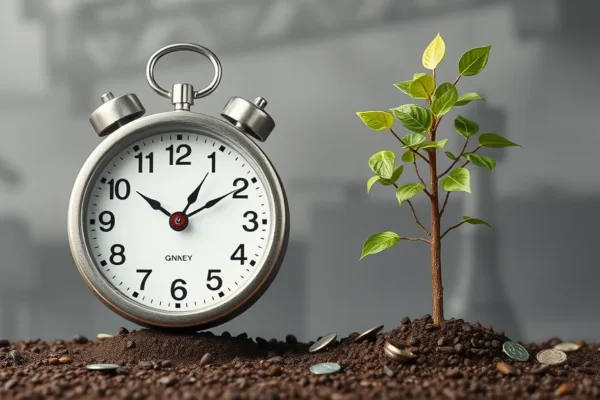
Why This Idea Matters to You
Imagine you have a choice: get $100 today, or get $100 a year from now. Which would you choose? Most people would instinctively grab the $100 today. But why? It’s not just about impatience. It’s about a fundamental concept that shapes everything from your personal savings to global economics: the time value of money. Understanding this idea is like gaining a superpower for your personal finance. It helps you make smarter decisions about saving, borrowing, and investing, ultimately leading to better financial planning and a more secure future. You’ll learn why money you have now is worth more than the same amount of money in the future, and how to harness this power for yourself.
The Simplest Way to Think About It
At its heart, the time value of money simply means that a dollar today is worth more than a dollar tomorrow. Think of it like this: would you rather have an ice cream cone right now, or the promise of an ice cream cone next week? You’d want it now so you can enjoy it. Money works similarly. Having it now gives you the chance to use it, enjoy it, or make it grow.
Building Your Understanding Brick by Brick
Before we dive deeper, let’s lay some groundwork. To grasp the time value of money, you need to understand a few related ideas:
- Interest: This is like a fee you pay for borrowing money, or a reward you get for lending it (like when you save it in a bank). Banks pay you interest to use your money, and you pay them interest if you borrow from them.
- Inflation: Picture this: a loaf of bread costs $3 today. What if next year, the same loaf costs $3.50? That’s inflation. It’s the general increase in prices and the fall in the purchasing value of money. Inflation means your money buys less over time.
- Opportunity Cost: This is what you give up when you choose one thing over another. If you spend $100 on a new gadget today, the opportunity cost is whatever else you could have done with that $100, like investing it and earning more money.
These three concepts are like the essential ingredients in a recipe. You need them all to understand the final dish – the time value of money.
How the Magic of Time Value Actually Works
The core mechanism behind the time value of money involves two main processes: compounding and discounting.
Compounding The Growth of Your Money
Imagine you have $100 and you decide to put it in a savings account that earns 5% annual interest.
- Year 1: You earn 5% of $100, which is $5. You now have $105.
- m> Year 2: This is where it gets interesting. You don’t just earn interest on your original $100. You earn interest on your new total*, $105. So, you earn 5% of $105, which is $5.25. Your new total is $110.25.
- Year 3: You earn 5% on $110.25, which is $5.51. Your total grows to $115.76.
This is compounding. It’s earning interest not just on your initial amount, but also on the accumulated interest from previous periods. Albert Einstein reportedly called compound interest the “eighth wonder of the world.” It’s how your money can grow exponentially over time, especially with investments. This process highlights why having money sooner is better – the sooner you start, the more time it has to compound.
Discounting The Value of Future Money
Now, let’s think in reverse. Suppose someone promises to pay you $100 one year from now. How much is that promise worth to you today? You know that money in the future is worth less than money today. To figure out its current worth, you need to discount it.
Discounting is the process of calculating the present value of a future sum of money. It’s the opposite of compounding. You essentially undo the interest that would have been earned. If we assume an interest rate (or discount rate) of 5% (the same as our compounding example), that $100 one year from now is worth less than $100 today.
To calculate the present value, we use a formula. For this simple example, it’s roughly $100 divided by (1 + interest rate). So, $100 / (1 + 0.05) = $100 / 1.05, which equals about $95.24.
This means that receiving $95.24 today is financially equivalent to receiving $100 one year from now, assuming a 5% interest rate. If the interest rate were higher, say 10%, the $100 a year from now would be worth even less today (approximately $90.91). This illustrates how higher interest rates reduce the present value of future money.
Why This Principle Works: The Power of Earning and Earning Power
The time value of money works for two primary reasons:
1. Earning Potential (Interest and Investment Returns): Money you have today can be put to work. You can deposit it in a savings account, buy stocks, or invest in other opportunities. This allows your money to grow through compounding. A dollar today has the potential to become more than a dollar in the future. A dollar received a year from now has lost that potential earning period.
2. Inflation and Risk: As we discussed, inflation erodes the purchasing power of money. A dollar next year will likely buy fewer goods and services than a dollar today. Furthermore, there’s always a risk that you might not receive the money promised in the future. The person making the promise could default, or unforeseen circumstances could arise. Because of these risks and the certainty of inflation, money today is more valuable than the promise of money tomorrow.
Historically, the understanding of the time value of money evolved alongside the development of financial markets and economics. Early forms of lending and borrowing existed in ancient civilizations, but the formalization of compounding and discounting as mathematical tools gained prominence during the Renaissance and the Enlightenment, with mathematicians like Luca Pacioli and later Isaac Newton contributing to the understanding of interest calculations. The principle is now a cornerstone of modern finance, supported by countless studies and universally accepted in economic theory.
Clearing Up Common Confusions
People often get a bit tangled up with the time value of money. Here are a few common points of confusion:
- m> Confusing “Value” with “Amount”: It’s easy to think that $100 is always $100. But the concept isn’t about the face value of the money; it’s about its worth or purchasing power* at different points in time. $100 today buys more than $100 will buy in five years due to inflation.
- Thinking Compounding is Only for Rich People: While large sums benefit more dramatically, the principle of compounding applies to any amount, even small ones. The sooner you start saving and letting your money work for you, the more powerful compounding becomes, regardless of your initial wealth.
- Underestimating the Impact of Time: Many people underestimate how significant the passage of time is for financial growth. A $100 investment that grows at 7% per year will double in about 10 years. Over 30 years, it will have more than tripled. The “time” in time value of money is incredibly powerful.
The confusion often arises because we tend to think linearly about money. We see $100 and think “that’s $100.” Understanding the time value of money requires shifting to a more dynamic, forward-looking perspective that accounts for earning potential and the erosion of value.
Where You See the Time Value of Money in Action
The time value of money is not just a theoretical concept; it’s woven into the fabric of our financial lives.
- Mortgages and Loans: When you take out a mortgage or a car loan, the bank isn’t just lending you the purchase price. They are lending you the money now, and you are paying them back over time with interest. The total amount you pay back is more than the original loan amount because of the time value of money – they are compensated for lending you the money today instead of having it themselves. The structure of loan payments, often called amortization, is built on discounting future payments to determine the present value of the loan.
- Retirement Planning (IRAs, 401(k)s): When you contribute to a retirement account, you are essentially paying yourself in the future. The money you invest today has decades to grow through compounding. Early contributions are far more valuable than later ones because they have more time to earn returns. This is why financial advisors stress starting to save for retirement as early as possible.
- Investment Decisions: Investors constantly use the time value of money to decide where to put their money. They might compare two different investment opportunities: one that pays $1,000 today, and another that promises $1,200 in two years. By discounting the future payment at an appropriate interest rate, they can determine which investment offers a better present value and is therefore more attractive today.
- Business Valuations: Companies use these principles to value their assets and make decisions about taking on new projects. They discount projected future earnings back to their present value to see if a project is likely to be profitable.
These applications demonstrate how the time value of money is a critical tool for making sound financial choices, from taking out a small loan to managing multi-billion dollar corporate budgets.
Connecting the Dots to Other Financial Ideas
The time value of money is a foundational concept that connects to many other areas of personal finance and economics.
- Interest Rates and Risk: As we’ve seen, higher interest rates make future money worth less today. This is directly linked to how lenders price risk. If an investment is considered risky, lenders will demand a higher interest rate to compensate for the increased chance of not getting their money back.
- Inflation and Purchasing Power: The time value of money inherently accounts for inflation. The fact that future money is worth less today is partly because inflation will reduce its purchasing power. Understanding this connection helps explain why maintaining a positive real return (return after inflation) on investments is crucial.
- Financial Markets and Asset Pricing: All financial markets, from stock exchanges to bond markets, operate on the principles of the time value of money. The price of a stock, for example, reflects the market’s expectation of the company’s future earnings, all discounted back to their present value.
- Economic Growth: On a larger scale, the time value of money underpins economic growth. When individuals and businesses invest money today, it fuels future production and innovation, leading to a growing economy.
By understanding the time value of money, you gain a clearer perspective on why interest rates matter, how inflation affects your wealth, and the fundamental logic behind investing.
The Big Picture: Why This Concept Shapes Your Future
At its core, the time value of money is about making better choices today to build a more prosperous tomorrow. It’s the secret ingredient that transforms small, consistent savings into significant wealth over time. It empowers you to look beyond immediate gratification and understand the long-term financial implications of your decisions.
For an individual, grasping this concept is crucial for effective financial planning. It helps you understand why starting to save early for retirement is so powerful, why taking on high-interest debt can be detrimental, and how to evaluate investment opportunities. It’s the principle that allows you to make your money work harder for you, rather than letting it sit idle and lose value to inflation.
On a broader scale, the time value of money is a fundamental pillar of how our entire economy functions. It guides decisions in businesses, governments, and financial institutions worldwide, influencing everything from how businesses invest in new factories to how governments price bonds. Understanding it gives you a more informed perspective on the economic forces that shape your life and the world around you.
Key Takeaways and Your Questions Answered
The time value of money (TVM) is the idea that money available at the present time is worth more than the same amount in the future due to its potential earning capacity and the effects of inflation.
Why is money today worth more than money tomorrow?
Money today can be invested to earn interest through compounding, making it grow over time. It also retains its full purchasing power, unaffected by future inflation.
What is the difference between Future Value and Present Value?
Future Value is the worth of a sum of money at a specified date in the future, assuming it grows at a certain interest rate. Present Value is the current worth of a future sum of money, discounted back to the present.
How does compounding work?
Compounding is the process of earning interest on your initial investment as well as on the accumulated interest from previous periods. It’s essentially “interest on interest.”
What is discounting and why is it used?
Discounting is the opposite of compounding. It’s used to calculate the present value of future cash flows by reducing their future worth to today’s terms, using an assumed interest rate or discount rate.
Does the time value of money always apply?
Yes, the core principle that money has a time value is universally accepted in economics and finance due to earning potential and inflation. However, the rate at which this value changes can vary greatly depending on interest rates, inflation, and perceived risk.
How does inflation affect the time value of money?
Inflation erodes the purchasing power of money. This means that money received in the future will likely buy fewer goods and services than the same amount of money received today, increasing the attractiveness of having money sooner.
What is the role of interest rates?
Interest rates are crucial for calculating both the future value (through compounding) and the present value (through discounting). Higher interest rates mean money grows faster and future money is worth less today.
Further Learning: To deepen your understanding, explore topics like the Rule of 72 for estimating how long it takes for an investment to double, or delve into different types of investment vehicles and their associated risks and returns.
Further Learning: To deepen your understanding, explore topics like the Rule of 72 for estimating how long it takes for an investment to double, or delve into different types of investment vehicles and their associated risks and returns.











