

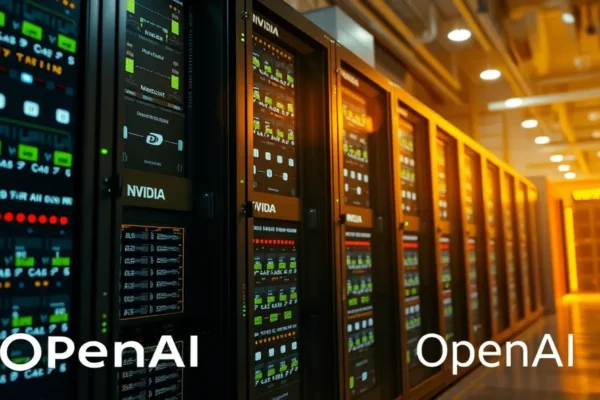
Nvidia Invests Heavily in AI Infrastructure, Fueling OpenAI’s Growth
Nvidia, a titan in the world of high-performance computing, has announced a significant investment of $1.5 billion in a data center developer owned by SoftBank. This strategic move is designed to bolster the infrastructure needed to power the rapidly expanding demands of Artificial Intelligence (AI), particularly for prominent AI research labs like OpenAI. The investment underscores a critical bottleneck in the AI revolution: the sheer computational power required to train and run sophisticated AI models. As AI capabilities surge, the need for specialized data centers equipped with advanced processors becomes paramount. This development highlights the intertwined nature of chip manufacturing, cloud computing, and cutting-edge AI research in shaping the future of technology.
How This Boosts AI Power
At its core, this investment is about providing the physical space and power for cutting-edge computing. Think of a modern AI model, like those developed by OpenAI, as an incredibly complex brain. Training this brain requires immense amounts of data and a vast network of specialized processors, often referred to as GPUs (Graphics Processing Units). Nvidia is a leading manufacturer of these GPUs, which are exceptionally good at performing the parallel calculations needed for AI.
A data center, in this context, is a specialized facility that houses thousands of these powerful computers. It’s not just about the computers themselves; these facilities also need robust power supplies, advanced cooling systems to prevent overheating, and high-speed networking to allow the processors to communicate efficiently. SoftBank, through its subsidiary, is developing these data centers. Nvidia’s investment essentially means Nvidia is providing substantial capital to help build and equip these facilities with its own state-of-the-art Nvidia chips. This creates a symbiotic relationship: Nvidia gets its chips into the hands of major AI players, and AI developers get the necessary infrastructure to continue their groundbreaking work.
AI Infrastructure in Action Today
The impact of this type of AI infrastructure investment is already being felt across various sectors. OpenAI, a leader in generative AI with models like ChatGPT, relies heavily on massive computing resources to train its AI systems and to make them accessible to millions of users worldwide. These complex models require an enormous amount of processing power, far beyond what a typical home computer can provide.
Beyond OpenAI, other cloud computing providers and large enterprises are investing heavily in similar data center capabilities. Companies are using these advanced AI infrastructures for a wide range of applications, including:
- Drug Discovery: Accelerating the process of identifying and testing potential new medicines.
- Autonomous Vehicles: Training vehicles to understand and navigate complex real-world environments.
- Financial Modeling: Developing more accurate predictions for market trends.
- Content Creation: Powering tools that can generate text, images, and even music.
Currently, access to this level of computing power is primarily available through cloud providers, who then offer AI services to businesses and researchers. This Nvidia and SoftBank collaboration aims to expand that capacity, making it more readily available for advanced AI projects.
The Competitive AI Infrastructure Landscape
The race to build and equip the world’s AI infrastructure is highly competitive. Nvidia’s investment is a significant move, but it operates within a broader ecosystem. Other major technology companies are also heavily involved:
- Cloud Giants: Companies like Amazon Web Services (AWS), Microsoft Azure, and Google Cloud are not only building their own data centers but also developing custom AI chips to reduce reliance on external suppliers and optimize performance.
- Hardware Manufacturers: While Nvidia dominates the high-end AI GPU market, competitors like AMD are also vying for a significant share with their own offerings.
- Data Center Developers: Beyond SoftBank’s subsidiary, numerous other firms specialize in building and operating the physical infrastructure that houses these powerful computing systems.
Nvidia’s advantage lies in its established leadership and deep expertise in AI-specific chip design and its robust software ecosystem that supports AI development. By investing directly in the data center side, Nvidia is further solidifying its position by ensuring its chips are at the heart of the next generation of AI powerhouses. This move also strategically partners them with a key player in infrastructure development.
Reshaping Industries and User Experiences
The implications of this robust AI infrastructure investment are far-reaching. For industries, it means the potential for faster innovation and more efficient operations. Businesses will have access to more powerful AI tools, enabling them to tackle problems previously considered intractable. This could lead to breakthroughs in scientific research, personalized medicine, and more sophisticated automation.
From a user perspective, this translates to more advanced and capable AI applications becoming available. We can expect improved AI-powered assistants, more immersive virtual experiences, and AI tools that can genuinely augment human creativity and productivity. The economic implications include job creation in areas like AI development, data science, and data center management, though it also raises questions about automation’s impact on existing roles.
In the short term, this investment will help accelerate the deployment of existing AI technologies. In the long term, it lays the groundwork for entirely new categories of AI applications and services that we can only begin to imagine today.
Challenges and Limitations in AI Infrastructure
Despite the significant advancements, building and scaling AI infrastructure comes with considerable challenges. One of the primary bottlenecks is the immense power consumption and cooling requirements of these data centers. Running thousands of high-performance processors generates substantial heat, demanding sophisticated and energy-intensive cooling systems. This raises environmental concerns and contributes to high operational costs.
Another challenge is the sheer cost of the hardware. Nvidia’s advanced AI chips, essential for cutting-edge AI, are expensive, making the upfront investment in data centers substantial. Furthermore, the supply chain for these specialized components can be volatile, leading to potential delays in deployment.
For AI developers, ensuring the security and privacy of the vast amounts of data processed within these centers is a constant concern. The complexity of managing and maintaining these large-scale infrastructures also requires highly specialized expertise. While the technology is rapidly advancing, the availability of skilled personnel to build, manage, and utilize these resources remains a critical factor.
The Future of AI Computing Power
Looking ahead, the trajectory for AI infrastructure is clear: continued growth in scale, efficiency, and specialization. We can expect to see even more powerful and energy-efficient chips designed by Nvidia and its competitors. The trend towards custom AI silicon, developed by cloud providers, will likely continue, aiming for optimized performance for their specific AI workloads.
The development of more advanced cooling technologies, including liquid cooling and potentially more exotic methods, will be crucial to managing the heat generated by increasingly dense computing environments. Furthermore, the integration of AI at the edge – meaning closer to where data is generated, rather than solely in large, centralized data centers – will also play a significant role.
Nvidia and SoftBank’s collaboration represents an important step in this ongoing evolution, ensuring that the foundational hardware and physical spaces are available to support the ever-growing demands of artificial intelligence. Key developments to watch will include the rollout of next-generation AI chips, advancements in data center efficiency, and the increasing adoption of AI across a wider range of industries.
Key Questions and Answers About This Investment
What is the primary goal of Nvidia’s investment in SoftBank’s data centers?
The main goal is to ensure that there is enough advanced computing infrastructure, powered by Nvidia’s chips, to meet the growing demands of AI development and deployment, particularly for companies like OpenAI.
How does this investment help OpenAI?
By investing in data center developer SoftBank, Nvidia is helping to secure the physical facilities and computing power that OpenAI needs to train and run its sophisticated AI models, such as those powering ChatGPT.
What is a data center in the context of AI?
A data center is a specialized facility that houses thousands of powerful computers, often equipped with Nvidia chips, along with robust power, cooling, and networking systems, to perform complex computational tasks essential for AI.
Is this technology new or already in use?
The concept of data centers for computing is well-established, but the scale and specialization required for modern AI are rapidly evolving. Nvidia’s chips are currently used in many AI applications, and this investment aims to expand the underlying infrastructure.
Who are the main competitors in this space?
Key competitors include other major cloud providers like Amazon Web Services, Microsoft Azure, and Google Cloud, as well as other chip manufacturers like AMD, all of whom are investing in AI infrastructure and hardware.
What are the potential limitations or risks of this approach?
Challenges include the high energy consumption and cooling needs of data centers, the significant cost of advanced AI chips, potential supply chain issues, and the ongoing need for skilled personnel to manage and operate these complex facilities.
This article is based on publicly available information and industry trends. Specific details of the Nvidia-SoftBank deal and OpenAI’s infrastructure plans are proprietary. The AI field is rapidly evolving, and future developments may differ from current projections.











