

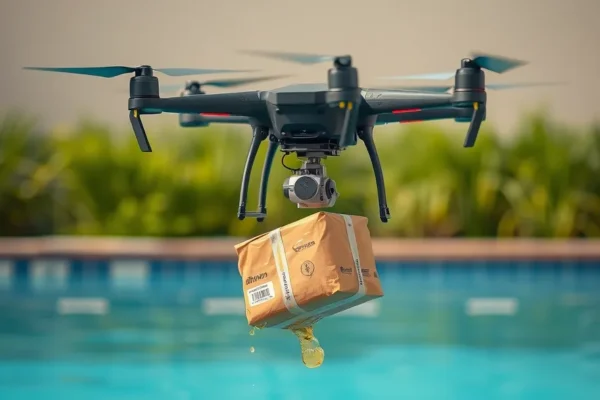
Amazon’s Drones: More Splash Than Delivery?
Amazon’s ambitious Prime Air project, a vision of speedy package delivery via autonomous drones, has captured imaginations worldwide. The idea of getting that urgent gadget or forgotten grocery item delivered to your doorstep in minutes is incredibly appealing. However, the journey to making aerial delivery a seamless reality has been, well, a bit bumpy – sometimes quite literally ending up in water. Reports and social media buzz have highlighted instances where Amazon’s delivery drones have apparently missed their mark, with packages finding their way into swimming pools and ponds. While these “drone delivery mishaps” might provide a chuckle, they raise important questions about the current capabilities and the future viability of such advanced logistics solutions.
The Dream of Prime Air
At its core, Amazon drone delivery is an extension of the company’s relentless pursuit of faster, more convenient package delivery. The problem it aims to solve is the time lag and logistical complexity of traditional ground-based delivery, especially for small, urgent items. Imagine needing a specific tool for a DIY project that’s just broken, or a last-minute birthday gift. Prime Air promises to shave hours, if not days, off that waiting period. This retail innovation is significant now because Amazon, a giant in e-commerce and logistics, has been investing heavily in this technology for years. They aim to revolutionize last-mile delivery, making it quicker, potentially more eco-friendly (by reducing road traffic), and more efficient. The company, of course, is Amazon, with its extensive resources and deep commitment to developing its own technologies.
How the Drones Are Supposed to Work
The concept behind Amazon’s Prime Air involves a network of automated drones that launch from local fulfillment centers. Once a customer places an order eligible for drone delivery, the item is picked, packed, and loaded onto a drone. This unmanned aerial vehicle, essentially a sophisticated, remote-controlled aircraft, then navigates to the customer’s address using a combination of GPS, sensors, and onboard cameras. Think of it like a very precise, automated paperboy, but instead of a newspaper, it’s carrying your Amazon purchase. The drone is designed to fly autonomously, identifying a safe landing zone, which ideally is your backyard or a designated delivery spot. Upon arrival, it would hover, lower the package using a cable system, and then return to its base. The technology relies on complex algorithms for flight path planning, obstacle avoidance, and precise landing. For instance, sensors help the drone “see” and avoid things like trees, power lines, and even birds.
When Drones Make a Splash: Current Real-World Applications
Despite the high-profile water-logged incidents, Amazon has been gradually expanding its Prime Air testing and pilot programs. Currently, drone delivery is not a mainstream service available to all Prime members. Instead, it operates in specific, limited geographic areas where Amazon has received regulatory approval and established suitable operational infrastructure. For example, Amazon has conducted trials in parts of Texas, California, and even in Italy. These early adoption phases are crucial for gathering data, refining the technology, and understanding customer reception. The use cases are typically for small, lightweight items, such as health and wellness products, over short distances. It’s important to note that these are not yet widespread, everyday occurrences for the vast majority of Amazon customers.
The Crowded Skies of Drone Delivery
Amazon is far from alone in exploring aerial delivery. Several other companies and startups are also developing drone delivery solutions. Wing, a subsidiary of Alphabet (Google’s parent company), has been operating a successful commercial drone delivery service in Australia and parts of the US for years, delivering food, medicine, and household items. Companies like Zipline, though focused on medical supplies in remote areas, have demonstrated the viability of drone logistics on a larger scale. Walmart has also explored drone delivery partnerships for groceries and other retail items. Compared to some competitors, Amazon’s approach with Prime Air is characterized by its integration with its massive e-commerce ecosystem and its focus on delivering a wide range of consumer goods. Wing, for instance, often partners with local businesses to deliver their products, while Zipline’s model is built around critical, time-sensitive deliveries. The advantage Amazon holds is its vast customer base and existing logistics network, which could facilitate rapid scaling if the technology matures and regulations allow.
The Ripple Effect: Implications of Aerial Delivery
If Amazon drone delivery and similar initiatives can overcome their current challenges, the implications for industries and consumer behavior are substantial. For retail, it represents the next frontier in fulfilling customer demand for instant gratification, potentially transforming the “last mile” of delivery from a cost center into a competitive advantage. Consumers could see drastically reduced delivery times, making online shopping even more appealing. Socially, it could alleviate traffic congestion and reduce carbon emissions associated with traditional delivery vehicles, provided the energy sources for drones are sustainable. Economically, it could create new jobs in drone operation, maintenance, and software development, while also disrupting existing logistics employment models. In the short term, we’ll likely see more targeted pilot programs expanding slowly. In the long term, if successful, it could redefine urban logistics and how we receive goods daily.
When Drones Meet Puddles: Limitations and Challenges
The infamous pool and pond landings highlight some of the significant limitations and challenges facing Amazon drone delivery. These drone delivery mishaps aren’t just funny anecdotes; they point to real-world problems with navigation, landing zone accuracy, and environmental factors. Adverse weather conditions, such as high winds, heavy rain, or snow, can ground drones or affect their stability. Obstacle avoidance systems, while advanced, aren’t perfect and can struggle with unexpected or rapidly moving objects. Furthermore, regulatory hurdles remain a major bottleneck. Aviation authorities worldwide are still developing comprehensive frameworks for the safe and widespread operation of autonomous drones in civilian airspace. Privacy concerns also arise, as drones equipped with cameras will be flying over residential areas. The cost of developing, deploying, and maintaining such a sophisticated aerial fleet is also immense. Amazon’s technology fails in these instances point to the complexity of turning a controlled test environment into a reliable public service.
The Horizon of Aerial Logistics
The future trajectory of Amazon drone delivery, and aerial delivery in general, points towards continued refinement and gradual expansion. We can expect ongoing improvements in drone design, including enhanced payload capacity, longer flight times, and greater resilience to weather. Software and AI will continue to evolve, improving navigation precision and obstacle avoidance capabilities. Key developments to watch will be regulatory approvals for broader operations, the integration of drones into existing delivery networks, and advancements in battery technology to support longer flights. Amazon’s stated goal is to eventually deliver packages within 30 minutes of an order, but reaching this milestone will likely take several more years of development and testing. Expert consensus suggests that while fully autonomous, widespread drone delivery is still some way off, incremental progress in niche applications and specific regions is highly probable in the coming decade.
Frequently Asked Questions About Amazon Drone Delivery
Is Amazon drone delivery available everywhere?
No, Amazon drone delivery, or Prime Air, is currently only available in select pilot locations where Amazon has received regulatory approval and established operational infrastructure. It is not yet a widespread service.
Why do packages sometimes end up in pools or ponds?
These drone delivery mishaps are often due to challenges in precise landing in varied environments, unpredictable weather conditions, or unforeseen obstacles that can interfere with the drone’s navigation and delivery system.
What kind of packages can be delivered by drone?
Currently, drones are designed to carry small, lightweight packages, typically under five pounds, and are best suited for urgent or convenience items like small electronics or health and wellness products.
Who are Amazon’s main competitors in drone delivery?
Key competitors include Wing (Alphabet’s drone company), Zipline (focused on medical deliveries), and Walmart, which is exploring drone delivery for groceries and retail items.
When will Amazon drone delivery be a common service?
While Amazon aims for widespread adoption, a realistic timeline for when this technology will be a common service for most customers is likely several years away, dependent on technological maturity and regulatory approvals.
What are the main challenges for the future of delivery with drones?
The primary challenges include overcoming technical limitations in navigation and weather resilience, navigating complex aviation regulations, ensuring public safety and privacy, and reducing the high costs associated with developing and operating drone fleets.
This article is based on publicly available information and Amazon’s ongoing development efforts. The technology is still in its early stages of development and testing, and actual capabilities and timelines may vary.











