

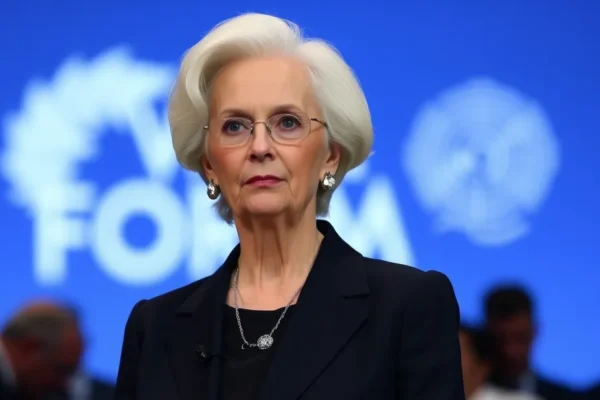
Lagarde’s WEF Engagement Signals Shifting Central Bank Role
A recent report in a Swiss newspaper indicated that Christine Lagarde, the President of the European Central Bank (ECB), expressed openness to serving the World Economic Forum (WEF). This statement, if accurate, suggests a potential deepening of engagement between prominent central bank leaders and the influential Davos-based organization, with significant implications for global finance and the ECB’s own policy direction.
The Strategic Shift Towards Broader Influence
The core development here is Christine Lagarde’s reported willingness to formally engage with or serve the World Economic Forum. This isn’t just about attending the annual meeting in Davos, which many global leaders do. It suggests a potential for Lagarde to take on a more defined role within the WEF’s structure or initiatives. The trigger for such a discussion likely stems from the increasing complexity of global economic challenges, including inflation, geopolitical instability, and the accelerating pace of technological change. Central banks, historically focused on domestic monetary policy, are finding their mandates and influence extending into broader macroeconomic and societal issues.
The WEF, a platform known for bringing together business, political, and cultural leaders to shape global, regional, and industry agendas, provides a unique ecosystem for such discussions. For Lagarde and the ECB, an increased alignment with the WEF could offer a powerful avenue to articulate their perspectives on the global economy, influence international policy dialogues, and gather insights from diverse stakeholders. The report, citing statements made in Swiss newspaper articles, highlights this developing narrative around central bank leadership and its engagement with global forums.
Rationale: Navigating Global Complexity and Enhancing Soft Power
The strategic rationale behind Lagarde’s potential increased involvement with the WEF likely centers on several key objectives. Firstly, it addresses the growing interconnectedness of the global economy. Issues like climate change, supply chain disruptions, and digital transformation have profound impacts on inflation, economic growth, and financial stability, all of which fall within the ECB’s purview. The WEF offers a unique forum to discuss these complex, cross-border challenges with a wide array of influential actors.
Secondly, it’s about enhancing the ECB’s “soft power” and influence on the global stage. By actively participating in and potentially shaping discussions at the WEF, Lagarde can project the ECB’s vision, advocate for its policy approaches, and build consensus on key global economic issues. This can be particularly important in times of economic uncertainty, where clear and coordinated global responses are needed. Furthermore, it allows the ECB to gain valuable insights into emerging trends and technological advancements that could impact future monetary policy and financial stability. This proactive engagement could help the ECB stay ahead of potential disruptions and inform its long-term economic policy formulation.
Competitive Positioning: Central Banks and Global Think Tanks
The potential for increased central bank leadership engagement with organizations like the WEF alters the competitive landscape for influence in global economic governance. Historically, central banks have operated with a degree of independence, focusing on their core mandates. However, as global challenges become more systemic, the traditional boundaries of central bank influence are blurring. Lagarde’s potential deeper involvement positions the ECB, and by extension, European monetary policy, as a more active participant in shaping global economic narratives and agendas, alongside other major central banks like the U.S. Federal Reserve and the Bank of England, which also engage in international forums.
Competitors in this informal arena are not just other central banks, but also international financial institutions like the International Monetary Fund (IMF) and the World Bank, as well as influential think tanks and private sector coalitions. By embracing a more prominent role at the WEF, the ECB could aim to carve out a distinct leadership position, advocating for a European perspective on issues ranging from sustainable finance to digital currencies. This could be seen as a move to strengthen Europe’s voice in global economic discussions, potentially gaining an advantage over other regions or blocs if its policy recommendations resonate widely.
Industry Implications: Redefining Central Bank Mandates
This development signals a broader trend within the financial industry and central banking itself. It suggests that central banks are increasingly expected to engage with systemic, non-traditional risks and to play a more proactive role in shaping the broader economic environment, not just reacting to it. The WEF, as a nexus of global thought leadership and policy influence, becomes a critical arena for this evolution.
Industry peers, including other central banks and financial regulators, will likely observe this trend closely. If Lagarde’s increased engagement proves successful in shaping policy discussions or fostering international cooperation, other central bank leaders might feel pressure to similarly enhance their presence and influence within such global platforms. This could lead to a more coordinated, albeit still independent, approach to global economic challenges, with central banks taking a more visible leadership role in dialogues on climate risk, technological disruption, and sustainable growth. The implications extend to how financial institutions and markets perceive the proactive stance of central banks in addressing a wider range of societal and economic issues.
Financial and Operational Impact: Indirect Influence and Long-Term Strategy
The direct financial implications for the ECB from Lagarde’s potential WEF role are likely to be minimal in terms of immediate revenue or cost. However, the long-term financial and operational impacts could be significant. By fostering stronger international cooperation and influencing global policy discussions, the ECB could indirectly benefit from a more stable and predictable global economic environment, which is crucial for the health of the Eurozone economy and the effectiveness of its monetary policy. A more coordinated global approach to issues like inflation control or financial regulation could reduce systemic risks that might otherwise negatively impact European financial markets and the broader global economy.
Operationally, this requires investing time and resources in high-level engagement, research, and communication. It means ensuring that the ECB’s policy stances are effectively communicated and understood within the WEF’s influential circles. The potential for improved global economic stability could lead to more favorable long-term investment environments and a reduction in crisis management costs that central banks often incur during periods of significant economic downturns.
Execution Risks: Balancing Influence with Mandate
Despite the potential benefits, there are considerable execution risks associated with increased engagement with organizations like the WEF. The primary challenge is maintaining the perception and reality of central bank independence. Critics might argue that closer ties with a forum that includes significant private sector representation could compromise the ECB’s impartiality and its focus on its core mandate of price stability. There’s a fine line between informed engagement and undue influence, and crossing it could erode public trust and central bank credibility.
Historical precedents show that central bankers engaging in broader policy discussions can face scrutiny. The risk is that time and resources allocated to WEF-related activities detract from the meticulous analysis and policy execution required for managing monetary policy effectively. Furthermore, the WEF’s agenda can be broad, and Lagarde would need to strategically focus her contributions to ensure they align with the ECB’s objectives, avoiding dilution of its core mission. The political sensitivities surrounding global economic governance also pose a risk, as differing national interests can complicate consensus building.
Stakeholder Implications: Trust, Transparency, and Expectations
The implications for stakeholders are multifaceted. For European citizens and businesses, this engagement could mean a more proactive ECB working to secure a stable and prosperous global economic environment that benefits the Eurozone. Investors and financial markets might see it as a sign of strong financial leadership, potentially increasing confidence in the ECB’s ability to navigate complex global challenges. However, for some, it could raise questions about the ECB’s primary focus and governance structure.
Employees within the ECB would need to adapt to a potentially broader scope of external engagement, requiring enhanced communication and analytical capabilities. Customers, in the broadest sense (i.e., the public and financial institutions), would expect increased transparency regarding the ECB’s positions and contributions to global discussions. The cultural shift within the ECB itself might involve a greater emphasis on proactive external relations and international policy shaping, moving beyond its traditional role as a reactive monetary authority.
Outlook and Next Steps: Measuring Impact and Influence
If Christine Lagarde’s engagement with the WEF deepens, the next steps will involve observing the nature and extent of her participation. Key milestones to watch include the specific roles she might undertake within the WEF, the policy initiatives she champions, and the extent to which her contributions influence global dialogues and outcomes. Measurable outcomes could include the adoption of policy recommendations discussed at the WEF, increased international cooperation on key economic issues, or a demonstrable positive impact on global economic stability that indirectly benefits the Eurozone.
We should also look for indicators of how other central banks and international bodies respond. Will they mirror this increased engagement? Over the medium to long term, success would be judged by whether this proactive approach leads to more effective global economic governance, contributes to price stability and financial resilience within the Eurozone, and maintains the ECB’s standing as an independent and credible institution. A timeline of 1-3 years would be reasonable to start seeing tangible evidence of the impact of such deepened engagement.
Key Questions and Answers
Will Christine Lagarde’s increased WEF engagement benefit the global economy?
Increased engagement could foster better international dialogue and coordination on complex global economic issues like inflation and climate finance, potentially leading to more stable global economic outcomes. However, its success hinges on effective execution and maintaining central bank independence.
Why is Christine Lagarde considering a more formal role with the World Economic Forum, considering the ECB’s mandate?
The rationale likely stems from the increasing interconnectedness of global challenges and the need for central banks to engage in broader discussions to inform their economic policy. The WEF provides a platform for this type of high-level strategic engagement.
What are the main risks of a central bank president serving the WEF?
The primary risk is the perception or reality of compromising central bank independence by engaging closely with a forum that includes significant private sector interests. There’s also the risk of diverting focus from core monetary policy duties.
How does this compare to what other central banks are doing?
Many central bank leaders, including those from the U.S. Federal Reserve and the Bank of England, already engage actively with the WEF. Lagarde’s potential formal role could signify a deeper commitment to using such platforms for strategic influence.
How long until we see tangible financial implications for the ECB or the Eurozone from this?
Direct financial impacts are unlikely in the short term. However, if this engagement contributes to greater global economic stability, indirect long-term financial benefits for the Eurozone are possible, though difficult to quantify precisely and subject to execution risk.
What is the difference between attending Davos and serving the WEF?
Attending Davos is typically about participation in annual meetings and discussions. Serving the WEF implies a more formal, ongoing commitment, potentially involving leadership roles in committees, initiatives, or shaping the organization’s agenda, offering a deeper level of influence.
It is important to note that all business outcomes are subject to execution risk and unforeseen market dynamics.











