

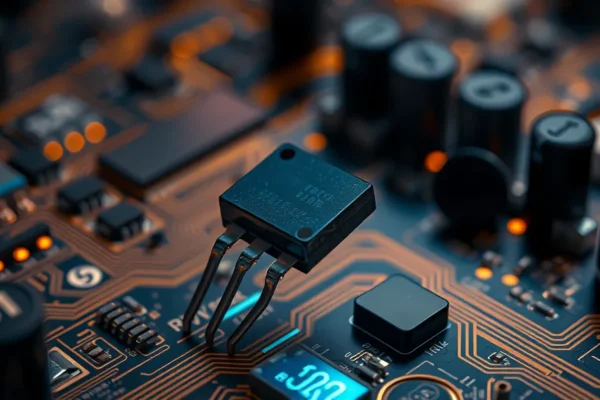
The Tiny Switches That Built Our Digital World
Imagine a world without smartphones, personal computers, or the internet. It’s a stark picture, and one that would be our reality without a seemingly simple electronic component: the transistor. This tiny marvel, smaller than a grain of sand, is the fundamental building block of virtually all modern electronics. It acts as a gatekeeper for electrical signals, either allowing them to pass or blocking them, and its ability to perform these actions with incredible speed and efficiency is what powers the digital revolution. Without transistors, the complex calculations and vast data processing that define our interconnected age would simply be impossible.
The journey of the transistor from a laboratory curiosity to the heart of global technology is a testament to human ingenuity. Its invention in 1947 by John Bardeen, Walter Brattain, and William Shockley at Bell Labs marked a pivotal moment in the history of computing and electronics. They were seeking a solid-state alternative to bulky, unreliable vacuum tubes, which were the backbone of early electronic devices. The transistor, made from semiconductor materials, offered a more compact, energy-efficient, and durable solution. This breakthrough paved the way for smaller, more powerful, and more affordable electronic devices, directly fueling the exponential growth in computing power we’ve witnessed ever since, often described by trends like Moore’s Law.
How Transistors Work: The Digital Switch
At its core, a transistor acts as a tiny electronic switch or an amplifier. For the purposes of understanding its role in computers, thinking of it as a digital switch is most helpful. Most modern transistors are made from semiconductor materials, most commonly silicon. These materials have properties somewhere between a conductor (like copper, which easily lets electricity flow) and an insulator (like rubber, which blocks electricity). By carefully doping silicon with specific impurities, engineers can create regions that are sensitive to electrical control.
A common type of transistor is the MOSFET (Metal-Oxide-Semiconductor Field-Effect Transistor). Think of a MOSFET like a water faucet. It has three main connections: a source, a drain, and a gate. The source and drain are like the water pipe coming in and the spout where water comes out. The gate is like the handle of the faucet. When you turn the handle (apply a small electrical voltage to the gate), it controls whether water flows from the source to the drain. In the case of a transistor, it controls whether an electrical current flows between the source and drain. A tiny electrical signal at the gate can switch a much larger current on or off. This on/off capability is the basis of binary code (0s and 1s) that computers use to represent and process information.
Current State and Real-World Applications
Transistors are ubiquitous; they are the foundational component of every microchip and integrated circuit that powers our modern world. From the processors in your smartphone and laptop to the memory chips storing your data, to the control systems in your car and the advanced sensors in medical equipment, transistors are working tirelessly. The sheer scale is staggering: a single modern high-end processor can contain billions of transistors.
The technology is mature and has been in mainstream adoption for decades. The development and manufacturing of transistors are dominated by a few key players in the semiconductor industry, such as Intel, TSMC (Taiwan Semiconductor Manufacturing Company), and Samsung. These companies continually push the boundaries of miniaturization and efficiency, shrinking transistors to nanometer scales. This relentless progress allows for more powerful devices that are also more energy-efficient and cost-effective to produce.
The Competitive Landscape: A Race for Miniaturization
The semiconductor industry is fiercely competitive, with companies constantly vying for leadership in transistor technology. The primary goal is to make transistors smaller, faster, and more energy-efficient, a trend famously predicted by Gordon Moore in his observation known as Moore’s Law. This has led to an intense race in developing new manufacturing processes and transistor architectures.
While traditional silicon-based MOSFETs remain dominant, research is ongoing into alternative materials and designs. Companies like IBM and various university research groups are exploring materials such as carbon nanotubes or new types of semiconductor compounds to overcome the physical limits of silicon. However, replacing silicon entirely is a monumental challenge due to its cost-effectiveness, abundance, and well-established manufacturing infrastructure. For the foreseeable future, the competition will likely focus on refining existing silicon-based transistor designs and advanced packaging techniques to continue the trajectory of performance improvements.
Implications and Impact: The Foundation of the Digital Age
The impact of transistors on society cannot be overstated. They are the engines of the computer revolution, enabling the creation of powerful computers that have transformed every facet of life. From scientific research and medical diagnostics to global communication and entertainment, transistors have made the impossible possible. They have driven economic growth by creating new industries and transforming existing ones, leading to increased productivity and access to information on an unprecedented scale.
Socially, transistors have connected people across the globe, democratized access to knowledge, and enabled new forms of collaboration and creativity. However, this pervasive technology also raises questions about digital divides, data privacy, and the environmental impact of electronic waste. In the short term, we see continuous improvements in device performance and efficiency. In the long term, the ongoing miniaturization and integration of transistors will likely lead to even more intelligent and pervasive computing systems, potentially blurring the lines between the physical and digital worlds.
Limitations and Challenges: Pushing the Physical Limits
Despite their incredible capabilities, transistors face fundamental physical limitations. As transistors shrink to atomic scales, quantum mechanical effects begin to interfere with their reliable operation. Electrons can “tunnel” through insulating barriers, causing leakage and errors. This phenomenon poses a significant challenge to maintaining the predictable on/off switching behavior that is essential for digital logic.
Another major challenge is heat dissipation. Packing billions of transistors into a small space generates a tremendous amount of heat, which can limit performance and shorten the lifespan of devices. Overcoming these challenges requires innovative engineering solutions, such as new materials, advanced cooling technologies, and novel transistor designs that can operate more efficiently. Furthermore, the extreme precision required for manufacturing these nanoscale components makes production incredibly complex and expensive, contributing to the high cost of cutting-edge semiconductor fabrication.
Future Trajectory: Towards Even Greater Intelligence
The future of transistors lies in continuing the trend of miniaturization, improving energy efficiency, and exploring new functionalities. While we are approaching the physical limits of silicon, research into new materials and transistor architectures, such as advanced FinFET (Fin Field-Effect Transistor) or Gate-All-Around (GAA) designs, promises further performance gains. Beyond traditional switching, researchers are exploring transistors that can perform more complex logic operations or even mimic some aspects of biological neurons, paving the way for more efficient artificial intelligence hardware.
The timeline for these advancements is a continuous process. We can expect incremental improvements in transistor density and speed with each new generation of microchips, typically arriving every 18-24 months, as suggested by the historical trend of Moore’s Law. Breakthroughs in entirely new transistor types or materials might take longer, potentially a decade or more, to move from laboratory research to mass production. Companies like TSMC and Intel are already detailing roadmaps for technologies beyond current leading-edge nodes, hinting at a sustained future for transistor innovation.
Key Questions and Answers
What exactly are transistors?
Transistors are tiny semiconductor devices that act as electronic switches or amplifiers. They are the fundamental building blocks of all modern electronic devices, enabling the processing and manipulation of electrical signals.
How do transistors work in a computer?
In computers, transistors function as digital switches, controlling the flow of electricity to represent binary information (0s and 1s). Billions of these switches working together perform the complex calculations that power our digital technology.
What is the history of transistors?
Transistors were invented at Bell Labs in 1947 by John Bardeen, Walter Brattain, and William Shockley, replacing bulky vacuum tubes. Their invention was crucial for the development of smaller, more powerful, and more energy-efficient electronics, leading to the computer revolution.
What are the most common types of transistors used today?
The most prevalent type of transistor in modern electronics is the MOSFET (Metal-Oxide-Semiconductor Field-Effect Transistor), widely manufactured using silicon as the primary semiconductor material.
How many transistors are in a modern computer chip?
A single high-performance computer chip, such as a central processing unit (CPU) or a graphics processing unit (GPU), can contain billions of transistors. For example, advanced CPUs can have upwards of 50 billion transistors.
What are the main challenges facing transistor technology?
The primary challenges include reaching the physical limits of miniaturization, where quantum effects cause reliability issues, and managing heat dissipation generated by densely packed transistors. Developing new materials and architectures is key to overcoming these hurdles.
This article explores the fundamental workings and impact of transistors. The information presented is based on widely accepted scientific principles and industry understanding. Specific claims about future capabilities or timelines are based on public announcements and research trends, and actual development may vary.











