

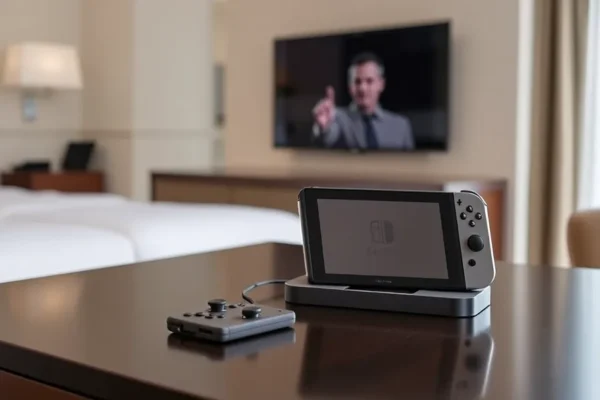
Redefining Portability for the Nintendo Switch
For years, the Nintendo Switch has occupied a unique middle ground between a home console and a handheld device. While the flexibility is its greatest strength, the official dock provided by Nintendo has always been a point of frustration for travelers. It is bulky, heavy, and effectively anchors your gaming experience to a single living room setup. The GuliKit Switch 2 dock arrives as a solution to this limitation, offering a high-performance, compact design that aims to liberate the console from the confines of the home entertainment center.
The GuliKit Switch 2 dock is a specialized gaming accessory designed to shrink the traditional console connection experience into a pocket-sized form factor. By replacing the large plastic housing of the original hardware with a sleek, minimalist adapter, GuliKit allows users to maintain full TV connectivity while traveling. This innovation is significant because it addresses the persistent demand from the gaming community for a more mobile-friendly way to output high-definition content from the Nintendo Switch to external displays, such as hotel TVs or portable monitors.
How a Portable Dock Translates Power to Screens
To understand the GuliKit Switch 2 dock, think of it like a translator between two people who speak different languages. The Nintendo Switch outputs a digital signal that is not inherently compatible with a standard television’s HDMI port without a specific handshake protocol. The original Nintendo dock performs this translation, manages power delivery, and facilitates USB data communication simultaneously.
The GuliKit approach performs these exact functions but strips away the excess weight and unnecessary plastic shell. It uses a high-density circuit board that manages the Power Delivery (PD) protocol, which is the industry standard for fast-charging modern electronics. By efficiently routing electricity from a wall outlet to the console while simultaneously funneling video data through an HDMI port, the device enables seamless TV connectivity. The key technical achievement here is miniaturization. GuliKit has successfully condensed the complex circuitry of a full-sized dock into a device that can be tossed into a backpack without creating clutter. It is essentially a bridge, providing the necessary signal routing to get your game onto a larger screen without requiring a bulky station.
Real World Use and Current Availability
The GuliKit Switch 2 dock is currently seeing widespread adoption among frequent travelers and digital nomads who want to keep their gaming setups lightweight. In practice, this device is being used in hotel rooms, conference centers, and temporary housing where users wish to bypass the small built-in screen of the Nintendo Switch for a more immersive experience on a larger monitor or television.
As of late 2024, the product is in a mainstream consumer state, readily available through major online retailers and the official GuliKit website. Unlike beta-stage hardware, this accessory is a finished, retail-ready product that has undergone cycles of iteration based on previous generation feedback. It functions as a plug-and-play device, meaning it requires no software updates or complex configuration, making it accessible to both casual players and power users alike.
Comparing GuliKit against the Competition
The market for portable docking solutions is crowded, with several high-profile competitors vying for space in the traveler’s luggage. The most prominent rival is the Genki Covert Dock, which popularized the “power-adapter-meets-dock” form factor. When comparing the GuliKit Switch 2 dock to the Genki offering, the differences often come down to port configuration and build philosophy.
The Genki Covert Dock is highly regarded for its integrated wall-plug design, which creates an all-in-one charging and display unit. In contrast, many iterations of GuliKit’s portable offerings focus on a modular design, separating the docking hardware from the power source. This gives the user more flexibility if they already own high-quality USB-C chargers. While both serve the same purpose of facilitating TV connectivity, GuliKit typically competes on price and durability, often targeting a more value-conscious demographic compared to the premium-priced Genki alternatives. The advantage remains with the consumer, who can choose between the all-in-one convenience of Genki or the potentially more robust, modular build of a GuliKit device.
The Impact of Mobile Gaming Infrastructure
The emergence of reliable, third-party accessories like the GuliKit Switch 2 dock is fundamentally reshaping the expectations of gamers. We are moving toward a future where “home console” and “portable” are no longer mutually exclusive categories. This shift puts pressure on manufacturers to design hardware that is inherently more portable, knowing that users will inevitably demand to take their experience on the road.
Economically, this has created a thriving sub-market for specialized gaming accessories. It has allowed independent companies to succeed by filling the “usability gaps” left by hardware giants. Socially, the ability to bring a high-fidelity gaming experience to a hotel room or a friend’s house promotes gaming as a communal, mobile activity rather than a stationary hobby. Over the next few years, we can expect this trend to accelerate as portable displays and USB-C connectivity become the default for all electronic devices.
Limitations and the Missing Piece
Despite the utility of the GuliKit Switch 2 dock, it is important to be realistic about its limitations. While it offers excellent TV connectivity and charging capabilities, it does not magically boost the internal performance of the Nintendo Switch. If a game suffers from frame rate drops or graphical limitations in handheld mode, moving it to a large screen via a dock will not fix those performance bottlenecks.
Furthermore, there is a notable “missing piece” for the travel-heavy gamer: reliable, low-latency wireless audio. While the device handles video and power perfectly, travelers often find that setting up external audio requires additional dongles or messy wired connections. Most portable docks, including this one, do not include integrated Bluetooth transmitters for high-quality audio routing, forcing the user to rely on the console’s sometimes finicky internal Bluetooth or additional external hardware. Additionally, users must be aware that using non-official docks has historically been a point of contention regarding console warranty; while modern firmware has stabilized this, users should always use high-quality, reputable power adapters to prevent voltage irregularities.
Looking Toward the Future
The trajectory for this technology is moving toward even greater integration. As we look ahead to future iterations of the Nintendo Switch hardware, it is likely that the “docking” process will become even more seamless. We may reach a point where specialized hardware is no longer required at all, as USB-C standards evolve to handle video, power, and data with more universal efficiency.
Key developments to watch in the coming year include advancements in GaN (Gallium Nitride) charging technology, which will allow for even smaller power bricks that can handle the increased power demands of next-generation consoles. Experts anticipate that the next phase of gaming accessories will focus on “universal compatibility,” where a single pocket-sized device can bridge a smartphone, a tablet, and a gaming console to a display with identical performance standards.
Common Questions about the GuliKit Switch 2 Dock
Is the GuliKit Switch 2 dock compatible with all Nintendo Switch models?
Yes, the dock is generally compatible with the original Nintendo Switch, the Switch OLED model, and the Switch Lite (though note that the Switch Lite does not support video output to a TV, even with a dock).
Can this device be used as a standard charger?
While the device facilitates power delivery, it is primarily a display adapter. You should always use a charger that meets the specific voltage and wattage requirements of your Nintendo Switch to ensure safe and efficient charging.
Does the GuliKit Switch 2 dock require firmware updates?
Unlike some other gaming accessories, the GuliKit dock is designed as a plug-and-play solution. While future versions may offer updateable firmware, most current models function without the need for manual software intervention.
What are the primary risks when using third-party docks?
The primary risk with any non-official accessory is the quality of the internal power management circuitry. To mitigate risks, ensure your dock is from a reputable manufacturer and use the official Nintendo power adapter or a high-quality, certified USB-C PD charger.
How does this compare to the original Nintendo dock for travel?
The GuliKit Switch 2 dock is significantly more portable, as it removes the bulky plastic housing, making it much easier to pack for trips. It provides the same functionality—TV connectivity and charging—without the extra weight and size.
Note: This article is based on current market availability and technical specifications provided by GuliKit and independent reviewers as of late 2024. All technical descriptions are intended for informational purposes and should not be considered official endorsements of the product’s safety or compatibility with future hardware iterations.











