

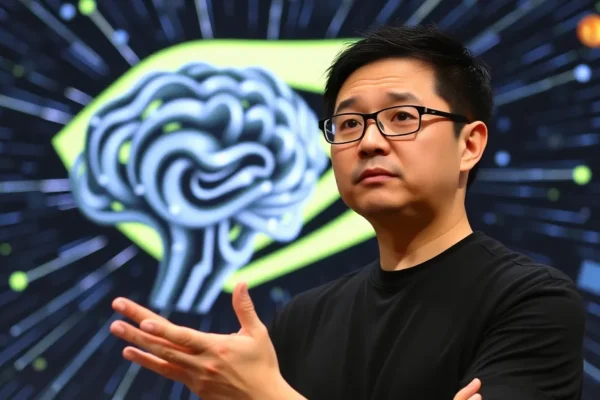
Nvidia’s Jensen Huang and the AGI Claim: A Milestone or a Metaphor?
In the rapidly evolving landscape of artificial intelligence, the term “artificial general intelligence,” or AGI, represents a Holy Grail. It refers to AI that possesses human-like cognitive abilities, capable of understanding, learning, and applying knowledge across a wide range of tasks, much like a human. Recently, Jensen Huang, the co-founder and CEO of Nvidia, made a bold statement during an Nvidia earnings call, suggesting that Nvidia had achieved AGI. This claim, however, was met with a degree of industry skepticism and even labeled “senseless” by Huang himself, sparking debate about the true nature of AI progress and the elusive goal of AGI. This article explores Huang’s assertion, its implications, and the nuanced reality behind the current state of AI.
What is Artificial General Intelligence?
Artificial General Intelligence (AGI) is a theoretical type of artificial intelligence that can understand, learn, and apply intelligence to any intellectual task that a human being can. Unlike current AI systems, which are often designed for specific tasks (like playing chess or recognizing images), AGI would be versatile. Think of it like a skilled handyman who can fix a leaky faucet, assemble furniture, or even offer advice on home improvement, all without needing specialized training for each individual job. Current AI, on the other hand, is more like a highly specialized tool – an expert screwdriver, perhaps, but useless for hammering a nail.
The pursuit of AGI is a long-standing ambition in the tech industry, with researchers and companies like OpenAI and DeepMind pushing the boundaries of what AI can do. The significance of achieving AGI lies in its potential to revolutionize nearly every aspect of human life, from scientific discovery and healthcare to education and creative endeavors. The recent advancements in large language models and sophisticated AI architectures have brought this concept back into sharp focus, leading to increased discussion and, sometimes, ambitious claims.
Decoding Nvidia’s AGI Milestone
Jensen Huang’s assertion, made during Nvidia’s fourth-quarter earnings call in February 2024, centered on the idea that Nvidia’s advanced AI technologies, particularly its GPUs (graphics processing units) and software, were enabling systems that could perform a broad spectrum of tasks at a human level. He referred to the company’s own AI development efforts and the systems they power. While not explicitly stating that Nvidia had created a single, conscious AI entity, Huang implied that the underlying capabilities being developed and facilitated by Nvidia’s hardware and software stack were approaching AGI-level performance in certain domains. This announcement came on the heels of Nvidia’s stellar financial results, largely driven by the demand for its AI chips.
The core mechanism behind Nvidia’s claim relates to the immense computational power and sophisticated software infrastructure they provide. Their GPUs are designed to process vast amounts of data in parallel, which is crucial for training complex AI models. These models, often based on neural networks, learn by identifying patterns in data. Nvidia’s contribution is akin to building the most advanced, high-speed highways and sophisticated traffic management systems that allow these AI “vehicles” to learn and operate at unprecedented speeds and scales. Huang’s statement points to the ability of these systems to generalize learning from one domain to another, a key characteristic of AGI, rather than merely excelling at a single, predefined task.
Current AI in Action: Beyond Specialized Tasks
While true AGI remains a future aspiration, current AI systems are demonstrating increasingly versatile capabilities. Large language models (LLMs) like those developed by OpenAI (e.g., GPT series) and Google (e.g., Gemini) are prime examples. These models can write text, translate languages, answer questions, generate code, and even engage in creative writing. Nvidia’s hardware and software platforms are instrumental in developing and deploying these advanced AI models. Companies across various sectors are integrating these AI capabilities:
- Healthcare: AI is being used for drug discovery, diagnosing diseases from medical images, and personalizing treatment plans.
- Finance: AI algorithms are employed for fraud detection, algorithmic trading, and customer service chatbots.
- Automotive: Self-driving car technology relies heavily on AI for perception, decision-making, and navigation.
- Customer Service: AI-powered chatbots and virtual assistants are becoming commonplace for handling inquiries and providing support.
These applications are largely in the early to mainstream adoption phases, with accessibility growing rapidly thanks to cloud platforms and the availability of powerful AI tools. Nvidia’s own offerings are used by a vast array of developers and enterprises to build these cutting-edge AI solutions.
The Competitive Arena for AI Advancement
The pursuit of advanced AI, and by extension AGI, is a fiercely competitive field. Nvidia, while a leader in AI hardware, operates within an ecosystem where other major players are making significant strides. Key competitors include:
- OpenAI: Known for its groundbreaking LLMs like ChatGPT and its ongoing research into AGI.
- Google (DeepMind): A pioneer in AI research, with significant contributions to areas like reinforcement learning and natural language processing.
- Microsoft: A major investor in OpenAI and a developer of its own AI technologies, integrating them across its product suite.
- Meta (Facebook): Actively involved in AI research, particularly in areas like computer vision and natural language understanding, with a focus on open-source models.
- Anthropic: Another prominent AI safety and research company developing advanced LLMs.
Nvidia’s unique advantage lies in its dominance in AI-specific hardware (GPUs) and its comprehensive software ecosystem (CUDA). This combination provides a powerful platform for AI development, making it the de facto standard for many researchers and companies. However, competitors like Google and OpenAI are developing their own AI chips and are leading in the development of the AI models themselves. The differentiation lies in Nvidia’s role as an enabler – providing the foundational infrastructure – while others are more focused on the direct development of AI capabilities and applications.
The Profound Implications of Advanced AI
If AGI were to be realized, the implications would be transformative, reshaping industries and human behavior in ways we are only beginning to imagine. The potential benefits are enormous:
- Accelerated Scientific Discovery: AGI could help solve complex problems in medicine, climate science, and materials science at an unprecedented pace.
- Economic Growth: New industries and efficiencies could emerge, leading to significant economic expansion.
- Personalized Education and Healthcare: Tailored learning experiences and highly individualized medical treatments could become the norm.
- Enhanced Creativity: AI could serve as a powerful co-creator for artists, musicians, and writers.
However, the societal implications also warrant careful consideration. Concerns include potential job displacement due to automation, ethical dilemmas surrounding AI decision-making, and the concentration of power in the hands of those who control advanced AI. The timeline for these impacts is uncertain, with some short-term shifts already visible and long-term, AGI-driven changes potentially decades away. Jensen Huang’s comments, while seemingly ambitious, highlight the rapid progress in creating systems that can perform a wider array of tasks, pushing us closer to the concept of AGI even if the true article is still out of reach.
Navigating the Hurdles to True AGI
Despite the impressive progress, significant limitations and challenges stand in the way of achieving true AGI. The primary bottlenecks are:
- Generalization and Adaptability: While current AI models can perform many tasks, they often struggle to adapt to novel situations or transfer learning effectively across vastly different domains without extensive retraining.
- Common Sense Reasoning: AI systems lack the intuitive understanding of the world and the “common sense” that humans possess, which is crucial for nuanced decision-making.
- Embodiment and Real-World Interaction: True intelligence often involves interacting with the physical world, something current AI is largely limited in doing without sophisticated robotics.
- Energy Consumption and Efficiency: Training and running large AI models require immense computational power and energy, posing environmental and economic challenges.
- Explainability and Trust: The “black box” nature of many advanced AI models makes it difficult to understand how they arrive at their decisions, hindering trust and accountability.
These technical challenges are coupled with societal hurdles, including the high cost of developing and deploying advanced AI, regulatory uncertainties, and the public’s perception and adoption curve.
The Horizon for Artificial General Intelligence
The future trajectory of AI is a dynamic and rapidly unfolding story. Key developments to watch include:
- More Efficient AI Architectures: Research is focused on developing models that require less data and computational power to train and operate.
- Improved Reasoning and Understanding: Efforts are underway to imbue AI with better common sense reasoning and a deeper grasp of causality.
- Multimodal AI: Systems that can process and understand information from various sources simultaneously (text, images, audio, video) will become more prevalent.
- Edge AI: AI processing moving from the cloud to local devices, enabling faster and more private AI applications.
While many researchers believe true AGI is still decades away, the progress made by companies like Nvidia, OpenAI, and Google suggests a steady, albeit non-linear, path forward. The consensus within the AI community is that incremental advancements are bringing us closer, but fundamental breakthroughs in understanding intelligence itself may be required.
Frequently Asked Questions About AGI and Nvidia
Has Nvidia achieved AGI?
According to Jensen Huang’s statements, Nvidia believes its technology is enabling systems that are approaching AGI-level capabilities by performing a wide range of tasks. However, he himself called the definitive claim “senseless,” suggesting it’s a nuanced point about the progress his company facilitates rather than a declaration of having created conscious, human-equivalent AI.
What is the difference between current AI and AGI?
Current AI, often called narrow AI, is designed and trained for specific tasks. AGI, on the other hand, would possess human-like cognitive abilities, capable of understanding, learning, and applying intelligence to any intellectual task, much like a person.
Why is AGI considered the “holy grail” of AI?
AGI is considered the ultimate goal because it represents AI that can think, learn, and solve problems across a vast array of domains, mirroring human intelligence. Its potential applications could revolutionize science, technology, and society.
What role does Nvidia play in the AI race?
Nvidia is a critical player in the AI race primarily due to its leadership in developing powerful GPUs and its comprehensive software ecosystem. These are the essential tools and infrastructure that power the development and deployment of advanced AI models by many other companies and researchers.
What are the potential societal impacts of reaching AGI?
The potential impacts are vast, ranging from accelerated scientific breakthroughs and economic growth to concerns about job displacement, ethical dilemmas, and the concentration of power. The arrival of AGI would necessitate significant societal adaptation.
When can we expect to see true AGI?
There is no consensus on when true AGI will be achieved. While some experts believe it could be decades away, the pace of innovation in the AI race, fueled by companies like Nvidia and OpenAI, makes predictions difficult. Current AI milestones are significant, but they are distinct from the theoretical concept of AGI.
This article explores the recent discussions surrounding Nvidia’s role in the pursuit of Artificial General Intelligence (AGI). It is important to note that the field of AI is rapidly evolving, and claims about its capabilities should be viewed within the context of ongoing research and development. The information presented is based on public statements and general industry understanding. Further technical details and independent verification of specific capabilities would be required for a definitive assessment.











