

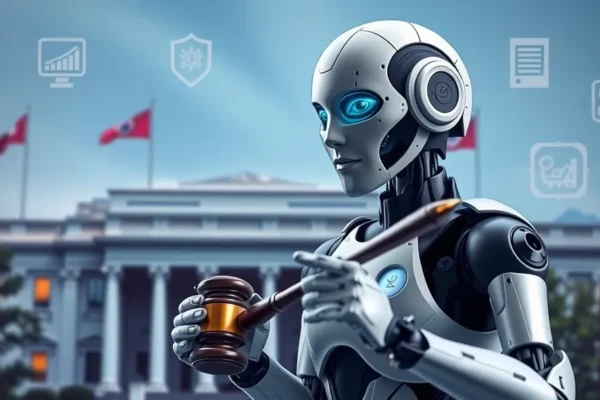
A Legal Showdown Over AI and the Supply Chain
The race to develop advanced artificial intelligence (AI) systems is a fast-paced competition, and increasingly, these cutting-edge technologies are finding their way into sensitive government applications. This has led to complex legal and ethical questions, as seen in a recent legal dispute between AI company Anthropic and the Pentagon. Anthropic has secured a significant legal victory against a Pentagon initiative aimed at labeling certain AI technologies based on their supply chain risks. This ruling highlights the ongoing tension between national security concerns and the rapid innovation within the AI sector.
The core of the dispute centers on the Pentagon’s attempt to implement a system that would classify AI components based on their perceived supply chain risks. This initiative, stemming from policies enacted during the Trump administration, aimed to identify and mitigate potential vulnerabilities in the AI systems used by the U.S. military. The concern is that if critical AI software or hardware relies on components from adversarial nations or unreliable sources, it could create backdoors for espionage or sabotage. However, Anthropic argued that this labeling system was overly broad, lacked transparency, and unfairly penalized companies developing secure and trustworthy AI.
The Federal Judge’s Ruling
A federal judge recently sided with Anthropic, issuing a ruling that blocks the Pentagon from enforcing its supply chain risk labeling requirements on the AI company. The judge’s decision was based on several key factors. Firstly, the court found that the Pentagon had not followed proper administrative procedures when implementing the labeling rule. This means that the agency failed to provide adequate notice and opportunity for public comment before imposing the requirements. Such procedural missteps are critical in administrative law, as they ensure fairness and accountability.
Secondly, the ruling suggests that the Pentagon’s broad application of the supply chain risk labels may have been arbitrary and capricious. This legal standard means that an agency’s decision must be based on evidence and reasoning, not on unsupported assumptions. Anthropic presented evidence that its AI development process and supply chain were robust and secure, and the Pentagon’s labeling did not adequately account for these assurances. This court win for Anthropic is a significant moment, suggesting that government agencies must provide more tailored and justified reasons for imposing stringent requirements on technology providers, particularly those developing advanced AI.
This legal victory for Anthropic is not the end of the legal battles concerning AI and government contracts. The AI company is currently involved in a second, ongoing lawsuit against the Pentagon. This new lawsuit reportedly challenges other aspects of the Pentagon’s contracting processes, potentially related to how AI technologies are evaluated and procured. While the specifics of this second lawsuit are still unfolding, it signals Anthropic’s continued commitment to ensuring fair and transparent practices in its engagement with government clients. The outcomes of these legal proceedings could set important precedents for how the U.S. government interacts with and regulates the burgeoning AI industry.
Understanding Supply Chain Risk in AI
To grasp the significance of this legal dispute, it’s important to understand what “supply chain risk” means in the context of artificial intelligence. Think of an AI system like a complex recipe. The final dish (the AI’s intelligence and functionality) depends on every single ingredient – the software code, the data it was trained on, and even the hardware it runs on. A supply chain risk arises when one of these ingredients is compromised.
For example, if a crucial piece of software code, or a component of the computer chip, is sourced from a country known for cyber espionage, there’s a risk that hidden “backdoors” could be inserted. These backdoors could allow unauthorized access to the system, enabling data theft or manipulation. Similarly, if the data used to train an AI is tampered with, the AI might learn biased or incorrect information, leading to flawed decision-making. The Pentagon’s initiative aimed to identify and flag AI systems that might be using such compromised ingredients, thereby reducing the risk of these vulnerabilities impacting national security.
How Anthropic’s AI Works
Anthropic is a leading AI company focused on developing safe and steerable artificial intelligence systems. Their flagship AI model, Claude, is designed with a strong emphasis on ethical considerations and alignment with human values. Unlike some other AI approaches that might prioritize raw performance above all else, Anthropic’s methodology involves a technique called “constitutional AI.”
Imagine teaching a child not just by telling them what to do, but by giving them a set of core principles or a “constitution” to follow. Constitutional AI works similarly. Instead of solely relying on human feedback to guide the AI’s behavior, Anthropic uses a predefined set of ethical principles. The AI is then trained to critique and revise its own responses based on these principles. This helps to ensure that the AI’s outputs are helpful, harmless, and honest, even when faced with novel or challenging prompts. This approach is designed to build more trustworthy AI systems from the ground up, addressing some of the inherent risks associated with powerful AI.
Current State and Real-World Applications
Anthropic’s AI technology, particularly its Claude models, is currently in use by various organizations for a range of applications. While not yet a mainstream consumer product in the way some other AI tools are, it is being adopted by businesses and researchers who require advanced AI capabilities with a strong emphasis on safety and reliability. These applications include content generation, customer service chatbots, data analysis, and assisting with complex research tasks.
For instance, companies are using Claude to summarize lengthy documents, draft marketing copy, and even assist in writing code. Researchers might leverage it to analyze scientific literature or generate hypotheses. The technology is available through APIs (Application Programming Interfaces), which allow developers to integrate Anthropic’s AI into their own applications and services. This means that while end-users might not directly interact with “Anthropic,” they could be using services powered by its AI. The availability is typically through enterprise agreements and cloud platforms, indicating a focus on business and institutional adoption rather than broad public release at this stage.
The Competitive AI Landscape
The AI field is highly competitive, with several major players vying for dominance. Anthropic’s primary competitors include OpenAI, the creator of ChatGPT, and Google DeepMind, which has produced models like LaMDA and PaLM. Other significant players include Microsoft, which heavily invests in and partners with OpenAI, and various research institutions and startups globally.
What differentiates Anthropic is its explicit focus on safety and its unique constitutional AI approach. While OpenAI and Google are also investing heavily in AI safety research, Anthropic’s methodology is a more direct and principled way of embedding safety into the AI’s core training. This could give Anthropic an advantage in sectors where trust and reliability are paramount, such as government, healthcare, and finance. However, competitors like OpenAI often have broader accessibility and a wider range of deployed applications, giving them a larger user base and more real-world data for further development. The current advantage often lies with those who can scale quickly and demonstrate broad utility, but Anthropic’s principled approach could prove more valuable in the long run for critical applications.
Implications for Government and Technology
This legal victory has significant implications for both the technology sector and government contracting. For AI companies like Anthropic, it reinforces the importance of due process and transparent regulation. The ruling suggests that government agencies cannot impose blanket regulations without clear justification and adherence to established legal procedures. This could lead to more nuanced and tailored approaches to AI regulation, which may encourage innovation by reducing the burden of overly restrictive policies.
For the Pentagon and other government bodies, this ruling underscores the need for careful consideration when developing and implementing policies that affect cutting edged technology. It highlights the challenge of balancing national security concerns with the need to foster a thriving domestic AI industry. The ongoing second lawsuit indicates that the legal and regulatory landscape for AI in government is still very much in flux. The potential impact is a more collaborative and less adversarial relationship between the government and AI developers, leading to more effective and secure AI adoption by national security agencies in the future.
Current Limitations and Challenges
Despite the rapid advancements, AI technology, including Anthropic’s offerings, faces several limitations and challenges. One primary challenge is the computational cost of training and running advanced AI models. These systems require immense processing power and energy, making them expensive to develop and deploy.
Another significant limitation is the potential for AI systems to exhibit unintended biases or to “hallucinate” – to generate information that is factually incorrect but presented confidently. While Anthropic’s constitutional AI aims to mitigate these issues, it’s not a foolproof solution. The complexity of real-world scenarios means that AI can still produce unexpected or undesirable outcomes. Furthermore, the development of truly general artificial intelligence, capable of understanding and performing any intellectual task a human can, remains a distant goal. Current AI is specialized and excels at specific tasks rather than possessing broad, human-like intelligence.
The Future Trajectory of AI and Regulation
The trajectory for AI technology is one of continued rapid advancement, coupled with an increasing focus on regulation and ethical considerations. We can expect to see AI systems becoming more powerful, more integrated into our daily lives, and more capable of complex reasoning. This includes advancements in areas like multimodal AI, which can understand and generate information across text, images, audio, and video.
For AI regulation, the trend is towards developing more specific frameworks tailored to different AI applications and risk levels. The Anthropic case is a prime example of how legal challenges can shape regulatory approaches. We may see a move towards “risk-based” regulation, where AI systems posing higher risks (e.g., in critical infrastructure or autonomous weapons) face stricter oversight than those with lower risks. The focus will likely remain on ensuring transparency, accountability, and safety as AI technology matures and its societal impact grows.
Key Questions About AI and Supply Chain Security
Is Anthropic’s AI technology mature?
Yes, Anthropic’s Claude models are considered mature and are being used in commercial and research applications. However, like all AI, they are constantly being updated and improved.
Who benefits from Anthropic’s legal victory against the Pentagon?
Both Anthropic and the broader AI industry benefit. It establishes a precedent for due process in government contracting for AI technologies and encourages a more balanced approach to regulation.
What are the risks of AI supply chain vulnerabilities?
The risks include potential espionage, data breaches, system manipulation, and compromised decision-making, especially in critical national security applications.
How long until AI is widely adopted in government?
AI is already being adopted across various government agencies, but widespread integration of highly advanced AI systems will likely take several more years, depending on regulatory clarity and technological maturity.
What is the difference between Anthropic’s AI and other AI companies?
Anthropic emphasizes a “constitutional AI” approach focused on safety and ethical alignment, differentiating it from competitors who might prioritize raw performance or use different methods for ensuring AI behavior.
What are the implications of the ongoing second lawsuit?
The second lawsuit suggests that the legal and regulatory challenges surrounding AI in government are complex and multifaceted, indicating a continued period of legal scrutiny and definition for AI procurement.
This article provides an overview of the legal developments concerning Anthropic and the Pentagon. The information presented is based on publicly available reports and legal filings as of the time of writing. The field of AI technology and its regulation is rapidly evolving, and future developments may alter the current landscape.











