

Understanding Sanctions and Their Economic Ripple Effects
Imagine a country is like a household. If that household isn’t following certain rules agreed upon by a neighborhood (other countries), the neighborhood might decide to stop trading with them. They might say, “We won’t buy your apples, and we won’t sell you our flour.” This is a simplified way to think about sanctions. Sanctions are penalties imposed by one country or a group of countries on another nation. These penalties can take many forms, like blocking trade, freezing assets (money and property), or limiting travel. The goal is often to pressure the targeted country to change its behavior or policies.
Why should you care about understanding sanctions? Because these actions, often happening far away, can have a significant domino effect. They can disrupt global markets, affect the price of goods we all buy, and, most importantly, deeply impact the daily lives of ordinary people in the affected countries, forcing them to find new ways to manage their money.
How Sanctions Can Cripple an Economy
Let’s look at Iran. For years, the United States has imposed various sanctions on Iran, primarily due to its nuclear program and other foreign policy actions. These sanctions are like the neighborhood banning trade, but on a massive scale.
Here’s how it works in practice:
1. Restricting Trade: Sanctions can prevent other countries from buying Iranian oil, which is a major source of income for Iran. This is like the neighborhood refusing to buy apples from the targeted household; their main source of pocket money dries up.
2. Limiting Financial Transactions: Sanctions can make it very difficult for Iran to conduct international banking. This means Iranian businesses struggle to pay for imports (like machinery or medicine) and collect payments for their exports. Imagine if the household couldn’t use their bank account to pay for anything or receive money from selling things.
3. Freezing Assets: The assets of Iranian individuals or entities involved in sanctioned activities might be frozen, meaning they can’t access their money or property held in foreign countries.
The impact of these measures is profound. Companies that do business with Iran, or even those that use materials that pass through Iran, might face penalties themselves. This leads to a chilling effect, where even countries or companies not directly targeted by sanctions shy away from any dealings. For Iran’s economy, this means less money coming in, fewer goods available, and a struggle to maintain its infrastructure and services.
The Personal and Economic Fallout
For ordinary Iranians, the consequences of these sanctions are felt directly. The restriction on oil sales and financial transactions has led to a significant devaluation of the Iranian currency, the Rial.
Think of your own money. If the value of your country’s currency plummets, the money in your bank account buys less. A loaf of bread that used to cost 10 Rials might suddenly cost 20 Rials. This is called inflation, a general increase in prices and a fall in the purchasing value of money. When inflation is high, people’s savings lose value rapidly, making it hard to afford basic necessities.
This economic hardship fuels discontent. When people struggle to feed their families and see their savings disappear, they often express their frustration through protests. These protests aren’t just about politics; they are often a desperate cry against the financial hardship caused by the country’s economic isolation.
The geopolitical impact of these sanctions is also significant. They affect the broader Middle East economy and can influence international relations. While the intention might be to pressure a government, it’s often the citizens who bear the brunt of the economic crisis.
A History of Sanctions and Economic Pressure
The use of economic sanctions as a foreign policy tool has a long history, but they have become increasingly sophisticated and widespread in recent decades. The US has employed sanctions against various countries for different reasons, from counter-terrorism to human rights abuses.
In Iran’s case, sanctions have been a recurring feature, tightening and loosening depending on diplomatic relations and international agreements, such as the Joint Comprehensive Plan of Action (JCPOA), often referred to as the Iran nuclear deal. When the US withdrew from the JCPOA in 2018 and reimposed stringent sanctions, Iran’s economy experienced severe shocks.
According to the International Monetary Fund (IMF), Iran’s GDP contracted significantly in the years following the re-imposition of sanctions. For instance, Iran’s economy contracted by 6.8% in 2018 and by another 5.5% in 2019, driven by a sharp decline in oil exports and reduced foreign investment. This demonstrates the direct link between sanctions and economic decline.
Navigating Financial Hardship with Alternative Assets
Faced with a devaluing currency and soaring inflation, Iranians have sought ways to protect their savings. This is where alternative investments like gold and cryptocurrency come into play.
Gold: Gold has historically been seen as a safe haven asset. This means that during times of economic uncertainty or high inflation, people often turn to gold because its value tends to hold up or even increase when other assets, like currency, are losing value. It’s like having a tangible treasure that is less affected by the changing value of paper money.
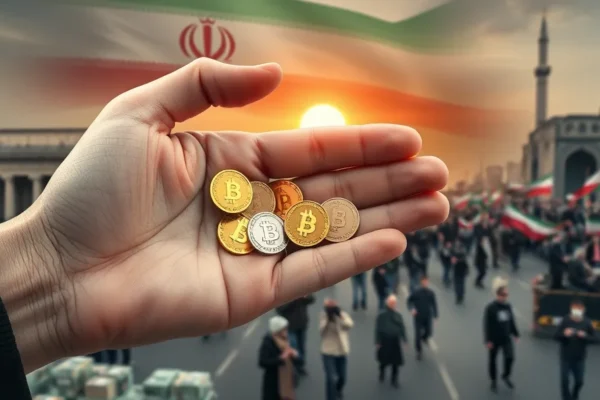
Cryptocurrency: Digital assets, or cryptocurrencies like Bitcoin, have also emerged as an alternative. These are digital forms of money that operate on decentralized networks, meaning they are not controlled by a single government or bank. For some Iranians, cryptocurrency offers a way to bypass traditional financial systems that are heavily impacted by sanctions. It allows for more direct peer-to-peer transactions, and some hope it can preserve wealth against currency devaluation.
These alternative investments are not without their risks. The price of gold can be volatile, and cryptocurrencies are known for their extreme price swings and regulatory uncertainties. However, for those in dire economic circumstances, they represent options to try and safeguard what little they have.
Connecting Sanctions to Broader Economic Concepts
Understanding Iran sanctions and their impact helps illuminate several key economic concepts:
- Currency Devaluation: The weakening of a country’s currency against others. This is a direct consequence of economic pressure and reduced trade.
- Inflation: The rate at which the general level of prices for goods and services is rising, and subsequently, purchasing power is falling. High inflation erodes savings.
- Geopolitics: The influence of geography and politics on international relations and economic activities. Sanctions are a prime example of geopolitical tools impacting economies.
- Alternative Investments: Assets that are not traditional stocks, bonds, or cash. Gold and cryptocurrencies are examples, often sought during times of economic instability.
- Economic Crisis: A severe downturn in economic activity, often characterized by high unemployment, inflation, and reduced production.
Understanding how sanctions affect a nation’s economy also sheds light on the resilience of individuals and their strategies for savings protection amidst financial hardship.
Frequently Asked Questions About Iran Sanctions and Digital Assets
Here are some common questions people ask about this complex situation:
How do US sanctions impact the Iran economy?
US sanctions significantly restrict Iran’s ability to sell its oil and conduct international financial transactions, leading to currency devaluation, inflation, and a struggling economy.
Can ordinary Iranians use cryptocurrency to protect their savings from inflation?
Some Iranians turn to cryptocurrencies as an alternative investment to safeguard their savings from the rapid inflation caused by currency devaluation, though this comes with significant risks.
What is the role of gold during an economic crisis in Iran?
Gold is often seen as a safe haven asset, and many Iranians buy gold to protect their savings from inflation and currency devaluation, as its value tends to be more stable than the local currency during turbulent times.
Are protests in Iran directly linked to the Iran sanctions?
While there are many factors, economic hardship caused by sanctions, leading to inflation and financial hardship, is a significant driver for public discontent and protests in Iran.
What are the risks of using digital assets as savings protection?
Digital assets like cryptocurrency are highly volatile, meaning their prices can change dramatically and quickly. They also face regulatory uncertainty, and there’s a risk of losing access to or the value of these assets.
How do sanctions affect the Middle East economy more broadly?
Sanctions on a major oil producer like Iran can disrupt regional trade flows, affect energy prices, and influence investment decisions across the Middle East.
Educational Content Disclaimer
This article provides general educational information about financial concepts and current events. It is not intended as personal financial advice, and decisions about investments, savings, or navigating economic hardship should be made in consultation with a qualified financial professional. Financial situations are unique to each individual, and outcomes can vary significantly.
This is educational content, not financial advice. Financial situations vary; consult a professional for personal advice.











