

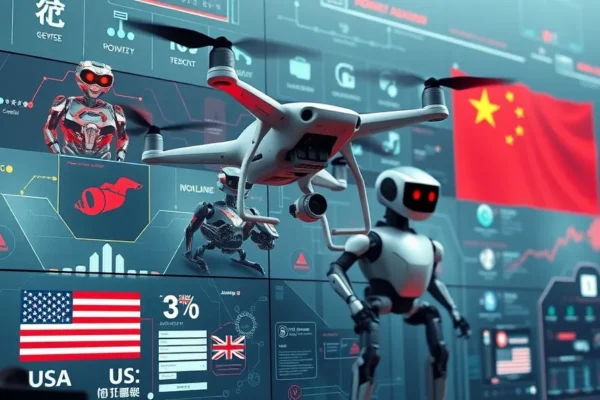
The Global Race for Smarter Machines
The world of robotics and autonomous systems is advancing at a breakneck pace. These intelligent machines, from drones that fly overhead to robots that navigate factories, are no longer science fiction. They are increasingly shaping our industries, our security, and our daily lives. At the heart of this technological evolution lies a complex interplay of innovation, manufacturing power, and geopolitical strategy, particularly between the United States and China. Recent shifts in US drone policy, aimed at limiting the reach of foreign-made technology, highlight this dynamic, forcing a global re-evaluation of supply chains and fostering intense competition in the robotics sector. This article delves into the innovations, their real-world applications, and the wider implications of this accelerating global tech competition.
Understanding the New Generation of Machines
At its core, this technological wave involves creating machines that can perceive their environment, make decisions, and act without constant human input. This includes advanced robotics, which are sophisticated machines capable of performing complex tasks, and autonomous systems, a broader category encompassing devices like self-driving cars or advanced drones that operate independently.
Think of it like teaching a very capable but literal assistant to handle tasks. Initially, you’d give precise instructions. But as the assistant learns, it can understand context, adapt to new situations, and even anticipate your needs. This is the essence of AI development powering these robots and drones. Artificial Intelligence (AI) is the “brain” that allows these machines to process information from sensors (like cameras or radar), learn from data, and make intelligent choices.
A significant breakthrough enabling this is the miniaturization and increased power of processors, combined with vast amounts of data that AI algorithms can learn from. For instance, companies like Boston Dynamics have showcased robots like “Spot” capable of navigating challenging terrains and performing inspections. In the drone space, advancements in battery life and sensor technology, coupled with sophisticated flight control software, allow for longer flight times and more precise operations. These developments are not entirely new, but recent improvements in AI algorithms and sensor fusion—the process of combining data from multiple sensors—have significantly enhanced their capabilities.
Where Smart Machines Are Working Today
Today, advanced robotics and autonomous systems are already integrated into various sectors. In manufacturing, robots perform repetitive, dangerous, or highly precise tasks on assembly lines, increasing efficiency and reducing errors. Companies like FANUC and KUKA are well-established players in this industrial robotics market.
In logistics, autonomous mobile robots (AMRs) navigate warehouses, moving goods and optimizing inventory management. Companies like Amazon use these AMRs extensively in their fulfillment centers. Drones are now commonplace for aerial photography, agricultural monitoring (e.g., checking crop health), infrastructure inspection (e.g., bridges, power lines), and even package delivery in some pilot programs. Companies like DJI, a Chinese firm, have become dominant in the consumer and commercial drone market due to their product innovation and manufacturing scale.
The maturity level of these technologies varies. Industrial robots are largely mainstream in many developed economies. Drones are rapidly moving from early adoption to mainstream use in specialized fields, while fully autonomous vehicles for public roads are still in advanced testing and limited deployment phases. The availability of commercial-grade drones and industrial robots is widespread, though regulations and operational complexities can vary by region.
The Intensifying Global Competition
The global tech competition in robotics and AI is fierce, with the United States and China often seen as the two leading forces. This rivalry is increasingly playing out on the global stage, influencing supply chains and national security strategies.
US drone policy has recently included restrictions on the procurement and use of drones manufactured by certain foreign companies, particularly those based in China, citing national security concerns. This move, announced by various US government agencies, aims to reduce reliance on foreign technology and bolster domestic industries. While this policy is designed to secure US interests, it also creates ripples across the global market, pushing other nations to consider their own technological dependencies and supply chain resilience.
China’s advantage in this race stems significantly from its immense manufacturing scale and a concentrated national effort to become a global leader in AI and robotics. This manufacturing scale allows Chinese companies to produce advanced robots and drones at competitive prices, often enabling faster adoption and wider deployment. For example, Chinese drone manufacturers have achieved a dominant global market share in many segments. This scale not only impacts the global market through pricing and availability but also fuels further innovation as companies have larger user bases to test and refine their products.
The US, while facing manufacturing cost challenges compared to China’s scale, often leads in fundamental research and AI development. American companies are at the forefront of cutting-edge AI algorithms, advanced sensor technologies, and specialized robotics for defense and high-tech industrial applications. The tension between US export controls and China’s manufacturing prowess creates a dynamic where each side pushes the other to innovate and adapt.
Reshaping Industries and Our World
The impact of advanced robotics and autonomous systems is profound and far-reaching. Industries are being reshaped by increased automation, leading to higher productivity, greater precision, and the creation of new kinds of jobs focused on programming, maintenance, and supervision of these intelligent machines.
Economically, this revolution promises significant growth. Markets for AI development, advanced robotics, and autonomous systems are projected to expand rapidly. Businesses that adopt these technologies stand to gain a competitive edge through efficiency and innovation. However, there are also concerns about job displacement in sectors heavily reliant on manual labor.
Socially, these technologies offer numerous benefits, from improved healthcare through robotic surgery to enhanced safety through autonomous monitoring systems. They can enable new forms of exploration and assistance, particularly for individuals with disabilities. On the other hand, ethical considerations surrounding data privacy, AI bias, and the potential misuse of autonomous weapons systems are critical societal challenges that need careful consideration and regulation.
The short-term impact is already visible in smarter factories and more efficient logistics. In the long term, we can expect more integrated autonomous systems in transportation, a significant shift in defense capabilities, and potentially new forms of human-robot collaboration in everyday life.
Navigating the Hurdles Ahead
Despite the rapid progress, significant limitations and challenges remain. One of the biggest bottlenecks is the complexity and cost of developing and deploying truly intelligent autonomous systems. AI development, while advancing, still struggles with nuanced decision-making in unpredictable environments and common-sense reasoning that humans take for granted.
Technical challenges persist in areas like robust sensor perception in all weather conditions, reliable navigation in complex or GPS-denied environments, and the ethical programming of autonomous systems to handle moral dilemmas. For example, ensuring a self-driving car can make the safest decision in an unavoidable accident scenario is an ongoing research problem.
Adoption barriers include the high initial investment required for advanced robotics, the need for specialized training to operate and maintain these systems, and regulatory frameworks that are still catching up with the pace of technological change. Public trust and acceptance are also crucial factors that need to be built over time. Many advanced robotics concepts remain in the research or early prototype phase, far from widespread commercial availability.
The Road Forward for Intelligent Machines
The future trajectory of robotics and autonomous systems points towards increasing autonomy, intelligence, and integration into our lives. We can expect to see more sophisticated AI that allows machines to learn and adapt in real-time, leading to more flexible and capable robots.
Key developments to watch include advancements in swarm robotics (coordinating large numbers of smaller robots), human-robot interaction interfaces that feel more natural, and the integration of AI across different autonomous systems, allowing them to work together seamlessly. The ongoing research in areas like reinforcement learning and generative AI is likely to significantly boost the capabilities of these machines.
The timeline for the next major breakthroughs is difficult to pinpoint precisely, but many experts anticipate significant progress in areas like advanced AI reasoning and robust autonomous navigation within the next five to ten years. Widespread adoption of highly complex autonomous systems, like personal robot assistants, may take longer, depending on breakthroughs in AI, cost reduction, and societal acceptance.
Frequently Asked Questions
Here are some common questions about the current state and future of US drone policy, China robotics, and the broader global tech competition:
What is the main impact of US drone policy on the global market?
US drone policy, through export controls and procurement restrictions, aims to reduce reliance on foreign-made drones for national security reasons. This can influence global supply chains by encouraging countries to develop domestic capabilities or seek alternative suppliers, potentially altering market dynamics and fostering regional tech competition.
How does China’s manufacturing scale affect global tech competition?
China’s vast manufacturing scale allows its companies to produce robots and drones at lower costs and higher volumes than many competitors. This can lead to faster adoption rates globally and puts pressure on other nations to find ways to compete, whether through innovation, specialization, or strategic partnerships.
Are advanced robotics and autonomous systems currently mature enough for widespread adoption?
The maturity varies significantly by application. Industrial robots are largely mainstream in manufacturing. Drones are becoming common in specialized fields like agriculture and inspection. However, truly general-purpose autonomous systems, such as fully self-driving cars or personal robot assistants capable of complex household tasks, are still in development and early adoption phases.
What are the primary limitations hindering the advancement of AI development in robotics?
Key limitations include achieving human-like common-sense reasoning, robust performance in unpredictable environments, and ethical decision-making. While AI can excel at specific tasks, creating machines with adaptable intelligence that can generalize learning across diverse situations remains a significant challenge.
Who benefits most from the current global tech competition in robotics?
Nations that invest heavily in AI research and development, along with companies that can innovate rapidly and scale production, tend to benefit most. Consumers and industries can also benefit from increased access to more affordable and capable technologies, but concerns about job displacement and data security need to be addressed.
What is the timeline for seeing advanced robotics and autonomous systems become commonplace?
Widespread adoption will be a gradual process. We are already seeing increasing integration in industries like logistics and manufacturing. More complex systems, like advanced autonomous vehicles or sophisticated personal robots, are likely to become more prevalent over the next decade, with their ultimate impact depending on continued innovation and overcoming current challenges.
This article explores the dynamic landscape of advanced robotics and autonomous systems, driven by innovation and shaped by geopolitical factors. The interplay between US drone policy, China’s robotics prowess, and the broader quest for AI development creates a complex yet exciting global tech competition with far-reaching implications for industries and society alike.











