

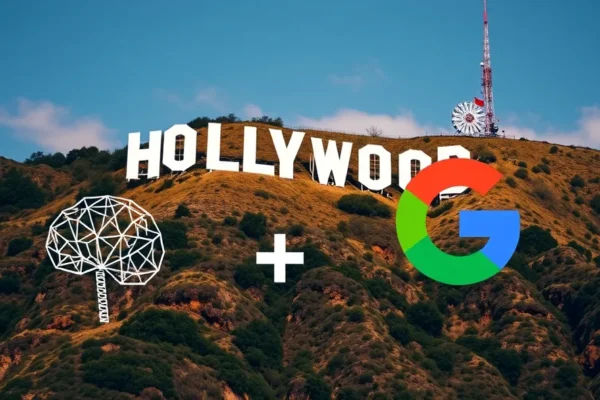
Google’s AI Ambitions Meet Hollywood’s Treasure Trove
The digital world is buzzing with a new kind of dealmaking. Google, a titan of the tech industry, is reportedly in discussions to license a vast amount of Hollywood content for training its advanced artificial intelligence (AI) models. This move signifies a crucial development in the ongoing quest by tech companies to feed their AI systems with the rich, diverse data needed to learn and improve. It also presents both a potential financial boon and significant risks for the major film and television studios involved. This strategy taps directly into the heart of how modern AI, particularly large language models and generative AI, learns to understand and create.
Feeding the AI Machine with Stories
At its core, training an AI model is much like teaching a very sophisticated student. Think of AI training as providing an immense library filled with books, images, and conversations for the AI to read, analyze, and absorb. The more diverse and high-quality the material, the better the AI becomes at understanding context, generating creative text, answering complex questions, and even mimicking human-like communication. Google’s AI strategy in this context involves leveraging copyrighted material from Hollywood – films, TV shows, scripts, and potentially even music – to enhance its AI models. This allows AI to learn about narrative structure, character development, dialogue nuances, visual aesthetics, and a wide spectrum of human emotion and storytelling. For instance, an AI trained on Hollywood movies might learn to write more compelling screenplays, generate realistic movie trailers, or even create new scenes based on existing characters and plots. This process requires vast datasets, and Hollywood’s content represents a concentrated, high-value source of such data.
The Current Landscape of AI Content Partnerships
While specific deals are still under wraps, the trend of tech companies seeking to license copyrighted content for AI training is already evident. Companies like OpenAI, the creators of ChatGPT, have faced scrutiny and lawsuits over the use of data scraped from the internet without explicit permission for their AI models. Google’s reported approach to directly license content from Hollywood studios suggests a more formalized and potentially less legally contentious path forward. This could involve deals that grant Google access to libraries of films and television series for the explicit purpose of AI training. The maturity level of these negotiations is likely in the early to mid-stages, with some potential agreements beginning to take shape. The primary goal for Google is to build more powerful and versatile AI models, which could then be integrated into its vast array of products and services, from search to creative tools.
A Crowded Field of AI Innovators
Google is not alone in its pursuit of high-quality data for AI development. Other major tech companies, including Microsoft (through its partnership with OpenAI), Meta, and Amazon, are also heavily invested in building sophisticated AI models. These companies are all vying for access to diverse datasets, which can include everything from publicly available web content to licensed books, articles, and, increasingly, media. The key differentiator in this emerging market will be the quality and breadth of the licensed data. While competitors might rely more on publicly accessible web data, Google’s potential studio deals could give it an edge in training AI on narrative-driven, visually rich, and high-quality content. This could lead to AI models that are particularly adept at creative tasks related to storytelling and media production.
Reshaping Entertainment and Beyond
The implications of Google’s AI licensing strategy for Hollywood content are far-reaching. For Google, it represents a significant investment in the future of AI, potentially leading to AI models that can generate highly engaging and creative content. This could power new features in their existing products or unlock entirely new business ventures within the entertainment industry. For the studios, licensing their content could provide a substantial financial boon, offering a new revenue stream beyond traditional distribution models. This could be particularly beneficial for older or less frequently viewed content in their archives. On a broader scale, this could accelerate the development of generative AI tools capable of assisting in scriptwriting, visual effects creation, and even personalized entertainment experiences. The short-term impact could see pilot programs and experimental AI tools emerging, while the long-term impact could see AI becoming an integral part of the entire content creation and consumption pipeline.
Navigating the Minefield of Intellectual Property and Consent
Despite the potential benefits, significant risks and challenges accompany this strategy. The most prominent concern revolves around intellectual property rights and copyright. Hollywood content is protected by stringent copyright laws, and unauthorized use for AI training could lead to costly legal battles. While licensing agreements aim to mitigate this, the precise scope of AI training and its permissible uses within these licenses will be critical. Furthermore, there are ethical considerations regarding the fair compensation of creators and the potential for AI-generated content to displace human jobs in the entertainment industry. Studios also face the risk of their own content being used to train AI models that could eventually compete with them or devalue their original productions. The complexity of negotiating these studio deals, ensuring proper attribution, and managing the ethical implications are substantial hurdles.
The Road Ahead for AI and Media
The trajectory for AI development and its integration with media content is one of continuous evolution. We can expect to see more formalized licensing agreements emerge as tech companies and content creators establish clearer frameworks for collaboration. The focus will likely shift towards training AI models that can not only understand but also generate sophisticated creative outputs, potentially leading to new forms of interactive storytelling and personalized media. The timeline for widespread adoption of AI deeply integrated with licensed Hollywood content is likely a few years away, as negotiations, legal frameworks, and technological refinement take time. However, early stages of this integration, such as AI-assisted script analysis or preliminary content generation, could appear sooner.
Key Questions About Google AI and Hollywood Content Licensing
What is Google’s primary goal with licensing Hollywood content for AI training?
Google aims to enhance its AI models by providing them with a vast and diverse dataset of high-quality narrative and visual content, enabling them to better understand and generate creative outputs.
What are the main benefits for Google AI in this venture?
The benefit lies in building more sophisticated and capable AI models, potentially leading to advancements in areas like content creation, personalized user experiences, and improved understanding of human language and narrative.
What are the significant risks for Hollywood studios involved in these studio deals?
Studios face risks related to intellectual property, potential devaluation of their content by competing AI-generated works, and the complex negotiation of terms to ensure fair compensation and control over their library.
How does this strategy differ from past methods of AI training?
This approach moves beyond scraping publicly available web data to actively licensing copyrighted material, suggesting a more structured and potentially legally sound method for acquiring high-quality training data.
When can we expect to see the results of this AI licensing in public-facing applications?
While negotiations are ongoing, the full impact and integration of AI models trained on such extensive Hollywood content are likely several years away, though early applications in content analysis or assistance tools might appear sooner.
What are the broader implications of tech companies licensing copyrighted material for AI models?
This trend could reshape the media industry, creating new revenue streams for content owners and accelerating the development of generative AI, but also raises important questions about copyright, compensation, and the future of creative professions.
It is important to note that many aspects of AI technology, particularly in its cutting-edge applications, are still in active research and development. Information regarding specific licensing agreements and their terms is often confidential. The capabilities discussed represent potential future advancements based on current trends and stated industry goals.











