

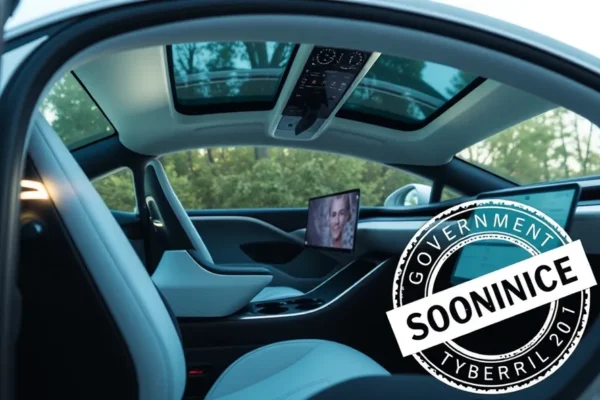
Tesla’s Cybercab: A Glimpse of the Future, Now Under Scrutiny
Tesla’s latest bold move, the Cybercab, is turning heads and sparking debate. This isn’t your grandpa’s car. Imagine a vehicle designed from the ground up to drive itself, completely ditching the steering wheel and pedals. It’s a concept that promises a new era of transportation, but as with many leaps forward, it’s not without its bumps. The immediate focus? Safety. The US government is taking a close look at the Cybercab’s revolutionary design, particularly its reliance on advanced autonomous technology and the absence of traditional driving controls. This investigation highlights the massive regulatory hurdles and safety standards that must be cleared before we see these robotaxis on our streets.
Riding the Robotaxi Wave: What the Cybercab Means for You
At its core, the Tesla Cybercab is envisioned as a fully autonomous vehicle, essentially a robotaxi. Think of it as a personal chauffeur that you summon with your phone, much like you might use Uber or Lyft today. The idea is to offer a convenient, efficient, and potentially more affordable way to get around, especially in urban areas. For everyday folks, this could mean less stress about parking, no more designated driver worries on a night out, and potentially reclaiming commute time for work or relaxation.
Imagine this:
- Busy Professionals: Instead of white-knuckling it through rush hour traffic, you could be catching up on emails, taking a video call, or even enjoying a quiet moment before your next meeting, all while your Cybercab navigates the city.
- Families on the Go: Need to ferry kids to multiple after-school activities? Picture sending a Cybercab to pick up your children while you’re still at work, ensuring they get home safely and on time without you having to rearrange your entire schedule.
- Travelers: Arriving at a new city and unsure of local roads? A Cybercab could whisk you from the airport to your hotel seamlessly, allowing you to relax and enjoy your trip from the moment you land.
The Cybercab safety investigation is crucial because it touches upon the very fabric of how we regulate new technologies that have the potential to significantly impact public safety. It’s a complex dance between innovation and caution, and the outcome will influence the future of transport for all of us.
Who’s This Futuristic Ride For?
The Tesla Cybercab, in its current conceptual stage and facing regulatory review, is primarily aimed at early adopters, tech enthusiasts, and fleet operators who are eager to embrace the future of autonomous mobility. It’s designed for those who value convenience and cutting-edge technology and are willing to be part of the pioneering phase of self-driving services.
- Best For: Tech-forward urban dwellers and businesses looking to integrate advanced autonomous transport into their services or daily lives. Think companies managing fleets, or individuals who live in areas where autonomous vehicle deployment is likely to be prioritized.
- Good For: Those who frequently use ride-sharing services and are curious about the next generation of personal transport. If you’ve ever dreamed of a car that drives itself and you’re not overly concerned about traditional car ownership, this is worth keeping an eye on.
- Skip If: You’re a traditional car enthusiast who enjoys the act of driving, need a vehicle for personal ownership with extensive customization options, or are uncomfortable with technology that lacks traditional human controls. The current regulatory uncertainty also means it’s not a practical option for immediate personal purchase or daily commuting for the average consumer right now.
Beyond the Wheel: What Else is Out There?
The concept of autonomous vehicles is not new, and Tesla isn’t the only player. Competitors like Waymo (Google’s self-driving car project) and Cruise (GM’s autonomous vehicle unit) have been testing and deploying self-driving taxis in limited areas for some time. However, the Cybercab’s radical design, completely removing the steering wheel and pedals, sets it apart.
- Tesla Cybercab’s Approach: Focuses on a fully driverless experience from the outset, emphasizing a streamlined passenger cabin. This design aims to maximize interior space and create a lounge-like feel, moving away from the traditional driver-centric layout.
- m> Competitors (Waymo, Cruise): Often utilize vehicles that can* still be driven manually, or have had steering wheels and pedals present during development and testing phases, even if their public deployments are driverless. This can offer a different level of perceived safety and regulatory comfort.
- Price Value: Currently, the Cybercab is not a purchasable consumer vehicle. Its value proposition will likely be tied to its service cost as a robotaxi, aiming to be more economical than traditional ride-sharing or car ownership in the long run, once operational. Competitor services like Waymo One already operate on a pay-per-ride model, with prices varying based on demand and location.
The key difference is Tesla’s full commitment to a steering-wheel-less, pedal-less design for its robotaxi service, which is precisely what has triggered the current US government investigation into its safety standards.
Getting Started: The Unknown Path
Since the Tesla Cybercab is not yet available for public use or purchase, a “setup” process in the traditional sense doesn’t exist for consumers. However, when it eventually launches as a service, the experience is expected to be similar to existing ride-sharing apps:
1. Download an App: You’d likely download the Tesla ride-sharing app.
2. Book a Ride: Input your destination, and the app would match you with an available Cybercab.
3. Board the Vehicle: The car would arrive, and you’d likely gain entry using your phone or a code.
4. Enjoy the Ride: Once inside, you’d simply relax as the vehicle takes you to your destination.
The learning curve for users is expected to be minimal, much like using a smartphone app today. The complexity lies entirely with Tesla’s engineering and the regulatory bodies ensuring its safety.
The Bright Side: What We Hope to See
While the Cybercab is still in its early stages and under scrutiny, the potential benefits are exciting.
- Enhanced Passenger Experience: Without a steering wheel or pedals, the interior can be reconfigured for maximum comfort, potentially offering a more spacious and relaxing environment akin to a lounge on wheels. This could make long commutes or journeys far more enjoyable.
- Increased Accessibility: For individuals who cannot drive due to age, disability, or other reasons, the Cybercab could offer unprecedented freedom and independence, significantly improving their quality of life.
- Potential for Reduced Traffic Congestion: As autonomous vehicle technology matures and fleet operations become more efficient, it’s hoped that shared robotaxis could lead to fewer personal cars on the road, easing traffic jams.
- Focus on Safety Technology: Tesla’s reputation is built on pushing technological boundaries. The Cybercab’s development is likely to incorporate advanced sensor arrays, robust AI, and redundant safety systems, aiming for a high level of operational safety, though this is exactly what’s under investigation.
The Hurdles Ahead: What’s Causing Concern
The US government’s investigation into the Cybercab’s safety is a significant point of concern, primarily because of its radical design.
- Lack of Traditional Controls: The absence of a steering wheel and pedals raises questions about how the vehicle will handle unforeseen circumstances or system failures, and what recourse passengers have in emergencies.
- Regulatory Compliance: The Cybercab’s design pushes the boundaries of current vehicle safety standards and regulations, which were largely developed with human drivers in mind. Significant updates or waivers will be needed.
- Public Trust and Acceptance: Convincing the public that a vehicle without human controls is safe is a major challenge. The safety probe is a necessary step to build that trust, but it also highlights the potential for public skepticism.
- Operational Limitations: Like all autonomous systems, the Cybercab will likely face limitations in adverse weather conditions (heavy snow, rain, fog) or complex driving environments that are still being perfected.
Cost and Value: A Future Investment
As the Tesla Cybercab is not yet available for purchase, its price and value proposition are speculative. When it launches as a service, the cost will be a critical factor.
- Service-Based Model: It’s expected to operate as a ride-hailing service, with pricing likely competitive with or potentially lower than current ride-sharing options, especially for frequent users or longer distances. Tesla aims to reduce the operational costs associated with human drivers.
- No Direct Purchase Price (Initially): Consumers won’t be buying the Cybercab outright in the near future. The investment is in using the service.
- Long-Term Value: If successful and widely adopted, the long-term value could be significant for users by saving time and reducing the costs associated with car ownership (insurance, maintenance, depreciation).
- Budget Alternatives: For now, traditional ride-sharing services like Uber and Lyft, or public transportation, remain the budget-friendly alternatives.
The Verdict: A Glimpse of Tomorrow, With Questions Today
The Tesla Cybercab represents a bold vision for the future of transportation, promising unparalleled convenience and a new kind of mobility. Its driverless, wheel-less design is undeniably innovative and could reshape our cities.
Who Should Be Excited: Tech enthusiasts, early adopters, and businesses looking to leverage cutting-edge autonomous technology for ride-sharing fleets will be watching the Cybercab’s development closely. If you envision a future where personal transportation is a service you summon, not a machine you operate, then the Cybercab is a glimpse into that world.
Who Should Wait: The average consumer looking for a personal vehicle for daily driving, or someone who is uncomfortable with the idea of a car completely devoid of human controls, should hold off. The current US government investigation means the Cybercab is still navigating significant regulatory hurdles, and it’s unlikely to be a readily available option for personal use in the immediate future. Patience is key here.
Ultimately, the Tesla Cybercab is a fascinating concept that pushes the boundaries of what a vehicle can be. Its future, however, hinges on navigating critical safety regulations and earning public trust. It’s a story we’ll be following closely.
Common Questions About the Tesla Cybercab
What is the Tesla Cybercab?
The Tesla Cybercab is an all-electric, fully autonomous vehicle designed to operate as a robotaxi, meaning it drives itself and doesn’t require a human driver, steering wheel, or pedals.
Is the Tesla Cybercab available to buy now?
No, the Tesla Cybercab is not currently available for purchase by consumers. It is being developed as a ride-hailing service, and its launch is pending regulatory approvals.
Why is the US government investigating the Cybercab’s safety?
The US government is investigating the Cybercab’s safety due to its innovative design lacking traditional driving controls like a steering wheel and pedals. This prompts scrutiny to ensure it meets stringent safety standards for autonomous vehicles.
How will I use the Cybercab?
You will likely use the Cybercab through a dedicated Tesla app on your smartphone. You’ll book a ride to your destination, and the autonomous vehicle will pick you up and drive you there.
Is it safe without a steering wheel and pedals?
This is the central question of the ongoing US government investigation. Tesla claims its advanced autonomous systems are designed to be safe, but regulatory bodies need to verify this through rigorous testing and review of its safety standards.
Will the Cybercab be cheaper than Uber or Lyft?
Tesla aims for the Cybercab service to be more cost-effective than current ride-sharing options by eliminating driver costs. However, actual pricing will be determined upon its launch and availability.
Can I drive the Cybercab myself?
No, the design of the Cybercab completely omits a steering wheel and pedals, meaning it is not intended for manual human operation.
Product prices and availability vary by region. Verify current pricing before purchase.











