

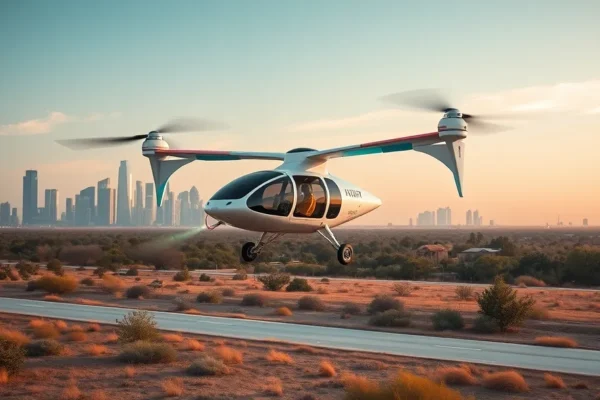
Taking Flight: Electric Air Taxis Begin Test Flights in Texas
The skies above Texas are buzzing with a new kind of aviation. Recent weeks have marked a significant milestone in the journey toward a new era of transportation: the first test flights of electric air taxis under a new program sanctioned by the Federal Aviation Administration (FAA). This development brings us closer to realizing the vision of Advanced Air Mobility (AAM), a concept that promises to transform how we travel, especially in and around urban areas. Companies like Joby Aviation, Beta Technologies, and Wisk Aero are at the forefront of this revolution, and these Texas test flights represent a crucial step in proving the safety and viability of these novel aircraft.
What Exactly are Electric Air Taxis?
At their core, electric air taxis are essentially small, electric-powered aircraft designed for short to medium-distance travel, often within cities or between nearby metropolitan areas. They are typically designed to carry a small number of passengers, from one to six, and many are envisioned to operate with a pilot initially, with a long-term goal of becoming autonomous aircraft. The key innovation is their use of electric propulsion, distinguishing them from traditional helicopters and planes. This shift to electricity aims to reduce noise pollution, emissions, and operating costs, making air travel more accessible and sustainable. The FAA’s involvement signifies the serious, regulatory-backed approach to integrating these new technologies into the existing airspace.
How These Aircraft Take to the Skies
The technology powering these electric air taxis, often referred to as eVTOL (electric Vertical Take-Off and Landing) aircraft, is a blend of established aerospace principles and cutting-edge electric vehicle technology. Think of them as a sophisticated evolution of drones, scaled up for human transport. Instead of large, heavy jet engines or rotor systems, eVTOLs commonly use multiple smaller electric motors powering propellers or ducted fans. This distributed electric propulsion system offers several advantages.
Firstly, it allows for vertical take-off and landing, much like a helicopter, meaning they don’t need long runways and can operate from smaller, more urban-friendly vertiports. This is often achieved through a combination of fixed wings for efficient forward flight and tilting rotors or dedicated lift fans that provide vertical thrust. For example, some designs might have rotors that tilt from a vertical position for liftoff to a horizontal one for cruising, similar to an Osprey tiltrotor aircraft but on a much smaller scale and powered by electricity. Other designs might have fixed wings with propellers mounted on them for lift and forward propulsion.
The power comes from advanced battery systems, similar to those found in electric cars, though significantly more robust and engineered for the demands of flight. This is where the “electric” in electric air taxi truly comes into play, promising quieter operations and zero in-flight emissions.
Real-World Testing in Texas
The recent test flights in Texas, supported by the FAA’s Advanced Air Mobility (AAM) initiative, are not just symbolic; they are critical for gathering real-world data. Companies like Joby Aviation, a prominent player in the eVTOL space, have been conducting extensive flight testing for years, with these Texas operations being a part of a broader certification effort. Beta Technologies has also been actively testing its ALIA aircraft, which is designed for both cargo and passenger transport, in various conditions. Wisk Aero, a joint venture involving Boeing, is also developing its own autonomous eVTOLs.
These test flights in Texas are designed to evaluate various aspects of the aircraft’s performance, including its handling characteristics, the efficiency of its electric propulsion system, the reliability of its batteries, and its acoustic signature. They are also vital for validating the operational procedures and safety protocols that will eventually govern commercial flights. While these are test flights, not commercial services, they represent a mature stage of development, moving beyond initial prototypes and into rigorous operational validation. The goal is to gather enough data to satisfy the stringent safety requirements of the FAA before passenger services can begin.
A Crowded Field of Innovation
The race to bring electric air taxis to market is highly competitive, with numerous companies worldwide investing heavily in this burgeoning sector. Joby Aviation, Beta Technologies, and Wisk Aero are among the leaders, but they face strong competition from entities like Archer Aviation, Volocopter in Germany, and EHang in China, among many others.
Each company is pursuing slightly different design philosophies and technological approaches. For instance, Joby’s aircraft is designed for multi-passenger transport with a focus on speed and range. Beta Technologies’ ALIA is notable for its elongated wing and pusher propeller, emphasizing efficiency for longer routes. Wisk Aero is heavily focused on developing a fully autonomous passenger aircraft from the outset.
The advantage for companies like Joby, Beta, and Wisk often lies in their strategic partnerships with established aerospace giants like Boeing (in Wisk’s case) or their significant venture capital funding and early progress in flight testing and regulatory engagement. The FAA’s structured approach to certification provides a clear, albeit challenging, pathway for these companies, differentiating them from those perhaps operating in less regulated environments.
Transforming Urban Mobility and Beyond
The implications of successful electric air taxi deployment are far-reaching. On a practical level, they promise to alleviate traffic congestion in major cities, offering a faster alternative for commuting and inter-city travel. Imagine bypassing gridlock by hopping into an air taxi for a journey that currently takes an hour or more by car. This could revolutionize logistics, enabling rapid delivery of goods, and emergency services, with air ambulances reaching patients faster.
Economically, the development and operation of these aircraft will create new industries and jobs, from manufacturing and maintenance to air traffic management and customer service. The market for Advanced Air Mobility is projected to be worth billions of dollars in the coming decades. Socially, it could enhance connectivity for underserved communities and provide greater accessibility for people with mobility challenges.
However, the timeline for widespread adoption is still a matter of careful planning and regulatory approval. While test flights are happening now, commercial passenger services are likely a few years away, with initial operations expected in select markets.
Navigating the Hurdles Ahead
Despite the excitement and progress, significant limitations and challenges remain for electric air taxis. One of the primary hurdles is battery technology. Current battery energy density limits the range and payload capacity of eVTOLs compared to traditional aircraft. While advancements are ongoing, achieving the performance needed for widespread, cost-effective commercial operation requires further breakthroughs.
Another critical challenge is the regulatory framework. The FAA and other aviation authorities are working diligently to establish comprehensive safety standards for these novel aircraft and the complex air traffic management systems required to integrate them into busy airspace. This process is thorough and inherently slow to ensure public safety.
Infrastructure is also a key consideration. Establishing a network of vertiports, charging stations, and maintenance facilities will require substantial investment and urban planning. Public acceptance is another factor; ensuring the safety, noise levels, and overall experience are acceptable to the general public is paramount. Finally, the cost of these services will likely be a barrier to entry for many in the early stages, making them a premium option before economies of scale can bring prices down.
The Road Ahead for Electric Flight
The future trajectory for electric air taxis is one of gradual, but significant, expansion. We can expect to see continued rigorous testing and certification processes by regulatory bodies like the FAA. As certifications are granted, initial commercial operations will likely begin with limited routes, possibly focusing on cargo or specialized passenger services in less congested areas.
Key developments to watch include advancements in battery technology, improvements in autonomous flight systems, and the development of integrated air traffic management solutions. Companies will also likely refine their aircraft designs based on real-world operational data. The timeline for broader adoption will depend on overcoming the challenges outlined above, but many industry experts anticipate seeing limited commercial passenger services within the next five to ten years, with more widespread availability beyond that.
Frequently Asked Questions About Electric Air Taxis
What is an electric air taxi?
An electric air taxi is a type of aircraft, often a type of eVTOL, that uses electric motors for propulsion, designed for carrying a small number of passengers on short to medium-distance flights, particularly in urban areas.
Are electric air taxis safe?
Safety is the top priority, and companies are working closely with regulators like the FAA to ensure these aircraft meet stringent safety standards. The numerous test flights are part of this rigorous certification process.
When will I be able to use an electric air taxi?
While test flights are happening now, widespread commercial passenger services are likely several years away. Initial services may begin in select locations within the next five to ten years, with broader availability expected later.
What is eVTOL?
eVTOL stands for electric Vertical Take-Off and Landing. It describes the class of aircraft that use electric power and can take off and land vertically, much like a helicopter, but with potential benefits like lower noise and emissions.
Who are the main companies developing electric air taxis?
Key players in this space include Joby Aviation, Beta Technologies, Wisk Aero, Archer Aviation, Volocopter, and EHang, among many others.
What are the main challenges for electric air taxis?
The primary challenges include advancing battery technology for better range, developing robust regulatory frameworks, establishing necessary infrastructure like vertiports, and ensuring public acceptance of this new form of transportation.
This article discusses emerging technologies and ongoing research. While significant progress has been made, the actual capabilities, timelines, and widespread adoption of electric air taxis are subject to further technological development, regulatory approvals, and market factors.











