

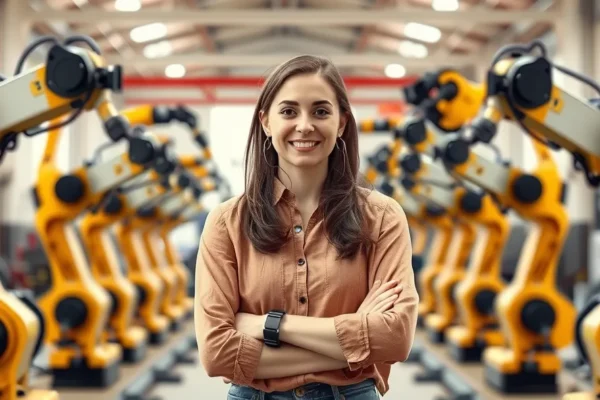
The Power of Perspective in Hardware Innovation
When most people think about a robotics startup, they imagine a basement full of engineers hunched over circuit boards and lines of complex code. As a female founder with a liberal arts degree, my journey into this space looked very different. I did not start by soldering wires; I started by asking human-centric questions. In the world of finance and business, we often treat technical knowledge as the only form of capital, but there is immense economic value in what we call soft skills—critical thinking, empathy, and narrative-building.
Think of a robotics startup as a complex financial portfolio. If you only invest in one type of asset, like high-risk tech stocks, you lack balance. Similarly, a company that only has technical talent often lacks the ability to translate innovation into a product that humans actually want or need. My liberal arts background served as the missing link in that portfolio, allowing me to bridge the gap between abstract engineering and real-world utility.
How Non-Technical Founders Drive Value
The process of building a business is fundamentally about problem solving. Think of it like conducting an orchestra: the conductor does not need to play every instrument perfectly, but they must understand how the cello, the violin, and the flute contribute to a cohesive symphony. In my case, I hired brilliant robotics engineering talent, but I provided the sheet music.
Let us look at a real-world scenario. Imagine a team of engineers is tasked with building a robot for warehouse automation. Left to their own devices, they might optimize the machine for speed at the cost of safety or user ergonomics. As a non-technical founder, my role was to step back and analyze the user journey. I asked, how does this machine affect the worker’s morale? Is the user interface intuitive for a non-expert? By focusing on the human side of hardware innovation, I ensured that our capital—the money we raised from investors—was spent on features that actually solved market pain points rather than technical vanity projects.
When you shift the focus from the machine to the user, you often find more efficient ways to reach profitability. This is the essence of startup scaling. By avoiding “feature creep,” which is the tendency to keep adding unnecessary technical bells and whistles that bloat costs, I kept our burn rate—the speed at which a company spends its cash before becoming profitable—under control.
Why Diversity in Tech Leads to Better Financial Outcomes
The tech industry diversity gap is not just a social concern; it is a financial one. When decision-makers all come from the same academic and technical background, they develop “groupthink,” which can lead to costly mistakes. In the context of your personal finances, imagine if every bank in the country operated with the exact same risk management model. If that model failed, the entire system would collapse. Diversity acts as a hedge—a strategy used to reduce risk—against narrow-minded decision-making.
For society at large, bringing nontraditional talent into high-growth sectors like robotics creates more sustainable career paths. It broadens the labor market and helps fuel long-term economic growth by applying different problem-solving frameworks to age-old inefficiencies. When a startup succeeds, it generates jobs, pays taxes, and increases local economic activity. Founders who bring diverse experiences help ensure that the technology we build serves the broadest possible population, which in turn increases the total addressable market for the product.
The Evolution of the Modern Founder
Historically, the image of a successful startup founder was dominated by engineers who could write code in their dorm rooms. According to the Kauffman Foundation, which tracks entrepreneurship data, the average age of successful startup founders is actually in their mid-40s, and many come from diverse professional backgrounds. This shift marks a move away from the “technical-only” mindset toward a “solutions-oriented” mindset.
In the past decade, we have seen an explosion in hardware innovation because the cost of prototyping has plummeted. It is now easier than ever to bring an idea to life. This trend has triggered a new wave of interest in robotics because the barriers to entry have shifted from “who can build the most complex robot” to “who can solve the most pressing societal problem.” Investors are increasingly looking for leaders who understand both the technology and the socioeconomic landscape, as these founders are often better equipped to navigate the complex regulatory and human realities of deploying robots into public spaces.
Applying Nontraditional Thinking to Your Career
Whether you are looking to launch a business or manage your personal financial trajectory, the most important lesson is to lean into your strengths. You do not need to be a coding wizard to influence the tech industry. In fact, many successful venture capital firms now prioritize “founder-market fit”—the unique combination of skills and experience a founder has that makes them uniquely suited to solve a specific problem.
If you are watching the news or evaluating potential investments in the tech sector, look for companies that prioritize human-centered design. Misconceptions persist that only those with a STEM degree belong in robotics. This is incorrect. The future of the economy relies on interdisciplinary thinkers who can synthesize information from history, psychology, and economics to make better hardware. Actionable insight: identify the “soft” gaps in your own industry. Where are the technical solutions failing because they don’t understand the people they serve? That is where your opportunity lies.
Connecting Innovation to Financial Health
Understanding how startups function is connected to larger concepts like venture capital, equity, and market valuation. When a robotics startup scales, it often goes through several rounds of funding. This dilutes the founder’s ownership but provides the capital necessary to reach mass production. Understanding these financial structures is vital if you are considering a career in the startup world or investing in startups through regulated crowdfunding platforms.
Related concepts worth exploring include:
- Angel Investing: Providing initial seed money for startups.
- Burn Rate Analysis: Evaluating how long a company can survive on its current cash.
- Human-Computer Interaction: The field that studies how humans interact with technology, which is critical for non-technical founders in robotics.
Common Questions About Nontraditional Leadership
How does a non-technical founder manage robotics engineering teams effectively?
By focusing on clear communication of objectives, milestones, and user requirements rather than micromanaging the technical implementation. The founder sets the ‘what’ and ‘why,’ allowing the engineering talent to solve for the ‘how.’
Is it possible to scale a robotics startup without being an expert in the field?
Yes, by building a complementary team where the founder focuses on strategy, fundraising, and market fit while senior engineers manage the hardware innovation and technical development.
What are the primary financial risks for a hardware-heavy startup?
The main risks include high upfront capital expenditure for manufacturing, supply chain disruptions that delay product launches, and the difficulty of accurately forecasting consumer demand before a product is market-ready.
How does tech industry diversity impact a company’s bottom line?
Research from firms like McKinsey & Company consistently shows that more diverse leadership teams are associated with higher profitability and better innovation outcomes, as they bring a wider range of problem-solving perspectives to the table.
Can a liberal arts degree provide a competitive advantage in a tech startup?
Absolutely. A degree in the liberal arts fosters critical thinking, storytelling, and ethical reasoning, all of which are essential for navigating the complex human and regulatory challenges that come with scaling a robotics business.
This content is provided for educational purposes only and does not constitute financial, investment, or career advice. Every financial situation is unique, and economic outcomes vary based on individual circumstances and market conditions. You should consult with a qualified financial advisor, mentor, or career coach before making significant business or investment decisions. There are inherent risks in startup entrepreneurship, including the potential loss of invested capital.











