

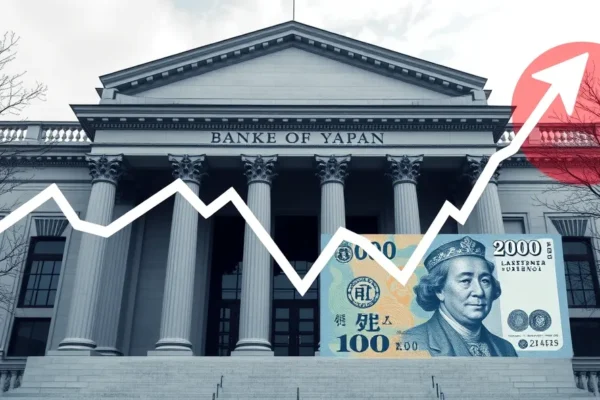
Bank of Japan Hikes Rates, But Why Did the Yen Tumble?
In a move that surprised many observers, the Japanese Yen tumbled despite the Bank of Japan (BOJ) implementing its first interest rate hike in 17 years. This unexpected currency slump, occurring immediately after the central bank’s significant policy shift, raises crucial questions about the effectiveness of monetary policy and market expectations. Governor Haruhiko Ueda’s prior statements, intended to signal a gradual normalization, appear to have had a different effect on the forex market than anticipated, leading to a significant currency slump.
The Business Move: A Policy Shift Under Scrutiny
On March 19, 2024, the Bank of Japan announced a landmark decision: it ended its negative interest rate policy and exited its yield curve control (YCC) framework. This marked a significant departure from years of ultra-loose monetary policy aimed at stimulating the Japan economy. Governor Ueda had previously hinted at such a possibility, stating in February 2024 that the central bank would consider ending negative rates if certain conditions were met. The decision to hike the short-term policy rate from -0.1% to a range of 0% to 0.1% was widely anticipated by many in the financial world. However, the immediate reaction in the forex market was a sharp depreciation of the Japanese yen, a puzzling outcome given the fundamental principle that higher interest rates usually strengthen a currency.
Strategic Rationale: Navigating Inflation and Normalization
The primary strategic rationale behind the Bank of Japan’s decision was to combat persistently low inflation and steer the Japan economy towards a more sustainable growth path. For years, the BOJ has struggled to achieve its 2% inflation target. Recent data, however, indicated a pickup in inflation, driven by rising import costs and growing domestic demand, particularly after the COVID-19 pandemic. Governor Ueda and the BOJ saw this as a crucial moment to normalize monetary policy, signalling a return to more conventional central banking practices. The intention was to gradually move away from extreme stimulus measures without derailing economic recovery. The pre-emptive statements were meant to prepare markets for this shift, allowing for a smooth transition and avoiding sudden shocks. The move away from yield curve control was also strategic, aiming to allow longer-term interest rates to be determined more by market forces, potentially leading to a healthier financial system.
Competitive Context: A Divergent Path from Global Peers
For over a decade, the Bank of Japan has operated on a divergent monetary policy path compared to its global peers. Central banks in the United States, Europe, and the UK have been raising interest rates to combat inflation that surged following the pandemic. This divergence created a significant interest rate differential, making the Japanese yen less attractive to investors seeking higher yields. As other central banks tightened their monetary policy, the yen weakened. The BOJ’s rate hike, while a significant policy shift for Japan, was seen by some market participants as still relatively dovish when compared to the aggressive tightening cycles elsewhere. For instance, the U.S. Federal Reserve had already raised its benchmark rate multiple times, creating a substantial gap. This context is crucial: the BOJ’s move, though a hike, still left Japan with one of the lowest interest rate environments globally. Therefore, while it represented a tightening for Japan, it didn’t close the yield gap enough to immediately support the yen against currencies like the U.S. dollar.
Industry Implications: Signaling a Global Policy Shift
The Bank of Japan’s decision to end negative rates and yield curve control is a significant signal about broader global monetary policy trends. It suggests that the era of prolonged ultra-loose monetary policy, prevalent since the 2008 financial crisis and exacerbated by the pandemic, is gradually coming to an end across major economies. This shift has profound implications for the forex market, global borrowing costs, and investment flows. Other central banks, while perhaps not immediately following the BOJ’s exact path, will be closely watching Japan’s experience. The yen tumbles despite the BOJ rate hike might encourage caution among other central banks considering similar normalization steps, highlighting the complexity of market reactions. It also suggests that currency markets are not solely driven by the direction of interest rate changes but by the magnitude of those changes relative to global expectations and existing differentials.
Financial & Operational Impact: A Balancing Act for the Economy
The immediate financial impact of the yen tumbles despite the BOJ rate hike is mixed. For Japanese exporters, a weaker yen typically boosts competitiveness by making their goods cheaper abroad, potentially leading to higher revenues when converted back into yen. Conversely, importers face higher costs, which can contribute to domestic inflation. On the operational side, companies that rely on imported raw materials or components will see their cost structures rise. For the broader Japan economy, a weaker yen can also make inbound tourism more attractive, a sector the government has been keen to promote. Longer-term, the BOJ’s move aims to foster a more stable and healthy financial environment. By allowing interest rates to rise, it could encourage domestic investment and savings. However, the immediate currency slump presents a challenge, potentially complicating efforts to manage inflation without stifling growth.
Execution Risks & Challenges: The Market’s Interpretation
The primary execution risk for the Bank of Japan lies in managing market expectations and ensuring that its gradual tightening path does not trigger excessive currency volatility or economic instability. The market’s reaction suggests a disconnect between the BOJ’s intended message and its interpretation. Governor Ueda’s cautious language, emphasizing a gradual approach and the possibility of further policy adjustments based on economic data, might have been interpreted by the forex market as a sign that the BOJ is still hesitant to embark on aggressive tightening. This contrasts with the more definitive tightening cycles seen elsewhere. Historical context shows that the BOJ has a long history of very gradual policy normalization, and markets have often tested its resolve. The risk is that if the yen continues to weaken significantly, it could create imported inflation that the central bank then feels compelled to combat with more aggressive, potentially destabilizing, rate hikes, or it could lead to public outcry over rising living costs.
Stakeholder Implications: Navigating a New Economic Reality
The Bank of Japan’s rate hike and the subsequent yen slump have multifaceted implications for various stakeholders. For Japanese consumers, a weaker yen means higher prices for imported goods, from food to energy, potentially eroding purchasing power. This could dampen domestic demand, a key factor for the Japan economy. For Japanese businesses, the impact is divided. Exporters might welcome the weaker yen for its competitive advantage, while companies reliant on imports will face increased costs and pressure on profit margins. Investors, both domestic and international, are reassessing their strategies. The move towards higher interest rates in Japan could make domestic assets more attractive over the long term, but the immediate currency weakness presents a challenge for foreign investors seeking to repatriate profits. Employee wages and job security could also be indirectly affected, depending on how companies adapt to changing costs and revenues.
Outlook & Next Steps: Monitoring the Yen’s Trajectory
The outlook for the Japanese yen and the Bank of Japan’s policy path remains highly uncertain. The key indicators to watch will be the future inflation data in Japan and the BOJ’s subsequent policy decisions. If inflation continues to trend upwards and the BOJ signals further gradual rate hikes, the yen might find support. Conversely, if the yen continues to weaken, potentially driven by continued interest rate differentials with other major economies or by market perceptions of the BOJ’s cautious stance, the central bank might face pressure to act more decisively. Key milestones to watch include upcoming BOJ policy meetings, statements from Governor Ueda, and the trajectory of Japanese economic indicators such as wage growth and consumer spending. Measurable outcomes will likely be seen over the next six to twelve months, as the market fully digests the implications of this policy shift and its effect on the Japan economy.
Key Questions & Answers on the Yen Tumbles and BOJ Rate Hike
Why did the Japanese yen tumble despite the Bank of Japan’s rate hike?
The yen tumbled because the market perceived the Bank of Japan’s rate hike as too small and too slow relative to the aggressive tightening cycles of other major central banks. The interest rate differential, though narrowing slightly, remained significant, making the yen less attractive to forex market investors seeking higher yields.
What are the strategic goals of the Bank of Japan’s policy shift?
The strategic goals are to normalize monetary policy after years of ultra-loose measures, combat persistent inflation, and foster sustainable economic growth in the Japan economy by moving towards market-determined interest rates.
How does this compare to other central banks’ actions?
Compared to the aggressive tightening by central banks like the U.S. Federal Reserve, the Bank of Japan’s move is seen as a much more gradual and cautious step towards policy normalization, which contributed to the yen slump.
What are the immediate risks for the Japan economy?
The immediate risks include imported inflation from a weaker yen increasing the cost of goods for consumers and businesses, potentially dampening domestic demand and complicating the central bank’s inflation control efforts.
What does this signal about the future of monetary policy globally?
This signals a potential end to the era of prolonged ultra-loose monetary policy globally, but also highlights the complex and often counterintuitive reactions of currency markets to central bank decisions.
When can we expect to see the yen strengthen if the BOJ’s strategy is successful?
It is difficult to predict a specific timeline, but sustained economic recovery, rising domestic demand, and clear signals of further gradual but consistent tightening from the Bank of Japan would be necessary for the yen to strengthen against major currencies.
Business outcomes are subject to execution risk and market dynamics.











