

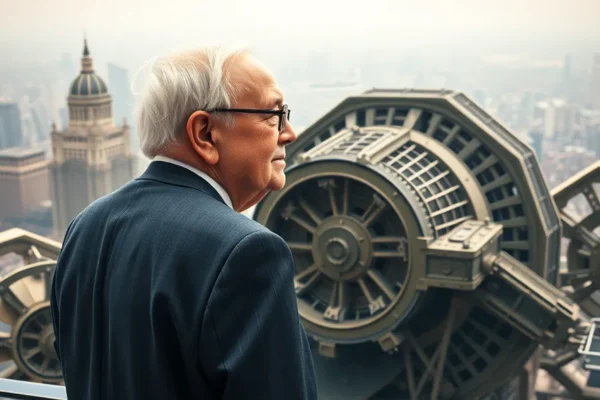
The Warren Buffett $1 Trillion Machine and What Comes Next
Imagine a giant, well-oiled machine that has been incredibly good at making money for over 50 years. This machine isn’t built of metal and gears; it’s a company called Berkshire Hathaway, and its chief architect, Warren Buffett, is one of the most famous investors in the world. For decades, Buffett has been the driving force behind this nearly $1 trillion business empire, a powerhouse built on smart investments and a unique financial playbook. Now, with Buffett stepping down as chairman, many are wondering about the future of this incredible “Warren Buffett $1 trillion machine” and its investment strategies.
Understanding How a Business Empire is Built
Think of a business empire like a collection of different businesses and investments that all belong to one parent company. Berkshire Hathaway is a prime example. Instead of focusing on just one product or service, Berkshire Hathaway owns a wide variety of companies. These range from insurance giants like GEICO to railroads like BNSF, to energy companies, and even a popular ice cream maker, Dairy Queen. Beyond owning entire companies, Berkshire Hathaway also holds massive stakes in publicly traded companies, meaning they own large chunks of stock in businesses like Apple, Coca-Cola, and American Express.
This approach is called conglomerate investing. A conglomerate is a large company that owns or controls a number of smaller companies that conduct business operations in different industries. The beauty of this model, as championed by Buffett, is diversification. If one part of the empire isn’t doing well, other parts might be thriving, helping to balance things out. It’s like having a diverse investment portfolio where you don’t put all your eggs in one basket. People care about understanding this because the success of such large entities can ripple through the economy, affecting jobs, investments, and even the prices of goods and services we use every day.
The Berkshire Hathaway Financial Playbook Explained
Warren Buffett’s investment strategies, often referred to as his financial playbook, are famously straightforward yet incredibly effective. The core idea is to buy wonderful companies at a fair price, not necessarily to buy fair companies at a wonderful price. Here’s a simplified breakdown:
- Focus on Value: Buffett looks for companies that are undervalued by the stock market. This means he believes their stock price is lower than the true worth of the company.
- Understandable Businesses: He invests in businesses he can understand. He avoids complex industries he doesn’t grasp.
- Strong Management: He prefers companies with capable and honest management teams who are good stewards of shareholder money.
- Long-Term Holdings: Buffett rarely sells what he buys. He aims to hold these investments for the long haul, benefiting from their growth over decades.
- Reinvesting Profits: The profits generated by Berkshire Hathaway’s businesses and investments are then used to buy more businesses or more stock, fueling the growth of the “Warren Buffett $1 trillion machine.”
A real-world example is Buffett’s massive investment in Apple. While many saw Apple as just a phone company, Buffett recognized its strong brand, loyal customer base, and its ability to generate consistent profits. He has held onto his Apple stock for years, turning an initial investment into a huge profit.
Think of it like this: if you found a small, reliable bakery that consistently makes delicious bread and sells it for more than its ingredients and labor cost, you’d want to buy that bakery, right? Then, you’d use the profits from that bakery to buy another successful local shop, and so on. That’s essentially what Buffett has done on a massive scale with Berkshire Hathaway.
Why This Business Empire Matters to You
The success and operations of a massive entity like Berkshire Hathaway have several implications for everyday people:
- Job Creation: Berkshire Hathaway directly employs hundreds of thousands of people across its many subsidiary companies. Its growth and stability contribute to a significant number of jobs globally.
- Investor Confidence: The performance of Berkshire Hathaway often reflects the health of the broader market. When Berkshire thrives, it can boost confidence among individual investors.
- Consumer Impact: Many products and services we use daily are either owned by Berkshire Hathaway or are part of industries where Berkshire is a major investor. Think of your insurance, your electricity, or even the credit card you use.
- Economic Stability: Large, stable companies like Berkshire Hathaway can act as anchors in economic downturns, providing a degree of stability.
However, there are also potential downsides. If a large conglomerate makes poor decisions, its negative impact can be widespread. Also, the sheer size of Berkshire means its investment strategies can sometimes influence market prices for certain stocks, potentially affecting smaller investors. The transition away from Buffett’s direct leadership also raises questions about whether this massive entity can maintain its exceptional performance without its iconic founder.
The Evolution and Current Interest in Berkshire Hathaway
Berkshire Hathaway began as a struggling textile mill in the mid-19th century. Warren Buffett, in 1965, began acquiring control of the company and gradually transformed it. He saw the potential in the insurance industry’s ability to generate “float” — money paid in premiums that an insurer can invest before it needs to pay out claims. This float became a crucial source of capital for Berkshire’s investments.
Over the decades, Buffett’s investment strategies, focusing on value and long-term holdings, proved incredibly successful. This transformed Berkshire Hathaway from a modest textile company into a titan worth well over $800 billion (approaching $1 trillion) as of late 2023/early 2024. Recent data from Berkshire Hathaway’s annual reports show its market capitalization has consistently grown, solidifying its status as a global financial powerhouse.
The current interest in the “Warren Buffett $1 trillion machine” is largely driven by two factors: the impending or recent changes in leadership and the sheer magnitude of the company. With Warren Buffett, now in his 90s, and his long-time business partner Charlie Munger having recently passed away, the spotlight is intensely on succession plans and how the company’s future investment strategies will unfold.
Practical Considerations for Investors and the Public
For individuals who invest in the stock market, understanding Berkshire Hathaway’s journey offers valuable lessons:
- Patience is a Virtue: Buffett’s success underscores the power of long-term investing. Rather than trying to make quick profits, focusing on quality and holding for extended periods can yield significant results.
- The Importance of Due Diligence: Buffett’s emphasis on understanding the businesses he invests in highlights the need for thorough research. Don’t invest in what you don’t understand.
- Beware of Hype: Buffett often steers clear of trendy investments that lack substance. It’s wise to question investments that seem too good to be true or are based solely on speculation.
A common misconception is that Buffett’s strategy is only for the ultra-wealthy. However, the principles of value investing and long-term growth are accessible to all investors, even with small amounts. It’s about the philosophy, not just the scale.
When you see news about Berkshire Hathaway’s future or its investment decisions, consider it as a case study in business management and investment. It’s a chance to learn about how capital is allocated and how large corporations operate. The transition in leadership at Berkshire Hathaway is a significant event, and how the new leadership implements their own investment strategies will be closely watched as a test of Buffett’s legacy and the company’s enduring strength.
Connecting to Other Financial Concepts
The story of Berkshire Hathaway and Warren Buffett’s investment strategies is deeply intertwined with several other core financial concepts:
- Value Investing: This is the investment philosophy of buying securities that appear underpriced by objective measures, typically by analyzing a company’s fundamentals. Buffett is the most famous practitioner of this.
- Diversification: As mentioned, spreading investments across different assets or industries to reduce risk. Berkshire Hathaway achieves this through its diverse ownership of companies.
- Capital Allocation: This refers to how a company decides to use its money, whether for reinvesting in operations, paying dividends, acquiring other companies, or repurchasing its own stock. Buffett is a master of capital allocation.
- Corporate Governance: This involves the systems by which companies are directed and controlled. Buffett’s focus on strong management and ethical practices is a key aspect of good corporate governance.
- Economic Moats: A business concept coined by Buffett, referring to a company’s competitive advantage that protects its long-term profits and market share from competitors.
Understanding these related concepts can provide a richer picture of how Warren Buffett built his $1 trillion machine and why his approach has been so enduring.
Frequently Asked Questions About Warren Buffett and Berkshire Hathaway
What is the $1 trillion machine referring to?
The “$1 trillion machine” is a nickname for Berkshire Hathaway, Warren Buffett’s conglomerate, which has grown to be worth close to $1 trillion. It refers to its immense size, profitability, and its ability to consistently generate wealth through its diverse holdings and investments.
How does Warren Buffett’s chairman stepping down impact Berkshire Hathaway’s future?
The chairman stepping down, especially with Buffett’s long tenure, raises questions about leadership transition and the continuation of his specific investment strategies. While Berkshire has a strong management team and a clear successor in place for the CEO role (Greg Abel), the chairman role’s shift signifies a new era for the company’s direction.
What are Warren Buffett’s main investment strategies?
Warren Buffett’s primary investment strategies focus on value investing: buying businesses with strong fundamentals at attractive prices, focusing on understandable companies, prioritizing excellent management, and holding these investments for the long term.
How does Berkshire Hathaway’s business empire affect the average person?
Berkshire Hathaway’s business empire affects the average person through job creation, the provision of essential goods and services (like insurance and utilities), and by its overall impact on financial markets and investor confidence.
Will Berkshire Hathaway continue to be successful without Warren Buffett’s direct leadership?
Many analysts believe Berkshire Hathaway has built a robust structure and culture that can endure beyond Buffett. However, the unique genius and decision-making ability of Buffett are hard to replicate, so its growth trajectory may differ.
What are the risks associated with Berkshire Hathaway’s investment strategies?
The risks include market downturns that affect all investments, potential missteps by future leadership, the challenge of deploying vast amounts of capital effectively, and the general risks inherent in owning and operating numerous diverse businesses.
Disclaimer: This article is for educational purposes only and does not constitute financial advice. Financial situations are unique, and it is recommended to consult with a qualified financial professional for personalized guidance. Investing involves risk, and past performance is not indicative of future results.











