

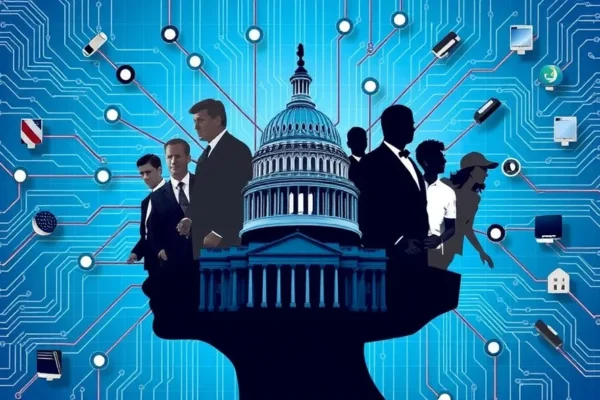
The Unusual Alliance Forming Around AI Risks
In recent months, a rare phenomenon has emerged in Washington. Political figures who rarely agree on anything—ranging from progressive Senator Bernie Sanders to populist commentator Steve Bannon—have found common ground on a topic that transcends traditional party lines: the existential and economic dangers of artificial intelligence. This shift in discourse was highlighted by MIT professor Daron Acemoglu, who has frequently argued that the current trajectory of AI development is driven more by business efficiency than by broad societal benefit.
The core of this movement is a growing consensus that AI regulation is no longer a fringe concern. When figures across the ideological spectrum begin to advocate for guardrails, it signals a major shift in the political climate. This isn’t just about political posturing; it is a fundamental challenge to how Silicon Valley has approached innovation for the last decade. As Capitol Hill begins to draft legislation, the tech industry faces a new reality where political unity against unchecked automation could change the rules of the game permanently.
The Strategic Rationale for Political Convergence
Why are such disparate political figures aligning on AI safety? The answer lies in a shared concern over power concentration. From a strategic perspective, AI acts as a “force multiplier” for whoever controls the underlying infrastructure. Senator Sanders views AI through the lens of labor rights, fearing that automation will worsen wealth inequality by displacing workers without providing a safety net. Conversely, figures like Steve Bannon focus on the cultural and geopolitical implications, fearing that a handful of tech giants could control information flow and undermine national sovereignty.
For these leaders, the decision to engage on AI regulation is a way to address a problem that their respective bases find increasingly urgent. For the political establishment on Capitol Hill, the motivation is slightly different: they are responding to the demand for risk mitigation. By pushing for bipartisan cooperation, lawmakers are positioning themselves to oversee a technology that is rapidly becoming a core utility for the global economy.
Competitive Dynamics in an Uncertain Regulatory Market
The push for AI safety regulation creates a complex competitive environment. Large technology firms like Microsoft, Google, and OpenAI are currently in a race to achieve AGI, or Artificial General Intelligence, which refers to a machine that can perform any intellectual task a human can. The strategic advantage currently lies with those who can scale their computing power the fastest. However, aggressive regulation could disrupt these “first-mover” advantages.
If new laws impose high compliance costs or mandatory safety audits, smaller startups may find it impossible to compete with established giants who have the legal teams and cash reserves to absorb these costs. Paradoxically, the industry leaders might prefer some level of regulation because it serves as a barrier to entry, protecting their dominant market position from upstart rivals. This creates a competitive paradox where those who claim to favor innovation are also the ones best positioned to survive a heavily regulated market.
Industry Implications for Global Tech Leaders
The broader industry is bracing for a shift toward “responsible AI.” We are seeing a move away from the “move fast and break things” philosophy that characterized the early internet era. Sector-wide, companies are now forced to integrate AI safety into their product design from day one rather than as an afterthought. This is an expensive shift that requires shifting talent away from feature development and toward ethical oversight and regulatory compliance.
Industry peers are likely to respond to this pressure by creating self-regulatory bodies and industry standards in an attempt to preempt more restrictive government laws. This is a classic business defensive maneuver: by setting the bar themselves, they hope to avoid the heavy hand of federal oversight. However, as the MIT professor noted in recent discussions, self-regulation has historically proven insufficient in industries where the financial incentives for expansion are so high.
Financial and Operational Impacts of Compliance
The financial implications of a sudden regulatory shift are significant. In the short term, companies will face higher operational costs as they build out compliance departments, invest in safety testing, and potentially pay fines for initial oversights. These costs hit the bottom line directly, potentially affecting quarterly earnings reports for the big tech firms that have invested billions into AI research.
Long-term, the financial structure of the industry could be fundamentally altered. If regulators require mandatory disclosures about the data used to train AI models, firms may lose the intellectual property advantages they currently enjoy. Investors are watching these trends closely; while the demand for AI remains high, the risk of “regulatory overhang”—the possibility that government action could stifle growth—is causing some volatility in tech stock valuations. Analysts expect that firms with more transparent and proactive safety measures will eventually command higher valuations, as they represent a lower risk to long-term shareholders.
Execution Risks and Real World Challenges
Moving from the intent to regulate to the actual implementation of AI safety measures is fraught with execution risk. The biggest challenge is the “pacing problem.” Technology is evolving at an exponential rate, while the legislative process remains linear and slow. By the time a law is passed on Capitol Hill, the nature of the AI risks being addressed may have already changed.
Historically, complex regulation in the tech sector has struggled with the “law of unintended consequences.” Efforts to restrict certain features can often suppress positive innovation in areas like medical diagnosis or climate modeling. Furthermore, there is the risk of geopolitical misalignment. If the United States imposes strict regulations while other nations continue to develop AI without oversight, American companies may lose their global competitive edge. This creates an organizational challenge: how does a firm satisfy domestic political demands while remaining competitive in an unregulated international market?
Implications for Key Stakeholders
The impact of this bipartisan turn extends far beyond the boardrooms of tech giants. For employees, the shift towards AI safety might mean more job security in the short term, as companies invest in human-in-the-loop systems. However, it also signifies a cultural shift within these organizations, moving from a culture of pure engineering to one of corporate accountability.
For customers, the result is a trade-off. They may experience more reliable and safer AI tools, but they might also face higher subscription fees as firms pass on the costs of regulatory compliance. Investors, meanwhile, need to adjust their expectations. The era of unchecked growth for AI companies is likely coming to an end, replaced by a period of maturing institutional oversight. The market sentiment is beginning to reflect this, moving from blind excitement about “all things AI” to a more granular analysis of which companies are actually prepared for a post-regulation landscape.
Outlook and Next Steps for the Industry
Looking ahead, the next twelve months will be critical. We should expect to see the introduction of several high-profile bills on Capitol Hill aimed at establishing a national framework for AI safety. The key milestone to watch is not necessarily the passing of a single law, but the development of an enforcement agency or a set of technical standards that companies are required to follow.
Strategic success will depend on whether companies can integrate safety measures without losing their competitive agility. Analysts will be monitoring R&D spending, the hiring of ethics and compliance officers, and the frequency of “model cards”—documents that explain how an AI model works and its limitations—as indicators of a company’s readiness. If the current momentum continues, AI will move from a wild west frontier into a regulated utility, a transition that will define the winners and losers of the next decade.
Frequently Asked Questions on AI Regulation
Will the push for AI regulation actually succeed in Congress?
While bipartisan cooperation is rare, the combination of public fear and the involvement of high-profile political figures makes some form of legislation highly probable. Success will likely be measured by the creation of new oversight agencies rather than a single comprehensive law.
How does AI regulation change the competitive landscape?
Regulation acts as a competitive filter. Larger companies with deeper resources can often absorb compliance costs more easily than startups, which could lead to further market consolidation and less “disruptive” competition.
What are the biggest risks to this regulatory strategy?
The primary risk is the gap between the speed of technological innovation and the speed of government policy. Overly rigid regulation could inadvertently favor international competitors who do not face the same legal constraints as American firms.
Why are figures like Bernie Sanders and Steve Bannon working on this?
They are focusing on different aspects of the same problem: the concentration of power. Sanders is concerned with economic inequality and labor displacement, while Bannon is concerned with the influence of tech elites on national institutions, creating a unique overlap in their goals.
How long until we see measurable outcomes from this trend?
We should expect initial policy frameworks and regulatory standards to emerge within the next 12 to 18 months. These will serve as the first benchmarks for gauging how the industry will adapt to the new legal environment.
Please note that all business strategies are subject to significant execution risk. The outcomes mentioned in this analysis are based on current market trends and political developments, which are inherently volatile and uncertain. Investors and stakeholders should treat these projections as estimates rather than guaranteed results.











