

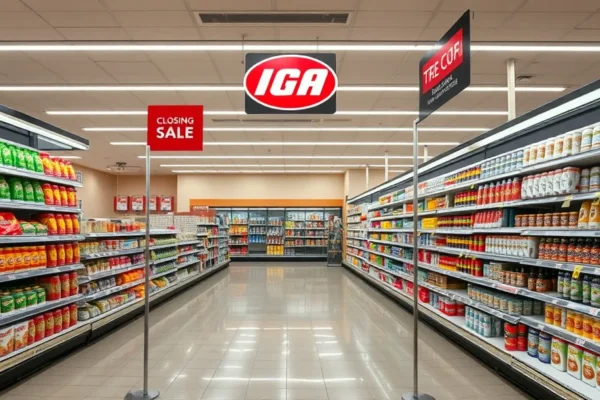
Understanding the Business of Grocery Store Closures
At the heart of the economy is the simple exchange of goods for money. When you visit a grocery store, you are participating in a complex supply chain that connects farmers and manufacturers to your kitchen table. When news breaks regarding IGA store closures, it highlights the fragility of this system. In business terms, a retail store is a physical location that must generate enough revenue to cover the cost of the products it sells, the wages of its staff, the rent of the building, and the utilities required to keep the lights on and the freezers running.
Think of a grocery store like a household budget. If a family’s monthly expenses consistently exceed their paycheck, they eventually run out of savings and must make difficult choices. For independent grocers, the margins—the difference between what they pay for a product and what they sell it for—are often razor-thin. When these businesses face rising costs that they cannot pass on to the customer, they become unprofitable. Understanding these closures is important because it serves as a bellwether for the broader retail landscape, reflecting how shifts in consumer behavior and economic pressures impact the neighborhoods where we live.
The Mechanics of Retail Profitability
To understand why store closings happen, we must look at the mechanics of profit. Imagine a local market owner who buys a gallon of milk for three dollars and sells it for three dollars and fifty cents. That fifty-cent difference is the gross profit. Out of that, the owner must pay for electricity, employee salaries, and property taxes. If the cost of electricity rises by twenty percent or if the rent goes up, the owner must either raise prices or find a way to operate more efficiently. If they cannot do either, the business fails.
In the case of recent IGA store closures, several factors are colliding. First, labor costs have risen significantly over the past few years as the competition for workers has intensified. Second, supply chain disruptions have made it more expensive for independent grocers to stock their shelves compared to large national chains that have more leverage to negotiate lower prices from suppliers. When a store cannot compete with the prices of massive supermarket chains, they lose customers. When they lose customers, their revenue drops, but their fixed costs—like the lease on the building—remain the same. This creates a “death spiral” where the business loses money every month until it is no longer sustainable to remain open.
Why Grocery Closures Affect Your Financial Future
While a store closure might seem like a local inconvenience, it has ripple effects on both personal and economic levels. For the individual, the loss of a nearby grocery store—often called a “food desert” in extreme cases—can force residents to travel much further for food, increasing transportation costs and decreasing the time available for work or family. This is a hidden tax on your time and your gas budget.
On a macro-economic scale, these closures are a sign of the changing retail landscape. When independent grocers shutter, the local tax base shrinks, which can affect the funding for local schools and public services. Furthermore, these closures reflect the impact of inflation. When the cost of doing business rises, smaller players are often the first to feel the squeeze. For investors and workers, this signals that the supermarket industry is undergoing a period of intense consolidation, where only the largest, most technologically efficient companies can survive the current economic climate.
The Evolution of the Supermarket Industry
The supermarket industry has evolved drastically since the mid-20th century. Decades ago, small, independent grocers were the cornerstone of every community. However, the rise of “big-box” retailers and later the emergence of digital grocery delivery services have changed how consumers shop. According to data from the Bureau of Labor Statistics, the retail sector has faced consistent pressure to automate and scale up to remain profitable in a high-inflation environment.
Recent reports regarding the closing of IGA locations in four states point to a combination of high operational costs and shifting consumer demographics. Independent grocers often struggle to match the economies of scale—the cost advantage that businesses obtain due to their size—enjoyed by national chains. As of 2024, the retail landscape shows that consumers are increasingly prioritizing convenience and price, leading to a decline in traditional, mid-sized independent stores that cannot pivot quickly to online ordering or automated inventory management.
Practical Implications for Your Financial Life
How should you view these developments? First, understand that retail volatility is a normal part of a dynamic economy. Businesses that do not adapt to changing costs or consumer preferences often exit the market. When you see news of store closings in your area, consider it a reminder to diversify where you shop and be mindful of how rising operational costs in the retail sector may lead to higher prices at the checkout counter.
Common misconceptions include the idea that store closures are always the fault of management. In reality, market forces like interest rates, supply chain bottlenecks, and labor shortages often play a much larger role. To protect your financial health, keep a close watch on your local community. If you rely on a specific retailer, consider how their potential closure might impact your monthly budget, such as an increase in travel expenses. Being proactive about identifying alternatives is a key component of sound financial planning.
Connecting Grocery Trends to Broader Economics
The closure of IGA stores is deeply connected to other essential financial concepts. For instance, the concept of inflation explains why store owners are struggling with the rising cost of goods. You can learn more about this in our guides on how central bank policies affect the price of basic commodities. Additionally, the shift toward automation in grocery stores is a classic example of capital expenditure, where companies invest in technology to replace expensive manual labor. Understanding these connections helps you see that retail news is never just about one store; it is about the broader forces of supply, demand, and efficiency that define our modern economy.
Frequently Asked Questions About Grocery Store Closures
Why are IGA store closures making headlines?
These closures are significant because they represent broader retail challenges faced by independent grocers. When established chains shut down in four states, it signals that small and mid-sized businesses are struggling to manage the rising costs of labor, logistics, and inventory.
How do economic factors like inflation cause grocery store closings?
Inflation raises the cost of everything from electricity to the wholesale price of produce. If a store cannot pass these costs to customers because they are worried about losing them to cheaper competitors, their profit margins vanish, eventually making the business unsustainable.
Do store closures always lead to higher prices for consumers?
Not necessarily, but they often lead to less convenience. When a local store closes, consumers may have to travel further to find comparable items, which increases their personal transportation costs and limits their options, potentially reducing competition in the long run.
Is the supermarket industry dying or just changing?
The industry is changing rapidly. While physical stores face retail challenges, the market is shifting toward a mix of large-scale, high-efficiency supermarkets and digital-first shopping experiences that require less physical retail space.
Can individuals influence these business trends?
While individuals cannot stop macroeconomic trends, they can support local businesses to help them maintain volume. However, personal financial decisions should always prioritize your own budget and needs over supporting a specific brand or store.
What should I do if my local grocery store closes?
The best approach is to assess how it changes your monthly expenses. Review your budget to see if the need to travel further for groceries will increase your gas or transit costs and adjust your spending or shopping frequency accordingly.
This content is provided for educational purposes only and does not constitute financial advice. Economic environments are complex and vary by region and individual circumstance. Readers are encouraged to consult with qualified financial professionals regarding their personal budgeting or investment decisions. Past market trends do not guarantee future outcomes.











