

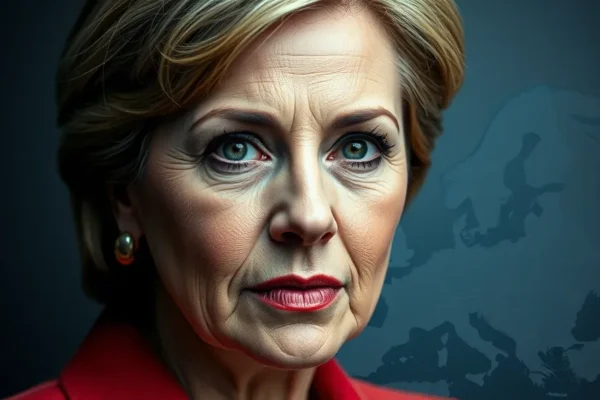
The Rise of Explicit Deepfakes Targeting European Politicians
The digital landscape is grappling with a disturbing new form of online harassment: sexually explicit deepfakes targeting prominent figures, with a recent surge focusing on over 100 European politicians, predominantly women. This phenomenon isn’t just a digital nuisance; it’s a potent weapon of disinformation and personal attack with profound implications for individuals, democratic processes, and internet safety. The technology behind these malicious creations, known as deepfakes, has advanced rapidly, making it increasingly accessible and sophisticated. Understanding what deepfakes are, how they are made, and their growing impact is crucial for navigating this evolving threat.
Understanding the Technology Behind Deepfakes
At its core, a deepfake is a type of synthetic media where a person’s likeness is digitally manipulated, often by superimposing their face onto another person’s body or by generating entirely new video or audio content that appears to be real. The term “deepfake” itself comes from “deep learning,” a subset of artificial intelligence (AI) that powers these sophisticated tools.
Think of it like a hyper-realistic digital puppet show. Instead of string puppets, AI algorithms are used. These algorithms are trained on vast amounts of data, such as images and videos of the target individual. This training allows the AI to learn the nuances of their facial expressions, speech patterns, and body language. Once trained, the AI can then generate new content, seamlessly swapping faces or creating entirely new performances. The process typically involves two competing neural networks: one that generates the fake content and another that tries to detect if it’s fake. Through this constant back-and-forth, the generator becomes increasingly adept at creating believable fakes.
Deepfakes in the Spotlight: Current State and Real-World Use
While the underlying deepfake technology has been around for a few years, its accessibility and quality have improved dramatically. Initially, creating convincing deepfakes required significant technical expertise and computational power. However, the development of user-friendly software and readily available AI models has democratized the creation process.
The most prevalent and concerning current application is the creation of non-consensual explicit deepfakes. As reported by organizations like the Global Disinformation Index, these explicit deepfakes targeting politicians, particularly women, have proliferated across various online platforms. These are not yet mainstream, widely accepted applications; rather, they represent a malicious exploitation of the technology. While deepfake technology also has potential positive applications in areas like film production (e.g., de-aging actors) or personalized advertising, the current reality for many public figures, especially women in politics, is a constant threat of having their likeness used in abhorrent ways. The availability of such tools means that anyone with malicious intent and access to basic computing resources can potentially create and disseminate these harmful videos.
A Crowded and Evolving Competitive Landscape
The field of synthetic media and deepfake technology is highly dynamic, with numerous players and approaches. Major AI research labs, including Google, Meta (Facebook), and OpenAI, have been instrumental in developing the foundational deep learning techniques that underpin deepfakes. Their research, often published in academic papers, pushes the boundaries of what’s possible in AI-driven content generation.
Beyond these tech giants, a diverse ecosystem of smaller companies and open-source projects are also contributing. Some focus on ethical applications, developing AI for creative industries or for detecting deepfakes. Others, however, operate in more ethically ambiguous spaces, offering tools that can be easily repurposed for malicious ends. The key differentiator in this landscape is often the intent and the ethical guardrails put in place. While some are striving for responsible innovation, others are contributing to the proliferation of harmful synthetic media. Alternatives to deepfake technology for digital manipulation exist, such as traditional video editing software, but they lack the same level of seamless realism and automation that AI-powered deepfakes offer.
The Far-Reaching Implications of Explicit Deepfakes
The proliferation of explicit deepfakes targeting European politicians, and indeed any public figure, carries significant implications. On a personal level, it constitutes severe online harassment and a violation of privacy, capable of causing immense psychological distress and reputational damage. For women in politics, this is a particularly acute problem, often serving as a tactic to silence and intimidate them, thereby undermining their participation in public life.
Economically, the spread of disinformation, which deepfakes can amplify, can destabilize markets and erode public trust in institutions. The cost of combating and mitigating the effects of deepfakes, from detection technologies to legal recourse, is also a growing concern. Socially, these explicit deepfakes erode trust in digital media, making it harder for citizens to discern truth from falsehood. This can have a chilling effect on free speech and democratic discourse, as individuals may become hesitant to engage in public life for fear of becoming targets. The short-term impact is already evident in the increased vulnerability of public figures, while the long-term impact could be a further erosion of democratic norms and an increase in political polarization.
Navigating the Technical and Ethical Hurdles
Despite the advances, deepfake technology still faces significant limitations and challenges. Creating truly indistinguishable deepfakes that can fool expert analysis or sophisticated detection systems remains a difficult task. Subtle artifacts, inconsistencies in lighting, unnatural blinking, or a lack of emotional nuance can sometimes betray the synthetic nature of the media.
Technical challenges include the computational resources required for high-quality generation and the ongoing arms race between deepfake creators and detectors. As detection methods improve, so too do the generation techniques. Beyond the technical, the primary challenge is ethical. The ease with which malicious actors can weaponize this technology, coupled with the difficulty of attribution and enforcement, poses a significant hurdle. Regulation struggles to keep pace with technological advancements, and the sheer volume of online content makes moderation a monumental task. The cost of developing and deploying effective detection and mitigation strategies also presents an adoption barrier for many organizations and governments.
The Future Trajectory: Evolving Capabilities and Countermeasures
The trajectory of deepfake technology points towards increasingly sophisticated and accessible tools. We can expect to see even more realistic synthetic media generated with greater speed and lower computational cost. This will likely lead to a continued arms race between creators and detectors, with AI continuously improving on both sides.
Key developments to watch include advancements in real-time deepfake generation, making live manipulation of video feeds a possibility. Furthermore, the development of more robust AI-powered detection systems that can identify subtle anomalies will be critical. Research into watermarking or digital provenance techniques to verify the authenticity of media is also an important area. While widespread adoption of deepfake creation tools for benign purposes may occur in creative industries, the malicious use of explicit deepfakes is likely to remain a persistent and evolving threat requiring ongoing vigilance and technological countermeasures.
Key Questions About Deepfakes and Their Impact
Is deepfake technology mature?
Deepfake technology is mature enough to create convincing and harmful explicit deepfakes that can be disseminated online. While perfection is not yet achieved, current capabilities are sufficient for malicious purposes and pose a significant threat.
Who benefits from explicit deepfakes targeting politicians?
Malicious actors, including political opponents, foreign adversaries, or individuals seeking to cause harm and sow discord, benefit from the creation and dissemination of explicit deepfakes. Their goal is often to discredit, silence, or intimidate individuals and to manipulate public opinion.
What are the primary risks associated with deepfake technology?
The primary risks include the spread of disinformation, reputational damage, online harassment, erosion of public trust, and the potential to undermine democratic processes and individual privacy.
How long will it take for deepfake detection to catch up?
It is an ongoing technological race. While detection methods are improving, deepfake generation techniques are also evolving. It is unlikely that detection will “catch up” in a definitive sense, but rather that both capabilities will continue to advance in parallel.
How can individuals protect themselves from deepfakes?
While individuals cannot directly prevent the creation of deepfakes, they can practice critical media consumption, be skeptical of sensational content, and rely on reputable news sources. Developing digital literacy is a crucial defense.
What is being done to combat explicit deepfakes targeting women in politics?
Efforts include developing AI-powered detection tools, legislative initiatives to criminalize non-consensual deepfakes, platform moderation policies, and awareness campaigns to educate the public about the dangers of synthetic media.
This article explores the current state and implications of deepfake technology, particularly its malicious use against public figures. The information provided is based on current research and reporting, but the field of AI is rapidly evolving, and future developments may alter these trajectories.











