

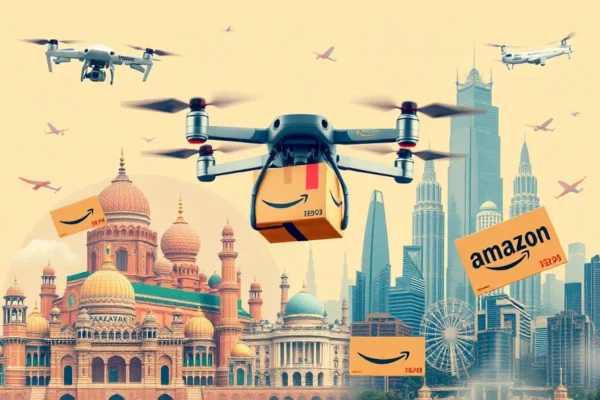
Amazon India Enters the Race for Rapid Delivery
Amazon is preparing a significant strategic shift in one of its most important growth markets. The company plans to invest approximately $3 billion into the quick commerce sector in India. Quick commerce refers to a business model focused on delivering small quantities of goods, typically groceries and household essentials, to customers in under 30 minutes.
This move represents a pivot from Amazon India’s traditional e-commerce model, which focuses on a vast selection of products delivered over several days. While Amazon already offers “Amazon Fresh” for groceries, the current plan aims to drastically reduce delivery times to compete with local players. According to industry reports and analysis of Amazon’s regional strategy, this investment will focus on building a dense network of micro-warehouses to facilitate rapid delivery across major Indian cities.
The Strategic Rationale Behind the Investment
The decision to invest $3 billion is driven by a fundamental shift in Indian consumer behavior. For years, online shopping was a planned activity where customers ordered items they needed for the week or month. However, a new trend called “instant gratification” has taken over urban India. Consumers now prefer to order a single bottle of soda or a packet of batteries and receive them within minutes.
Amazon is pursuing this opportunity for several strategic reasons:
- Increasing Order Frequency: Traditional e-commerce orders happen occasionally. Quick commerce orders happen daily. By capturing the daily grocery run, Amazon can increase the number of times a customer opens their app, strengthening brand loyalty.
- Closing the Grocery Gap: While Amazon dominates in electronics and fashion, it has struggled to capture the high-frequency grocery market in India, which is the heartbeat of retail spending.
- Data Acquisition: Hyper-local delivery provides Amazon with precise data on what people in specific neighborhoods are buying in real-time, allowing for better inventory management and targeted advertising.
From a strategic perspective, Amazon is not just selling groceries; it is fighting for “share of wallet.” If a customer spends their daily budget on a competitor’s quick commerce app, they are less likely to visit Amazon for their larger monthly purchases.
Competitive Dynamics and Market Positioning
Amazon is entering a crowded battlefield. Unlike the US market, where Amazon had a massive head start, the Indian quick commerce space is currently led by agile, local-first companies. Players like Blinkit (owned by Zomato), Zepto, and Swiggy Instamart have already established the infrastructure needed for 10-to-20 minute deliveries.
These competitors use a system of dark stores. A dark store is a small warehouse located in a residential neighborhood that is not open to the public but serves as a fulfillment center for online orders. This allows them to bypass the traffic and distance issues that plague larger, centralized warehouses.
Who gains from this move? The consumer is the immediate winner, as increased competition usually leads to better pricing and faster service. Amazon also gains a chance to reclaim its position as the “everything store” in India.
Who is threatened? Local startups like Zepto and Blinkit now face a competitor with nearly unlimited capital. While the startups have the current infrastructure, Amazon has the ability to sustain losses for years to win market share, a strategy known as “predatory pricing” or aggressive scaling.
Broad Implications for the Indian E-commerce Industry
Amazon’s entry into quick commerce signals a permanent change in the India e-commerce landscape. It confirms that the “next-day delivery” standard is no longer sufficient for the urban middle class. This move is likely to trigger a wave of consolidation across the sector.
We can expect several industry-wide shifts:
- Infrastructure War: The battle will shift from who has the best app to who has the most strategic real estate. The competition for small, affordable commercial spaces in dense city centers will intensify.
- Logistics Evolution: The industry will move further away from large trucks and toward electric two-wheelers to navigate narrow Indian streets efficiently.
- Peer Response: Other giants, such as Walmart-owned Flipkart, will likely accelerate their own rapid delivery investments to avoid losing ground to both Amazon and the local startups.
This trend reshapes the market from a “search-and-buy” experience to a “need-and-receive” experience, effectively merging the digital shopping experience with the convenience of the local neighborhood store (the kirana store).
Financial and Operational Impact
Investing $3 billion is a massive capital expenditure, which is money spent by a company to acquire or maintain fixed assets. For Amazon, this money will primarily go toward leasing thousands of small spaces for dark stores and hiring a massive fleet of delivery partners.
Short-term financial impact: Amazon should expect a significant increase in operational costs. The cost per delivery in quick commerce is much higher than in traditional e-commerce because the order value is typically lower, but the delivery speed requirements are higher. This will likely lead to a dip in profitability for the India division in the near term.
Long-term financial goal: The goal is to achieve “density.” Once Amazon has enough customers in a single neighborhood, the cost of delivery drops because one rider can deliver multiple orders in a small radius. If Amazon can achieve this density, the high-frequency nature of the business will eventually create a steady, predictable revenue stream.
Operationally, this requires a total rethink of the supply chain. Amazon must move from a “hub-and-spoke” model (one big warehouse feeding many small ones) to a “mesh” model where inventory is distributed across hundreds of tiny nodes throughout a city.
Execution Risks and Critical Challenges
Despite its resources, Amazon faces significant execution risks. The most prominent is the “burn rate,” which is the rate at which a company spends its venture capital or cash reserves before reaching profitability. Quick commerce is notoriously expensive to run, and there is no guarantee that the 10-minute delivery model is sustainable in the long run.
Historical Context: Amazon has attempted various iterations of rapid delivery globally. While successful in some markets, the unique chaos of Indian urban traffic and the highly fragmented nature of local retail present a different set of challenges. Amazon’s culture is built on extreme efficiency and standardization, which can sometimes clash with the chaotic, flexible nature of hyper-local logistics.
Regulatory Risks: India has strict laws regarding Foreign Direct Investment (FDI) in e-commerce. The government generally prohibits foreign companies from owning the inventory they sell (an inventory-led model) and requires them to act as a marketplace for other sellers. Transitioning to a dark store model may invite regulatory scrutiny if the government perceives that Amazon is controlling the inventory too closely.
Stakeholder Implications
This strategy creates a ripple effect across various groups:
- Customers: Urban users will enjoy more options and potentially lower prices. However, there is a risk that the “convenience” leads to higher impulse spending.
- Delivery Partners: The demand for gig workers will spike. This could lead to better job availability but also puts pressure on the industry to improve labor conditions and fair pay for riders.
- Local Sellers: Small neighborhood shops may find it harder to compete with Amazon’s efficiency and pricing, potentially forcing them to either join the Amazon platform or pivot their business models.
- Investors: Shareholders will be watching the “cost to acquire a customer.” While growth is good, investors will eventually demand a path to profitability for the India quick commerce venture.
Outlook and Next Steps
If this strategy succeeds, Amazon will no longer be just a place to buy a laptop or a dress; it will be the primary tool for daily survival in Indian cities. The next 12 to 24 months are critical.
Key milestones to monitor include:
- The rollout of a dedicated rapid delivery interface: Look for updates to the Amazon app that prioritize “under 30-minute” options.
- Dark store acquisition: Tracking the number of micro-fulfillment centers opened in cities like Bengaluru, Mumbai, and Delhi.
- Market share shifts: Watching for a decline in the growth rates of Zepto or Blinkit as Amazon scales.
Success will be measured not by the total amount of money spent, but by the “Average Order Value” (AOV) and the frequency of repeat purchases per customer.
Strategic Questions and Answers
Will Amazon India be able to beat local startups like Zepto?
Amazon has a massive advantage in capital and technology, but Zepto and others have a “first-mover advantage” in consumer habit. Whether Amazon wins depends on if it can build its logistics network faster than competitors can build brand loyalty.
Why didn’t Amazon try this sooner?
Amazon initially bet on the “Prime” model of consolidated, scheduled deliveries. The rapid rise of quick commerce in India was faster than expected, forcing Amazon to pivot its strategy to avoid becoming irrelevant in the grocery sector.
What are the biggest risks to this $3 billion investment?
The primary risks are regulatory changes regarding FDI laws in India and the high operational cost of maintaining dark stores in expensive urban real estate.
How long until we see measurable results?
Typically, logistics pivots of this scale take 18 to 36 months to show meaningful impact on market share and customer acquisition metrics.
Does this move threaten the traditional “Kirana” stores?
Yes, it places direct pressure on local mom-and-pop shops. However, some Kirana stores may survive by acting as the actual delivery nodes or partners within Amazon’s ecosystem.
Note: All business outcomes mentioned are subject to execution risk, regulatory changes, and market volatility. Actual results may differ from strategic projections.











