

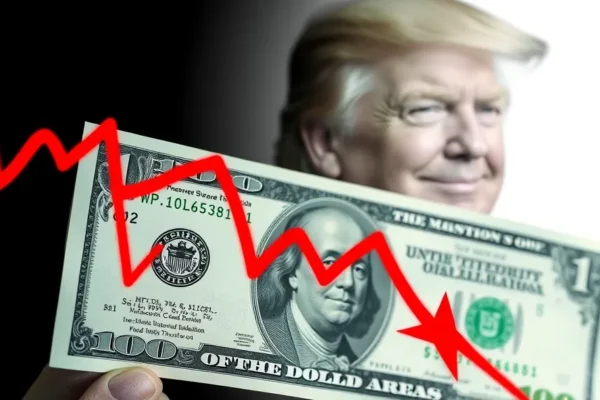
A Technical Signal for the Dollar Sparks Global Interest
The US dollar, a cornerstone of global finance, has recently shown a technical pattern that has captured the attention of market watchers worldwide. This pattern, known as a ‘death cross,’ is being analyzed for its potential economic implications and even its possible appeal to figures like former President Donald Trump. Understanding this development requires looking at technical analysis, the broader currency market, and insights from key economic figures.
What is the Dollar Death Cross?
A “death cross” is a technical analysis signal that occurs when a short-term moving average of an asset’s price crosses below its long-term moving average. For the US dollar, this often refers to the US Dollar Index (DXY). The DXY tracks the value of the dollar against a basket of six major world currencies. A death cross typically signals a potential bearish trend. Specifically, it occurs when the 50-day moving average of the DXY falls below its 200-day moving average. This technical event, when it materializes, can be interpreted by traders as a sign that downward momentum is strengthening.
Potential Economic Implications
The implications of a weakening US dollar, signaled by a death cross, can be far-reaching. A stronger dollar generally makes US exports more expensive for foreign buyers and imports cheaper for US consumers. Conversely, a weaker dollar can make US exports more competitive internationally, potentially boosting American manufacturing and trade. For global markets, a declining dollar can lead to increased investment flows into other economies as investors seek higher returns or as assets priced in other currencies become relatively cheaper. This can also influence commodity prices, as many commodities, like oil, are priced in US dollars. A weaker dollar can make these commodities cheaper for holders of other currencies, potentially increasing demand. Treasury Secretary Scott Bessent, when discussing market sentiment, has previously indicated an interest in economic policies that support American competitiveness, and a weaker dollar can align with such goals by enhancing the price advantage of US goods abroad.
Why Might Donald Trump Favor This Trend?
Former President Donald Trump has historically expressed a desire to reduce trade deficits and make American industries more competitive. A weaker US dollar can directly contribute to these objectives. When the dollar is weaker, US goods and services become cheaper for international buyers, which can boost exports and help shrink the trade deficit. This aligns with the “America First” economic policies often championed during his presidency. Furthermore, a weaker dollar can make it more attractive for companies to bring manufacturing back to the United States, as the cost of production relative to overseas locations might decrease. Treasury Secretary Bessent’s focus on market sentiment and economic policy often includes considerations for trade balance and industrial strength, areas where a dollar depreciation could be viewed favorably from a policy perspective aimed at bolstering domestic production.
Analyzing the Dollar’s Technical Picture
The concept of a death cross is a purely technical indicator. It suggests that recent price action (represented by the shorter-term moving average) has become weaker than the longer-term trend. However, it’s important to note that technical indicators are not always perfect predictors of future market movements. The US Dollar Index (DXY) is a widely watched benchmark, and shifts in its value can reflect a confluence of economic factors, including interest rate differentials, inflation expectations, geopolitical events, and overall global economic health. While a death cross might signal potential downside, the actual trajectory of the dollar will depend on a multitude of fundamental economic indicators and policy decisions.
Broader Market Trends and Investor Sentiment
The potential weakening of the dollar could have ripple effects across the financial markets. Investors might reallocate capital away from dollar-denominated assets towards those denominated in other currencies, particularly if other economies are experiencing stronger growth or offering higher interest rates. This could lead to increased volatility in currency markets and affect global stock and bond markets. Companies with significant international operations might see their earnings translate differently when repatriated to the US if the dollar’s value changes. For instance, a US-based company earning revenue in Euros would see those Euros convert to fewer dollars if the dollar weakens, potentially impacting reported earnings. Conversely, a company that imports a lot of goods might find its costs increasing. Market sentiment around the dollar is often influenced by the Federal Reserve’s monetary policy, inflation data, and global economic outlook.
What to Watch for Next
Investors and analysts will be closely monitoring several key factors that could influence the dollar’s trend. These include upcoming inflation reports, such as the Consumer Price Index (CPI), and statements from Federal Reserve officials regarding future interest rate policy. The strength of economic growth in other major economies, such as the Eurozone and Japan, will also play a role. Geopolitical developments and shifts in global trade policies can also introduce uncertainty and impact currency valuations. Observing how other currency pairs, like EUR/USD or USD/JPY, are performing alongside the DXY can provide further insights into broader currency market trends. The persistence of the death cross pattern on charts, alongside sustained economic data that supports a weaker dollar, would be critical to watch.
Risk Disclaimer
Past performance does not guarantee future results. Markets are volatile and can experience unpredictable movements. The information provided is for informational purposes only and does not constitute financial advice. Investors should conduct their own research and consult with a qualified financial advisor before making any investment decisions.
Frequently Asked Questions about the Dollar Death Cross
What is a death cross for the US dollar?
A death cross for the US dollar, typically observed on the US Dollar Index (DXY), occurs when the 50-day moving average of the index falls below its 200-day moving average. This technical signal is often interpreted by traders as a potential indicator of a bearish trend for the dollar.
What are the economic implications of a dollar death cross?
A death cross for the dollar suggests a potential weakening of the US currency. This could make US exports cheaper and more competitive globally, potentially improving the trade balance. Conversely, it might lead to higher import costs for US consumers and businesses, and could influence commodity prices as they are often priced in USD.
How might Donald Trump view a dollar death cross trend?
Given his past focus on reducing trade deficits and boosting American manufacturing competitiveness, Donald Trump might view a weakening dollar trend favorably. A lower dollar value can make US goods more attractive to international buyers, thereby supporting exports and potentially encouraging domestic production.
What is the significance of the US Dollar Index (DXY)?
The US Dollar Index (DXY) is a benchmark that measures the value of the US dollar relative to a basket of six major world currencies: the Euro, Japanese Yen, British Pound, Canadian Dollar, Swedish Krona, and Swiss Franc. It is a widely watched indicator of the dollar’s overall strength in the global currency market.
What other economic indicators should investors watch alongside a dollar death cross?
Investors should monitor key economic indicators such as inflation rates (CPI, PPI), Federal Reserve interest rate decisions and commentary, employment data (e.g., Non-Farm Payrolls), GDP growth figures for the US and other major economies, and global trade data. These fundamental factors can override or reinforce technical signals like the death cross.
Is a dollar death cross a guaranteed signal for a sustained dollar decline?
No, a death cross is a technical indicator and not a guaranteed predictor of future market movements. While it suggests a shift in momentum, fundamental economic factors, policy changes, and unforeseen global events can all influence the dollar’s trajectory and potentially reverse the trend indicated by the death cross.











