

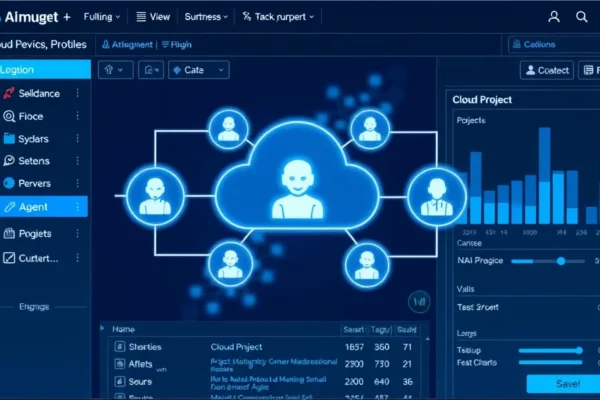
The Dawn of Cooperative AI: Claude Code Projects Reimagines Development
The landscape of artificial intelligence is rapidly evolving, moving beyond single, powerful AI models to a future where multiple AI agents can work together. At the forefront of this shift is Anthropic AI’s innovative approach with its revamped Claude Code Projects. This development aims to solve a fundamental challenge in AI development: how to efficiently manage and coordinate multiple AI agents, allowing them to collaborate on complex tasks. The significance of this announcement lies in its potential to unlock new levels of productivity and sophistication in AI-driven workflows, moving from theoretical multi-agent systems to practical, manageable tools.
Orchestrating a Symphony of AI Agents
At its core, Claude Code Projects introduces a sophisticated framework for managing multiple AI agents within a unified environment. Think of it like assembling a highly skilled team for a project. Instead of one person trying to do everything, you have specialists, each with their own strengths. Claude Code Projects allows developers to define and deploy these specialized AI agents, assigning them specific roles and responsibilities.
The key innovation lies in how these agents interact and share resources. Previously, coordinating multiple AI models often felt like passing notes between separate rooms, with a lot of lost information and duplicated effort. Claude Code Projects introduces a concept of “shared memory AI.” This means agents can access and contribute to a common pool of knowledge and context, ensuring they’re all working with the same up-to-date information. This is crucial for tasks that require consistent understanding across different AI functions.
Furthermore, the system facilitates “parallel AI tasks.” Imagine a complex software development project. One AI agent might be responsible for writing code, another for testing it, a third for documentation, and a fourth for debugging. Claude Code Projects allows these tasks to happen concurrently, rather than sequentially. This dramatically speeds up the development cycle, much like how different departments in a company can work on various aspects of a product launch simultaneously. At the heart of this coordination is often a “coordinator AI,” which acts as a project manager, directing the flow of information and tasks between the individual agents. This multi-agent framework, accessible through what can be thought of as “cloud AI sessions,” allows for dynamic and flexible workflow orchestration.
Putting Cooperative AI to Work Today
While Claude Code Projects is an evolving platform, its underlying principles are already influencing real-world AI development. Companies and researchers are increasingly exploring multi-agent systems for a variety of applications. In the realm of software development, early adopters are experimenting with these tools for automated code generation, bug detection, and even natural language processing tasks that benefit from specialized AI models working in concert. For instance, a financial institution might use one agent to analyze market trends, another to identify trading opportunities, and a third to manage risk, all within a single, coordinated “AI project management” environment.
The availability of such sophisticated AI project management tools is still in its early stages, with many advanced features under active development by companies like Anthropic AI. Users can currently access and experiment with Claude’s capabilities through its existing platforms, with future iterations of Claude Code Projects expected to offer more robust multi-agent management features. This is not yet a mainstream, off-the-shelf solution for every developer but represents a significant step forward in making complex multi-agent systems more accessible and manageable.
A Crowded Field of AI Collaboration
The concept of multiple AI agents working together is not unique to Claude Code Projects. Several other major players in the AI space are investing heavily in similar multi-agent frameworks and related AI development tools. Google, for example, has explored agentic AI through its various research initiatives, often focusing on large language models that can autonomously break down tasks and execute them. Microsoft is also deeply involved in AI development, with its Azure AI services providing a robust cloud infrastructure that can support complex AI deployments, including those involving multiple agents. OpenAI, the creator of ChatGPT, has also demonstrated advancements in agentic behavior and task decomposition, showcasing AI models that can plan and execute multi-step processes.
What distinguishes Claude Code Projects is Anthropic AI’s particular emphasis on safety and controllability within these multi-agent systems, alongside its focus on shared resources and efficient task parallelization. While others might focus purely on raw capability, Anthropic’s approach often prioritizes ensuring that the collective intelligence of these agents remains aligned with human intentions. This focus on responsible AI development within a collaborative framework provides a unique advantage.
Reshaping Industries with Collective AI Intelligence
The implications of advanced AI agent management are profound and far-reaching. In scientific research, multiple AI agents could collaborate to analyze vast datasets, design experiments, and accelerate the discovery of new drugs or materials. In customer service, a team of specialized AI agents could handle complex inquiries, with one agent gathering information, another formulating a response, and a third ensuring empathy and personalization. This will likely lead to more efficient workflows, faster innovation cycles, and the creation of entirely new business models built around sophisticated AI-powered services.
Economically, this could lead to increased productivity and the creation of new roles focused on designing, managing, and overseeing these AI ecosystems. However, it also raises important questions about job displacement as AI agents take on tasks previously performed by humans. Socially, while the benefits of faster problem-solving and improved services are clear, concerns around the control, transparency, and potential misuse of powerful, interconnected AI systems will need to be addressed proactively. The short-term impact will likely be seen in specialized industries, while the long-term impact could transform how we work, learn, and interact with technology on a global scale.
Navigating the Hurdles of Cooperative AI
Despite the exciting potential, significant limitations and challenges remain in the realm of AI agent management. One of the primary hurdles is ensuring robust and reliable communication between agents. Misunderstandings or data corruption in the “shared memory AI” could lead to flawed outcomes. Debugging complex multi-agent systems is also considerably more challenging than troubleshooting a single AI model. Identifying which agent or which interaction caused an error can be a daunting task.
The computational resources required to run and coordinate numerous AI agents simultaneously can also be substantial, potentially leading to high operational costs. Furthermore, establishing clear ethical guidelines and safety protocols for multi-agent systems is an ongoing challenge. How do we ensure that a group of AI agents, each operating with a degree of autonomy, collectively adhere to ethical standards and do not produce unintended negative consequences? The maturity level for truly seamless, fully autonomous multi-agent systems is still in its early stages, with much research and development needed.
The Road Ahead for Coordinated AI
The future trajectory for Claude Code Projects and similar AI agent management platforms points towards increasing sophistication and integration. We can expect to see enhanced capabilities in “workflow orchestration,” allowing for more dynamic and adaptive task assignment and resource allocation. Further research into “shared memory AI” will likely lead to more efficient and secure ways for agents to exchange information. The development of more advanced “coordinator AI” models will enable even more complex and nuanced collaborations between agents.
The trend is moving towards AI systems that are not just intelligent, but also collaborative and adaptable. Companies like Anthropic AI are likely to continue refining their “AI development tools” to make it easier for developers to build and deploy these sophisticated multi-agent applications. Over the next few years, we can anticipate seeing these technologies mature from experimental tools to more integrated components of various software and service platforms, becoming a more common aspect of “AI project management.”
Key Questions and Answers About Claude Code Projects
Is Claude Code Projects currently available?
Claude Code Projects represents an evolving platform. While developers can access and utilize Claude’s AI capabilities now, the specific advanced features for managing multiple AI agents with shared resources and parallel tasks are under continuous development and will be rolled out incrementally.
What is the main benefit of managing multiple AI agents?
The primary benefit is the ability to tackle more complex problems by dividing tasks among specialized AI agents. This leads to increased efficiency, faster development cycles, and the potential for more sophisticated AI applications that would be impossible for a single AI to handle.
How does Claude Code Projects handle “shared memory AI”?
Claude Code Projects aims to provide mechanisms for AI agents to access and contribute to a common pool of information and context. This ensures that all collaborating agents are working with consistent and up-to-date data, preventing conflicting actions or misinterpretations.
Who benefits most from this technology?
Software developers, AI researchers, and organizations looking to automate complex workflows will benefit significantly. This includes industries like finance, healthcare, and scientific research, where coordinating multiple specialized AI functions can lead to breakthroughs and efficiencies.
What are the potential risks or concerns?
Potential risks include the complexity of managing and debugging multi-agent systems, the high computational resources required, and the ethical considerations of controlling collective AI behavior. Ensuring alignment with human values and preventing unintended consequences are critical challenges.
How does this compare to other AI development tools?
Claude Code Projects distinguishes itself through Anthropic AI’s focus on controllable and safe AI, combined with a strong emphasis on enabling collaboration through shared resources and parallel task execution within a multi-agent framework.
This article discusses emerging technologies and ongoing research. Specific features and availability timelines are subject to change by the companies involved. The capabilities described are based on current understanding and may evolve.











