

Understanding Diplomatic Parity and State Media Reaction
When we talk about international relations, sometimes it’s helpful to think about how people interact in daily life. Imagine two neighbors who have always had a slightly unequal relationship. One neighbor always felt they had to defer to the other. Then, one day, the “more powerful” neighbor starts treating the other with a newfound sense of equal respect. This shift can lead to all sorts of reactions, and that’s a bit like what happens in global politics, especially when we look at how major countries interact.
In this context, the idea of diplomatic parity is key. It means treating another nation, and its leader, as equals on the world stage. It’s about mutual respect and acknowledging each country’s standing, regardless of size or economic might. When a leader like U.S. President Donald Trump was perceived by Chinese state media as offering President Xi Jinping equal treatment, it sparked a significant reaction in China. Understanding this reaction isn’t just about political news; it can ripple into economic stability, global trade, and even the financial decisions individuals make. Why? Because the relationship between two global giants like the US and China affects everything from the prices of goods we buy to the overall health of the global economy.
How Perceived Equal Treatment Unfolds
Let’s break down how this perception of equal treatment between leaders might play out and why it matters to China’s state media. Think of it like a schoolyard dynamic. If a popular student always looked down on another, but then started to engage with them as an equal, the entire social group would notice.
Here’s a simplified view:
- Initial Dynamic: For years, international relations between the U.S. and China have been complex. There have been periods where China felt its growing influence wasn’t fully recognized or respected by the West, including the United States. This could be seen in how leaders were addressed, the protocols followed during high-level meetings, or the general tone of international discourse.
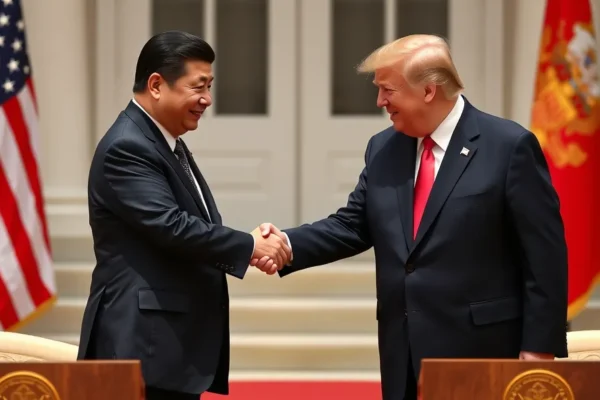
- The Shift: During the Trump administration, some observers noted a change in rhetoric and approach from the U.S. President towards China’s leader, Xi Jinping. Instead of the traditional, sometimes perceived as condescending, U.S. stance, there were instances where President Trump engaged with President Xi in a manner that suggested mutual respect and direct, peer-to-peer interaction. This is what we mean by “perceived equal treatment.” It’s not about whether one country is objectively “better,” but about the signals sent in official interactions.
- State Media Reaction: In China, state media plays a crucial role in shaping public opinion and projecting the government’s narrative both domestically and internationally. When state media, such as Xinhua or the Global Times, reported on interactions between President Trump and President Xi, they often highlighted moments that signaled this perceived diplomatic parity. The implication is that China, under Xi Jinping’s leadership, is commanding the respect it deserves on the global stage. This is a narrative of strength and restored national pride.
For instance, consider the language used. If U.S. state media typically referred to foreign leaders with formal titles and protocols, but President Trump engaged in more informal, yet respectful, direct dialogue with Xi Jinping, Chinese state media would likely amplify these instances. They might frame it as President Trump recognizing Xi Jinping’s stature, and by extension, China’s growing power. This focus serves to bolster the image of China as a major global player that is no longer to be overlooked or treated as a junior partner.
Why This Matters for Global Politics and Your Finances
This isn’t just about a few headlines; the perceived treatment of leaders and the resulting diplomatic atmosphere have tangible effects on global politics and, consequently, on everyday financial lives.
Personal Impact: When major global powers engage in stable, respectful relations, it often translates into a more predictable global economic environment. This predictability can reduce uncertainty for businesses and investors. For individuals, this might mean more stable prices for goods (especially those manufactured in China or relying on US-China trade), more consistent job markets, and less volatility in savings and investment accounts. Conversely, heightened tensions, even if stemming from perceived slights or strong diplomatic stances, can lead to economic disruptions.
Economic Impact: The Sino-US trade relationship is one of the largest bilateral trade relationships in the world. Any friction or perceived disrespect can lead to trade disputes, tariffs, or shifts in supply chains. For example, increased tariffs on goods exchanged between the US and China, which can be a consequence of strained relations or tit-for-tat responses to perceived diplomatic slights, can increase the cost of imported goods for consumers and businesses. This contributes to inflation. Furthermore, shifts in global trade patterns can affect employment in various sectors, both in the US and China, and in countries that are part of their supply chains.
Who Benefits and Who is Affected: A stable and respectful U.S.-China relationship generally benefits the global economy as a whole, fostering trade and investment. Countries that rely heavily on exports to either the U.S. or China, or that are integrated into their supply chains, tend to fare better in such an environment. Conversely, periods of high tension can negatively impact global growth. Specific industries that are heavily exposed to Sino-US trade (like technology, agriculture, and manufacturing) are particularly sensitive. Businesses that adapt quickly to changing trade policies or geopolitical climates may be better positioned than those that do not.
Historical Context and Current Interest
The dynamic between the U.S. and China has evolved dramatically. For decades after the establishment of diplomatic relations in 1979, the relationship was characterized by a U.S. advantage, often referred to as a period of U.S. hegemony in global affairs. China was seen as an emerging economy that was gradually integrating into the global order. However, China’s rapid economic growth and increasing geopolitical influence over the past few decades have fundamentally altered this landscape.
The current interest in how leaders are treated stems from this shift. China, under President Xi Jinping, has increasingly projected an image of strength and equality on the world stage. State media’s reaction to perceived diplomatic parity from the U.S. is a reflection of this evolving national confidence and ambition. President Donald Trump’s foreign policy approach, which often involved direct, transactional diplomacy and challenging existing international norms, created a unique environment where such perceptions of equal treatment could arise. This contrasted with previous administrations that might have adhered more strictly to traditional diplomatic protocols.
For instance, according to the World Bank, China’s GDP grew from approximately $300 billion in 1980 to over $17.7 trillion in 2022, illustrating its immense economic ascent. This economic power naturally translates into greater geopolitical weight, and leaders in China expect to be treated accordingly. The U.S. media and think tanks, as well as global financial analysts, closely watch how these interactions are portrayed and what they signify for future Sino-US trade relations and broader geopolitical stability.
Practical Ways to Think About These Interactions
When news about U.S.-China relations, or the perceived respect between their leaders, emerges, it’s useful to think about it from a broader economic and financial perspective. It’s not just about presidential egos; it’s about signals that can influence global markets.
How to Think About It:
- Look for economic implications: Does the reported interaction suggest a potential for smoother trade negotiations, or does it hint at upcoming trade disputes? If tariffs were previously an issue, is there a likelihood they will be maintained or increased?
- Consider supply chain impacts: If tensions rise, how might that affect the availability and cost of products you rely on? For example, a significant disruption in U.S.-China trade could impact the availability of electronics or clothing.
- Assess market sentiment: Geopolitical stability is a major driver of investor confidence. Positive or negative developments in major power relations can influence stock markets and currency values.
Common Misconceptions: A common misconception is that these high-level interactions are purely symbolic and have no real-world economic consequences. In reality, the perception of respect and equality can influence negotiations, trade agreements, and investment decisions. Another misconception is that individual actions can change this global dynamic. While individual consumer choices do matter, these large-scale geopolitical shifts are driven by government policies and international relations.
What to Watch For: When reading news about Donald Trump’s foreign policy or Xi Jinping’s diplomatic efforts, pay attention to reports on trade volumes, investment flows, and official statements regarding economic cooperation or competition. These often provide more concrete indicators of impact than just the tone of diplomatic exchanges.
One actionable insight is to diversify your investments and savings, as this can help mitigate risks associated with localized economic or geopolitical shocks. Another is to stay informed about global trade policies, as these can directly influence the cost of goods and services you purchase.
Connecting to Other Financial Concepts
Understanding how Chinese state media reacts to perceived diplomatic parity between leaders like Xi Jinping and Donald Trump connects to several other important financial and economic concepts:
- Geopolitical Risk: This refers to the risk that political events or instability in a country or region can negatively affect investment returns or economic activity. The U.S.-China relationship is a significant source of geopolitical risk for global markets.
- Trade Wars and Tariffs: When diplomatic relations sour, countries may impose tariffs (taxes on imported goods) on each other’s products. This directly impacts the cost of goods and can disrupt global supply chains.
- Currency Exchange Rates: The strength or weakness of currencies like the US Dollar and the Chinese Yuan can be influenced by bilateral relations and trade policies, affecting the cost of imports and exports.
- Global Supply Chains: The complex network of companies and processes involved in producing goods and services can be significantly disrupted by geopolitical tensions, impacting availability and prices.
Understanding how international relations impact these factors helps build a more comprehensive financial picture. For instance, learning about currency exchange rates can help you understand how international events might affect the value of your overseas investments or the cost of your next vacation.
Frequently Asked Questions
How does the state media reaction to President Trump and Xi Jinping’s equal treatment affect China US relations?
When Chinese state media highlights perceived equal treatment, it can signal to both domestic and international audiences that China is commanding respect. This can strengthen the government’s position, potentially influencing future negotiations and the overall tone of China US relations by reinforcing China’s expectation of being treated as a peer.
What does ‘diplomatic parity’ mean for President Xi Jinping?
For President Xi Jinping, diplomatic parity means being recognized and treated by global leaders, particularly those of major powers like the United States, as an equal. It signifies national strength, international standing, and the successful assertion of China’s influence on the world stage, a key objective for his leadership.
Can an individual’s financial decisions be impacted by Trump foreign policy and China news?
Yes, individuals’ financial decisions can be impacted. For example, changes in Trump foreign policy or developments in China news might lead to shifts in trade policies, impacting the prices of imported goods, the value of investments in companies exposed to Sino-US trade, or even job market stability.
What are the risks of Sino-US trade tensions, as perceived through media reactions?
The risks of Sino-US trade tensions include increased tariffs, disrupted supply chains, reduced investment, and potential currency fluctuations. These can lead to higher prices for consumers, reduced profitability for businesses, and broader economic slowdowns if not managed effectively.
How has the perception of presidential respect in international diplomacy changed over time regarding China?
Historically, there was often a perception of the U.S. as the dominant power dictating terms. However, as China’s economic and military power has grown, there’s an increased expectation and portrayal, amplified by state media, of Xi Jinping receiving a level of presidential respect and recognition as an equal peer from world leaders, reflecting a shift in global power dynamics.
What should investors watch for in terms of global politics and financial markets related to US-China relations?
Investors should watch for official statements on trade, investment policies, and geopolitical developments between the U.S. and China. Shifts in these areas can signal potential market volatility, changes in commodity prices, and impact the performance of companies with significant exposure to either economy.
Disclaimer: This article is for educational purposes only and does not constitute financial advice. Financial situations vary based on individual circumstances, and it is always recommended to consult with a qualified financial professional for personalized advice. Investing involves risk, and past performance is not indicative of future results.











