

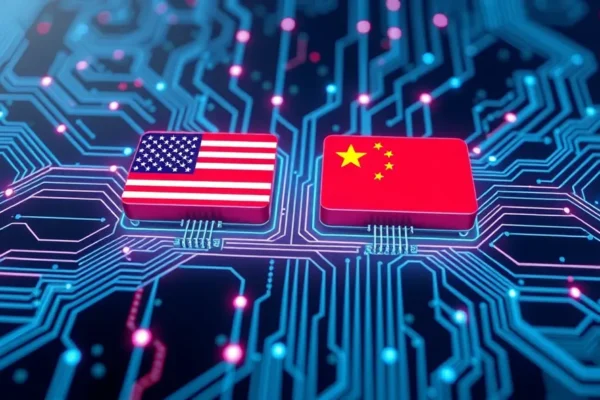
Understanding the US-China Tech Rivalry
At its simplest level, the US-China tech rivalry is a competition between the world’s two largest economies to lead the development of the technologies that will define the future. We are talking about things like artificial intelligence (AI), advanced computer chips, green energy, and 5G networks. This is not just about who makes the best gadget, but about who sets the rules for how the world operates.
Think of this like two massive construction companies competing to build the city of the future. If Company A builds the power grid, the water pipes, and the roads, everyone else in the city has to use Company A’s standards and pay Company A’s fees. If Company B creates a better, cheaper system, the city might switch. The “rivalry” happens when one company tries to stop the other from building, not because their tech is bad, but because they fear losing their position as the boss of the city.
Understanding this is important because these two countries are so deeply connected that a fight between them affects almost everything. From the price of your smartphone to the stability of your retirement fund, the tension in the global tech race ripples through the entire world economy.
How the Tech Race Works in Practice
To understand the argument made by Yu Tiejun, a scholar at Peking University, we first have to understand a concept called “tech securitization.” Securitization is when a government stops looking at a product as a simple tool for trade and starts seeing it as a threat to national security.
Imagine a scenario: Company A in the US makes a very powerful computer chip. Normally, they would sell this chip to Company B in China to make a profit. This is a standard economic transaction. However, if the US government decides that this chip could be used to build advanced weapons, they might ban the sale. This is tech securitization. The chip is no longer just a product; it is now a “security asset.”
Yu Tiejun argues that Washington’s approach is based on a “zero-sum game.” In a zero-sum game, one person can only win if the other person loses. If China becomes better at AI, Washington fears the US must be becoming weaker. Yu suggests this is a mistake. He argues that technological progress is not a limited pie. Instead, he believes that China’s growth is a natural result of economic development and that the US fear of losing “technological dominance” is misplaced because it ignores how interdependence actually works.
Think of it like two athletes training in the same gym. One athlete believes that if the other gets faster, it means they are falling behind. The other athlete believes that having a fast partner pushes them both to break world records. Yu Tiejun is suggesting that the US is viewing the relationship as a fight for a trophy, while the reality should be about mutual advancement.
Why This Rivalry Matters to Your Money
You might think that a debate between a professor at Peking University and policymakers in Washington is just academic theory, but it has real-world financial impacts.
Personal Financial Impact
- Consumer Prices: When the US and China place tariffs (taxes on imported goods) on each other’s tech, the cost of those goods goes up. If a company cannot buy a cheap chip from China, they might charge you more for your laptop or electric car to cover the cost of finding a more expensive supplier.
- Investment Risks: Many people have 401k plans or stock portfolios that include tech giants like Apple, NVIDIA, or Tencent. If US-China relations sour, these companies may lose access to huge markets or raw materials, which can cause their stock prices to drop.
Economic Impact
- Inflation: When supply chains are broken because of geopolitical competition, goods become scarce. Scarcity usually leads to inflation, which means your money buys less than it used to.
- Job Markets: As companies move factories out of China to avoid political risk (a process called “de-risking”), new jobs are created in some countries, but old jobs are lost in others.
In short, the winners are often companies that can provide “neutral” alternatives or those that successfully move their production to safe zones. The losers are typically consumers who face higher prices and investors who are caught in the middle of a trade war.
The History of the Tech Competition
For several decades, the US and China followed a policy of “engagement.” The idea was that if China became a major part of the global trade system, it would naturally adopt international norms and become a stable partner. This worked well for economic growth, as China became the “world’s factory” and the US became the world’s primary designer and consumer of tech.
However, around 2017 and 2018, the tone changed. The US government began to express concerns that China was using “forced technology transfers” (requiring foreign companies to share their secrets to do business in China) to catch up too quickly. This triggered a shift toward the current Washington policy of restriction and containment.
According to data from various trade monitors, the US has significantly increased the number of Chinese firms on its “Entity List,” which limits their ability to buy US technology. This shift was triggered by the realization that technology is no longer just about making money, but about who controls the data and the infrastructure of the 21st century.
Practical Implications for Your Financial Life
When you see headlines about the US-China tech rivalry, you do not need to panic, but you should think critically about how it affects your financial habits.
Common Misconceptions
- Misconception: “The US and China will completely stop trading (decoupling).”
- Correction: Complete decoupling is nearly impossible because their economies are too intertwined. Instead, they are “de-risking,” which means they are trying to rely less on each other for critical items like medicine or high-end chips.
What to Watch For
Keep an eye on “export controls.” When the government restricts what can be sold to another country, it is a sign that tech securitization is increasing. This often leads to short-term volatility in tech stocks.
Actionable Insights
- Diversify Your Holdings: If your investments are heavily concentrated in one country’s tech sector, you are more vulnerable to political shocks. Diversifying across different regions can help balance this risk.
- Monitor Supply Chain News: If you are looking to invest in a specific company, check where they get their parts. A company that relies on a single source in a high-conflict zone is riskier than one with a diverse supply chain.
Related Financial Concepts
To get a deeper understanding of this topic, it helps to look at other economic ideas. Understanding Protectionism helps here, as it explains why governments put up barriers to protect local industries from foreign competition.
Another related concept is Globalization. The current tech race is essentially a challenge to the era of globalization, where the goal was to find the cheapest place to make things regardless of borders. Now, “resilience” (the ability to survive a disruption) is becoming more important than “efficiency” (the ability to make things as cheaply as possible).
Common Questions About the Tech Race
How does the US-China tech rivalry affect inflation?
When countries restrict trade or move factories to more expensive locations to avoid political risk, the cost of production rises. These costs are usually passed on to the consumer, which can lead to higher prices for electronics and appliances.
Can individuals control the risks of this geopolitical competition?
You cannot control the policies of governments, but you can control your exposure. Diversifying your investments and avoiding over-reliance on a single market are the best ways to manage the risk.
What are the biggest risks of tech securitization?
The biggest risk is a “splinternet,” where the world ends up with two different versions of the internet and technology—one led by the US and one by China. This would make global communication and business much more difficult and expensive.
Why does Yu Tiejun think Washington is wrong?
He argues that the US is acting on fear rather than logic. He believes that China’s technological rise is an inevitable part of its growth and that trying to block it will only accelerate China’s drive to be self-sufficient, ultimately hurting US companies.
Who benefits from the current US-China economic relations tension?
Third-party countries often benefit. For example, countries like Vietnam, India, and Mexico have seen increased investment as companies move their manufacturing away from China to avoid US tariffs.
Disclaimer: This article is provided for general educational purposes only and does not constitute personal financial, investment, or legal advice. Financial situations vary based on individual circumstances; please consult a certified professional for advice tailored to your specific needs. We do not guarantee any specific financial outcomes resulting from the information provided here.











