

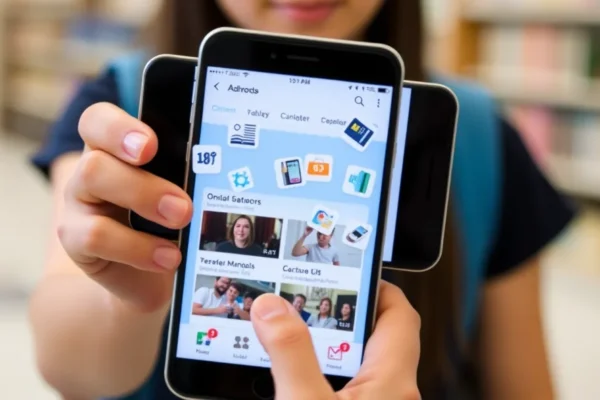
From Static Pages to Dynamic Feeds
For decades, the cornerstone of the educational experience has remained remarkably unchanged: the textbook. Whether it is a heavy, physical volume or a static PDF on a tablet, the medium relies on linear reading and long-form text to convey complex ideas. However, as student attention spans shift and digital habits evolve, a growing gap has emerged between how information is presented and how modern learners consume media. This is the problem that ScrollEd aims to solve.
Recently highlighted at TechCrunch Disrupt, ScrollEd is an edtech startup that is attempting to bridge this gap by reimagining the very structure of educational content. Instead of forcing students to navigate hundreds of pages of dense prose, the educational technology platform transforms traditional curricula into highly engaging, short-form video feeds. It essentially takes the structural logic of social media platforms and applies it to academic rigor.
The significance of this development lies in its timing. We are currently witnessing a massive shift in how information is processed. With the rise of platforms like TikTok and YouTube Shorts, a generation of students has become accustomed to “snackable” content—information delivered in quick, high-impact bursts. ScrollEd is not merely trying to make learning “fun”; it is attempting to align digital textbooks with the cognitive habits of the modern learner, turning passive reading into active, continuous engagement.
The Mechanism of Micro-Learning
To understand how ScrollEd operates, one must look past the visual interface and focus on the concept of micro-learning. Micro-learning is an instructional design approach that breaks down complex topics into small, manageable units. In a traditional setting, a chapter on cellular biology might take forty minutes to read and several hours to fully digest. On ScrollEd, that same chapter is broken into a series of 60-to-90-second video modules.
Think of it like the difference between watching a three-hour documentary and watching a series of curated clips on a social media feed. In the documentary, you are committed to a long, linear journey. With the clips, you can consume information in bursts, jumping between related concepts through an algorithmic feed that suggests the next logical step in your learning journey. This creates a sense of interactive learning where the student is constantly prompted by new, relevant content.
The core mechanism involves three technical layers. First, there is the content decomposition layer, where academic material is scripted into short-form modules. Second, there is the delivery engine, which uses a “scroll” mechanic to present these videos. Finally, there is the personalized learning layer. Much like a social media algorithm learns what you like, ScrollEd’s platform tracks which concepts a student struggles with or excels at, adjusting the feed to provide more reinforcement or more advanced challenges. This turns a static syllabus into a living, breathing e-learning platform.
Where ScrollEd Stands Today
At present, ScrollEd is in the early adoption phase. While it has gained significant traction following its appearances at major technology showcases, it is not yet a universal replacement for traditional curricula. The platform is currently being piloted in specific higher education segments and specialized high school programs where subject matter can be easily visualized through video, such as biology, history, and introductory physics.
The availability of the platform is primarily through institutional partnerships. Rather than being a consumer app that any student can download to replace their school books, it is being integrated as a supplemental study tool for universities and private educational institutions looking to boost student engagement. This “B2B” (business-to-business) approach allows the startup to ensure that the content being scrolled is academically vetted and aligned with specific course objectives.
While the technology is functional, we are seeing it move from the “proof of concept” stage into a more robust beta phase. The focus for the company right now is not just on the interface, but on the scalability of the content production—ensuring they can convert massive amounts of text into high-quality video without losing the depth required for university-level study.
The Battle for the Digital Classroom
ScrollEd does not exist in a vacuum. It enters a crowded marketplace occupied by two very different types of competitors. On one side are the “Legacy Giants,” such as Pearson and McGraw Hill. These companies have dominated the market for decades with massive catalogs of digital textbooks. Their advantage is their sheer scale and established relationships with school boards and universities. However, their digital offerings often feel like “digitized paper”—essentially PDFs with a few interactive quizzes tacked on—which lacks the native engagement of a video-first platform.
On the other side are the “Video Educators,” such as Khan Academy and Coursera. These platforms have mastered the art of online instruction through long-form video lectures. While highly effective, these platforms still follow a somewhat traditional, linear structure. They require a high level of student discipline to sit through a ten-minute lecture. They are “libraries” of knowledge, whereas ScrollEd is positioning itself as a “feed” of knowledge.
The competitive advantage of ScrollEd lies in its middle-ground approach. It aims to provide the academic depth of a textbook with the high-retention, low-friction delivery of social media. By focusing on the “scroll” rather than the “search,” it removes the cognitive barrier of deciding “what to learn next,” a common pain point in traditional e-learning platforms.
A Shift in How We Process Knowledge
The widespread adoption of platforms like ScrollEd could lead to profound shifts in both the economy of education and the sociology of learning. Economically, we may see a move away from the “one-size-fits-all” textbook model. If content can be modularized into video units, the publishing industry might shift toward a subscription-based model where institutions pay for access to dynamic “content streams” rather than individual, static books. This could lower long-term costs for students but will require a complete overhaul of how academic intellectual property is managed.
Socially, the implications are more complex. On the positive side, this technology could democratize high-quality instruction. If a student in a remote area can access a high-engagement, visually rich feed of the world’s best science explanations, the “quality gap” in education may begin to close. It also addresses the reality of modern attention spans, potentially reducing the frustration and “disengagement” that often leads to students dropping out of online courses.
In the short term, we will likely see this technology used as a powerful supplement to traditional classroom settings. In the long term, if the efficacy of micro-learning is proven through large-scale longitudinal studies, we may see the “textbook” as a concept become obsolete, replaced by personalized, AI-driven learning feeds that evolve alongside the student.
The Hurdles of Short-Form Education
Despite its potential, ScrollEd faces significant technical and pedagogical challenges. The most immediate bottleneck is the “Content Production Problem.” Creating a high-quality textbook is difficult, but creating thousands of high-quality, pedagogically sound short-form videos is an order of magnitude harder and more expensive. If the videos are low-quality or poorly scripted, the platform risks becoming “edutainment”—content that is engaging but lacks the depth necessary for true mastery.
There is also the “Dopamine vs. Depth” debate. Critics argue that the very mechanism that makes social media addictive—the rapid-fire delivery of information—is antithetical to deep, contemplative learning. There is a risk that students may develop a “surface-level” understanding of topics, feeling as though they have mastered a subject because they have scrolled through a dozen videos, while lacking the ability to synthesize complex, interconnected ideas in a written format.
Finally, there are adoption barriers. Traditional academic institutions are notoriously slow to change. Convincing professors to move away from established curricula and toward a new, experimental platform requires not just technological proof, but clinical evidence that video-feed learning leads to better exam scores and long-term retention. Until that data is undeniable, widespread mainstream adoption will remain a challenge.
The Roadmap Ahead
The trajectory of ScrollEd and similar technologies will likely be defined by the integration of Artificial Intelligence. Currently, the human cost of producing video is high. However, the next major milestone for this sector will be the development of AI-driven content synthesis. Imagine a system where a professor uploads a research paper, and an AI automatically generates a series of high-quality, narrated, and visually animated short-form videos that fit the ScrollEd format.
If this becomes possible, the scalability of educational technology will explode. We can expect to see further developments in “active” video, where the video feed pauses to ask the user a question or requires them to manipulate a 3D object on their screen before they can continue scrolling. This would merge the “passive” nature of scrolling with the “active” requirements of learning.
Within the next three to five years, we should watch for more large-scale pilot programs in major university systems. The success or failure of these programs will determine whether ScrollEd remains a niche tool for specific subjects or becomes the foundation of a new era in digital education.
Frequently Asked Questions
Is ScrollEd just a more expensive version of YouTube?
No. While YouTube has educational content, it lacks the structured, curriculum-aligned framework of ScrollEd. ScrollEd is designed as a specialized e-learning platform where every video is a vetted piece of a larger academic puzzle, specifically designed to meet learning objectives rather than just providing general information.
Will this technology replace traditional teachers?
The current trajectory suggests that ScrollEd is a tool to augment, not replace, educators. It handles the delivery of foundational facts and concepts through short-form video education, freeing up teachers to focus on high-level discussion, mentorship, and complex problem-solving with their students.
Does “scrolling” actually help with deep learning?
This is a subject of ongoing research. While micro-learning is excellent for retention of discrete facts and concepts, educators are still studying how to ensure that “snackable” content translates into the deep, systemic understanding required for advanced academic work.
Who benefits most from this edtech startup?
Initially, students who struggle with traditional reading-heavy formats and institutions looking to increase student engagement benefit most. In the long run, the entire educational ecosystem could benefit from more flexible, personalized, and scalable ways to deliver knowledge.
Is the platform ready for mainstream use?
ScrollEd is currently in an early adoption and beta phase. While it is available through specific institutional partnerships, it is not yet a mainstream product available to the general public as a total replacement for traditional schooling.
Note: The analysis provided is based on current technological trends and the specific development profile of emerging edtech startups. Future outcomes are subject to changes in pedagogical research and market adoption.











