

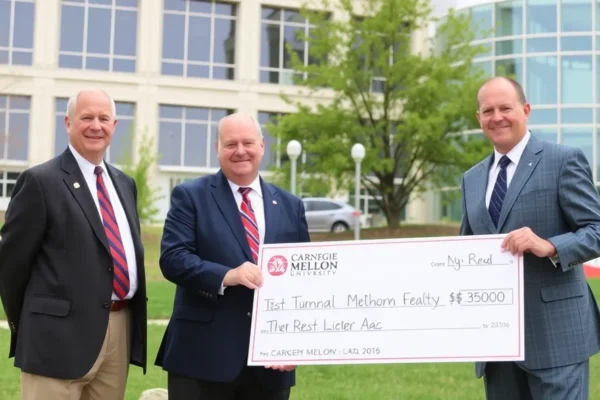
A Landmark Philanthropic Investment in Higher Education
Billionaire hedge fund manager Ken Griffin has committed a monumental $3 billion to Carnegie Mellon University (CMU). This significant university donation, announced in early 2023, represents one of the largest single gifts to an American university and is earmarked for substantial expansion and the establishment of a new campus in Miami. The investment signals a major play in the landscape of higher education funding and educational expansion, particularly in the burgeoning technology and innovation sectors.
Strategic Vision: Expanding Horizons and Fostering Innovation
The strategic rationale behind Ken Griffin’s substantial university donation is multifaceted. CMU, a globally recognized leader in computer science and engineering, aims to leverage this funding to accelerate its research and educational initiatives. The planned expansion will focus on key areas such as artificial intelligence, quantum computing, and biomedical engineering, fields that are increasingly critical for future economic growth and societal advancement. The establishment of a new Miami campus is a particularly ambitious element of this strategy. It represents a move to tap into a rapidly growing metropolitan area with a burgeoning technology scene and a diverse talent pool, while also diversifying CMU’s geographic footprint. This aligns with a broader trend of universities seeking to establish presences in new economic hubs to attract students and researchers and foster industry partnerships.
Competitive Landscape: A New Frontier for Higher Education
Ken Griffin’s investment positions Carnegie Mellon for a significant competitive advantage. In the fiercely competitive landscape of higher education, particularly for top-tier STEM talent and research funding, this infusion of capital allows CMU to outpace many rivals. While other universities also receive substantial philanthropic gifts, the sheer scale of Griffin’s donation enables CMU to undertake transformative projects that others might only dream of. The Miami campus development directly competes for talent and attention with existing and emerging institutions in Florida and beyond, including those in the broader tech ecosystem that has historically been dominated by Silicon Valley. This move could inspire similar large-scale philanthropic efforts from other major donors and alumni towards their alma maters, intensifying the competition for resources and influence.
Industry Trends: The Rise of Philanthropic Power and Geographic Diversification
This development underscores several critical trends within the higher education industry. Firstly, it highlights the increasing reliance on significant philanthropic funding to drive ambitious research and expansion projects. Universities are actively cultivating relationships with major donors to secure the resources needed to remain at the forefront of innovation. Secondly, the creation of a new Miami campus reflects a growing pattern of geographic diversification among leading academic institutions. As tech hubs emerge and expand across the United States, universities are recognizing the strategic imperative to establish a physical presence in these areas to access new talent pools, forge industry connections, and cater to a broader student demographic. The significant university donation by Griffin to Carnegie Mellon and its expansion plans, especially into Florida, signals a potential shift in the traditional concentration of elite academic institutions.
Financial and Operational Implications: Long-Term Growth and Strategic Investment
The $3 billion university donation from Ken Griffin represents a long-term investment with profound financial and operational implications for Carnegie Mellon. While the immediate impact is an injection of capital, the long-term financial benefits are expected to stem from enhanced research output, increased grant funding, and potentially higher enrollment and endowment growth. Operationally, the expansion will require significant investment in infrastructure, faculty recruitment, and administrative support. The development of the Miami campus, in particular, will involve substantial upfront costs for land acquisition, construction, and the establishment of new academic programs. While direct revenue from tuition will play a role, the primary financial driver of this initiative is the strategic cultivation of CMU’s reputation, research capabilities, and its ability to attract future funding and talent. The timeline for realizing significant financial returns on this investment will be long, likely spanning decades, as the new programs and campus mature.
Execution Risks and Challenges: From Vision to Reality
Despite the optimistic outlook, the execution of such an ambitious strategy is fraught with risks and challenges. The sheer scale of the $3 billion university donation means that meticulous planning and management are paramount. Key execution risks include potential cost overruns in construction and operational setup for the Miami campus, delays in securing necessary permits and approvals, and challenges in attracting and retaining top-tier faculty and students to a new location. Furthermore, the success of expanding into new technological frontiers like quantum computing relies heavily on breakthroughs that are inherently unpredictable. Historically, large-scale university expansions have faced hurdles, from community relations issues to difficulties in replicating the unique culture and research synergy of established campuses. Carnegie Mellon will need robust project management and adaptability to navigate these potential pitfalls. Market volatility, while perhaps less direct, could also impact the university’s broader financial health and its ability to sustain long-term operational commitments.
Stakeholder Implications: Shaping the Future of Education and Talent
This landmark university donation and expansion will have wide-ranging implications for various stakeholders. For current and prospective students, it promises access to cutting-edge programs and enhanced research opportunities, particularly in emerging fields. Faculty will benefit from increased research funding and the potential for new academic positions and collaborative environments. For the city of Miami, the arrival of a prestigious institution like Carnegie Mellon could catalyze its growth as a technology and innovation hub, attracting talent and investment. Investors in the technology sector may see this as a positive development, signaling a continued commitment to fostering the innovation ecosystem that drives future technological advancements. However, the organizational culture at CMU will need to adapt to accommodate significant growth and the integration of a new campus, ensuring that the university’s core values are maintained.
Outlook and Next Steps: Building a Legacy of Innovation
If Carnegie Mellon successfully executes this strategy, the long-term outlook is one of enhanced global standing and leadership in critical technological fields. Key milestones to watch will include the progress of construction and faculty recruitment at the new Miami campus, the launch of new research initiatives in AI and quantum computing, and the success in securing external research grants and partnerships. Within five to ten years, analysts will be looking for measurable increases in CMU’s research output and citations in these key areas, as well as the successful establishment of a vibrant academic community in Miami. The ultimate measure of success will be CMU’s continued contribution to technological innovation and its role in shaping the next generation of leaders in science and technology.
Key Questions and Answers
Will Ken Griffin’s $3 billion donation to Carnegie Mellon University lead to a significant shift in the US higher education landscape?
This substantial university donation provides Carnegie Mellon with a powerful advantage for expansion and innovation, potentially elevating its position further and inspiring similar large-scale philanthropic efforts at other institutions, thereby reshaping competitive dynamics.
Why did Ken Griffin choose to focus on Carnegie Mellon and its expansion, including a Miami campus?
Griffin’s choice likely stems from CMU’s established strength in technology and engineering, aligning with his investment focus. The Miami campus strategy pursues opportunities in a growing economic hub and diversifies the university’s reach, addressing both institutional growth and market expansion.
What are the primary strategic goals of Carnegie Mellon’s planned expansion and new Miami campus?
The primary goals are to accelerate research in critical fields like AI and quantum computing, expand the university’s geographic reach to tap into new talent and markets, and solidify its reputation as a leading institution in technological innovation.
How does the development of a Miami campus by Carnegie Mellon impact other universities in Florida?
The establishment of a major research university like CMU in Miami will intensify competition for students, faculty, and research funding with existing Florida institutions, potentially spurring them to enhance their own STEM programs and innovation initiatives.
What are the potential financial risks associated with this large-scale educational expansion and new campus development?
The key financial risks include significant upfront capital expenditure for construction, potential cost overruns, challenges in achieving projected enrollment and research funding targets for the new campus, and the long-term operational costs of maintaining two major campuses.
How long will it likely take to see the tangible results of this university donation and expansion from Ken Griffin?
Tangible academic and research outcomes from this university donation and expansion will take several years to materialize, with significant impacts on CMU’s research output and global standing potentially visible over a decade or more, as the new initiatives mature.
Business outcomes are subject to execution risk and market conditions.











