

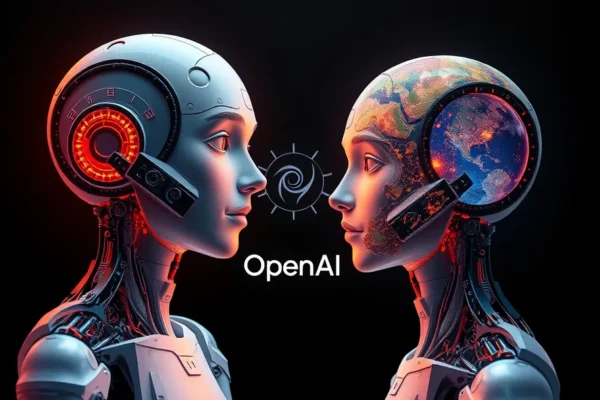
Introducing OpenAI’s Next Leap in Artificial Intelligence GPT-6 Sol and Luna
The world of artificial intelligence is constantly evolving, and recent announcements from OpenAI have once again captured global attention. The company, a leader in the field of generative AI and large language models, has unveiled details about its next generation of AI models: GPT-6 Sol and GPT-6 Luna. These new models promise to build upon the capabilities of their predecessors, offering enhanced performance, increased cost-efficiency, and significantly reduced error rates. This development marks a significant step forward in the ongoing AI innovation race, suggesting a future where artificial intelligence can perform complex tasks with greater reliability and accessibility.
Understanding the Core Innovations of GPT-6 Sol and Luna
At its heart, the innovation behind OpenAI’s GPT-6 Sol and GPT-6 Luna lies in a refined approach to how these large language models process and generate information. While OpenAI has not yet released exhaustive technical specifications for these specific models, based on their consistent advancements in machine learning, we can infer key improvements. These models are designed to understand and generate human-like text, but with a new emphasis on accuracy and efficiency. The goal is to make AI more practical and dependable for a wider range of applications.
Think of previous AI models like exceptionally gifted students who could write brilliant essays but sometimes made factual errors or took a very long time to complete assignments. GPT-6 Sol and Luna are being developed to be not only equally brilliant but also more meticulous and faster. This means they can handle more intricate instructions and produce outputs that are more aligned with factual reality, thereby solving the problem of AI-generated misinformation and unreliability.
How GPT-6 Sol and Luna Aim to Revolutionize AI Performance
The core mechanism driving the improvements in GPT-6 Sol and Luna likely involves advancements in several key areas of machine learning. One significant factor is the refinement of the model’s architecture, potentially incorporating new techniques for attention mechanisms and knowledge retention. This allows the AI to better focus on relevant information within vast datasets and recall it more accurately when generating responses.
Another crucial aspect is the improved training methodology. OpenAI has historically invested heavily in creating massive, diverse datasets for training its models. For GPT-6 Sol and Luna, it’s expected that the training data will be more curated for factual accuracy, and sophisticated error correction techniques will be integrated directly into the learning process. This is akin to a student not just reading textbooks but also having a dedicated tutor who points out and corrects every mistake, reinforcing correct understanding.
Regarding cost-efficiency, these advancements are crucial. Training and running large language models are computationally intensive and thus expensive. By making the models more efficient in their processing, OpenAI aims to reduce the computational resources required, which translates to lower operational costs for developers and end-users alike. This democratizes access to powerful AI capabilities.
Furthermore, the reduction in error rates is a critical feature. Previous generative AI models, while impressive, could sometimes “hallucinate” or generate plausible-sounding but incorrect information. The focus on reduced error correction in GPT-6 Sol and Luna suggests a move towards greater factual grounding and reliability, making them suitable for more critical applications where accuracy is paramount.
The Current State and Emerging Real-World Applications
While GPT-6 Sol and Luna are part of OpenAI’s forward-looking roadmap, the principles they embody are already influencing the development and deployment of generative AI. The push for more efficient, accurate, and cost-effective AI is a trend across the industry. We are seeing these advancements being applied in various sectors:
- Content Creation: Businesses are using AI to generate marketing copy, blog posts, and even scripts, with a growing demand for accuracy and originality.
- Customer Service: AI-powered chatbots are becoming more sophisticated, able to handle complex queries with fewer errors, leading to improved customer satisfaction and reduced support costs.
- Software Development: AI tools are assisting developers in writing code, debugging, and documenting, accelerating the software development lifecycle.
- Research and Analysis: Researchers are leveraging AI to sift through vast amounts of data, identify patterns, and summarize findings, potentially speeding up scientific discovery.
OpenAI’s previous models, like GPT-4, are already in widespread use through APIs and integrated into numerous applications. The forthcoming GPT-6 Sol and Luna models are expected to offer a significant upgrade, moving from early adoption to more mainstream integration as they become fully available, likely through phased rollouts to enterprise clients and developers first.
The Competitive Landscape in Large Language Models
The field of advanced AI and large language models is highly competitive. OpenAI’s work with GPT-6 Sol and Luna is happening in parallel with significant developments from other major tech players and research institutions. Companies like Google (with its Gemini models), Anthropic (with its Claude series), and Meta (with its Llama models) are all pushing the boundaries of AI capabilities.
Each of these approaches has its own strengths. Google’s Gemini, for instance, is designed to be natively multimodal, understanding and operating across text, images, audio, video, and code. Anthropic’s Claude models have often emphasized safety and ethical considerations in their design. Meta’s Llama models have seen success with their open-source approach, fostering broad community development.
OpenAI’s advantage with GPT-6 Sol and Luna lies in its established track record of pushing the performance envelope and its strong ecosystem of developers who build on its platforms. The focus on cost-efficiency and drastically reduced error rates, if realized, could be a significant differentiator, especially for businesses looking for reliable AI solutions that don’t break the bank. The “Astra models,” another term sometimes associated with advanced AI development, also represent the broader industry’s pursuit of more capable AI, and the competition spurs innovation across the board.
Implications and Impact Across Industries
The successful deployment of GPT-6 Sol and Luna has the potential to reshape industries and redefine how we interact with technology. The promise of more accurate and cost-effective AI could lead to:
- Accelerated Innovation: Businesses will be able to experiment with and deploy AI solutions more rapidly and affordably, leading to faster product development and service improvements.
- Enhanced Productivity: Automation of complex tasks, from writing intricate reports to analyzing financial data, could free up human workers to focus on more strategic and creative endeavors.
- New Business Models: The availability of powerful, reliable AI could spawn entirely new industries and services built around AI-driven capabilities.
- Democratization of Expertise: Complex analytical or creative tasks that once required specialized human expertise could become accessible to a broader range of individuals and small businesses.
In the short term, we can expect to see these models being integrated into existing platforms and workflows, offering incremental improvements. In the long term, the impact could be transformative, fundamentally altering how knowledge work is done, how businesses operate, and even how individuals learn and create.
Addressing the Limitations and Ongoing Challenges
Despite the exciting potential of GPT-6 Sol and Luna, it’s crucial to acknowledge the limitations and challenges that remain. Even with significant advancements in error correction, AI models are not infallible. Hallucinations, while reduced, may still occur, especially when dealing with novel or ambiguous information.
The cost of developing and deploying such advanced models, even with efficiency improvements, remains substantial. This can create a barrier to entry for smaller organizations. Furthermore, ethical considerations, such as potential biases in training data, the responsible use of AI, and the impact on employment, are ongoing challenges that require careful management and robust regulatory frameworks.
The complexity of the underlying technology also means that understanding and controlling AI behavior can be difficult. Ensuring transparency and explainability in AI decision-making is a critical area of research. The timeline for widespread adoption also depends on factors like regulatory approval, the development of user-friendly interfaces, and public trust.
The Future Trajectory of GPT-6 and Beyond
The development of GPT-6 Sol and Luna signals a clear direction for the future of artificial intelligence: greater sophistication, enhanced reliability, and increased accessibility. We can anticipate continued advancements in several key areas:
- Multimodality: Future models will likely become even more adept at understanding and generating information across various formats, including text, images, audio, and video, in a seamlessly integrated way.
- Personalization: AI will become more tailored to individual user needs and preferences, offering truly personalized experiences in education, entertainment, and productivity.
- Embodied AI: We may see AI increasingly integrated into physical systems and robotics, enabling more intelligent and autonomous machines.
- Specialized Models: Beyond general-purpose models, there will likely be a growing development of highly specialized AI models trained for specific industries or complex scientific domains.
OpenAI’s roadmap suggests a continuous cycle of research, development, and refinement, with each iteration building upon the successes and lessons learned from the last. The exact timeline for future breakthroughs is always subject to the unpredictable nature of scientific discovery, but the current trajectory points towards a rapid acceleration of AI capabilities.
Key Questions and Answers About OpenAI GPT-6 Sol and Luna
What are OpenAI’s new AI models, GPT-6 Sol and GPT-6 Luna?
GPT-6 Sol and GPT-6 Luna are the next generation of large language models being developed by OpenAI, aiming to offer significant improvements in performance, cost-efficiency, and accuracy over previous models like GPT-4. These models are part of OpenAI’s ongoing AI innovation.
How do these new AI models improve upon existing technology?
The primary improvements are expected in reduced error rates, meaning outputs will be more factually accurate and reliable, and increased cost-efficiency, making powerful AI more accessible by lowering computational requirements. This is achieved through refined machine learning techniques and training methodologies.
When will GPT-6 Sol and Luna be available?
OpenAI has not yet provided a specific public release date for GPT-6 Sol and Luna. Typically, such advanced models undergo extensive testing and are phased in, often starting with enterprise partners and developers before broader public access. Availability will likely be a gradual process.
What are the main benefits of increased cost-efficiency and reduced error rates?
Increased cost-efficiency means that more businesses and individuals can afford to use advanced AI, democratizing access. Reduced error rates lead to more trustworthy AI outputs, making them suitable for critical applications where accuracy is paramount, thereby improving reliability in generative AI tasks.
Who are OpenAI’s main competitors in the development of large language models?
Key competitors include Google with its Gemini models, Anthropic with its Claude series, and Meta with its Llama models. These companies are all actively engaged in AI innovation and developing advanced artificial intelligence capabilities.
What are the potential risks or limitations associated with these new AI models?
Despite advancements, limitations like potential biases in data, the possibility of residual errors, and ethical concerns surrounding AI deployment remain. Ensuring responsible use, transparency, and addressing societal impacts are ongoing challenges for all new AI models, including those from OpenAI.
Please note that information regarding specific features, release dates, and performance benchmarks for GPT-6 Sol and GPT-6 Luna is based on OpenAI’s stated development directions and industry expectations. The actual capabilities and timelines may evolve as the research and development process continues.











