

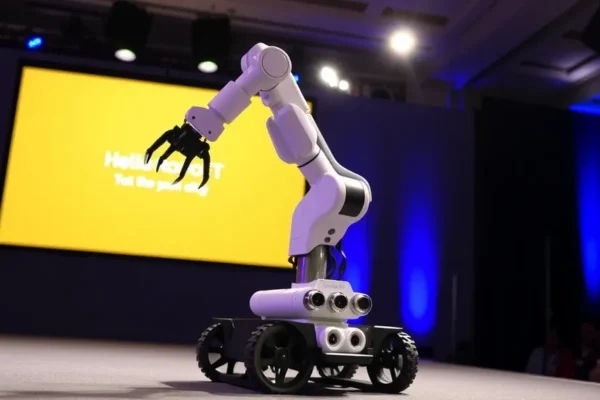
Hello Robot’s Stretch 4 Takes the Stage at TechCrunch Disrupt 2026
The future of artificial intelligence isn’t just in abstract algorithms and cloud computations; it’s increasingly found in physical form, capable of interacting with our world. At TechCrunch Disrupt 2026, the spotlight shone brightly on Hello Robot’s Stretch 4 mobile manipulator, showcasing a significant leap forward in making sophisticated robots accessible and practical for real-world tasks. Robot CEO Aaron Edsinger presented a compelling live demonstration on the Real World AI Stage, illustrating the robot’s capabilities and its potential to redefine automation.
The Innovation: Bringing Dexterous Robotics Out of the Lab
For years, advanced robotics has largely resided in controlled environments – factories, research labs, and highly specialized industrial settings. The core innovation with Hello Robot’s Stretch 4 is its design philosophy: to create a truly adaptable and user-friendly mobile manipulator capable of performing a wide range of tasks in less structured environments, like homes, offices, and retail spaces. This addresses a long-standing gap in robot technology, where the complexity and cost of existing systems have limited their widespread adoption beyond highly repetitive industrial applications.
The significance of this demonstration at TechCrunch Disrupt 2026 lies in its timing. As AI continues its rapid advancement, the demand for robots that can translate these intelligent capabilities into physical actions is growing. Hello Robot, with its focus on practical utility and intuitive control, is positioning itself at the forefront of this emerging wave of robotics innovation.
How the Stretch 4 Works: More Than Just a Movable Arm
At its heart, the Stretch 4 is a mobile manipulator. This means it’s not just a stationary robotic arm; it’s an arm mounted on a mobile base, allowing it to move around its environment. Think of it like giving a highly skilled worker both incredibly precise hands and the ability to navigate freely around a warehouse or a home. The mobile base, equipped with wheels and sensors, allows the robot to travel from one task location to another. This mobility is crucial for performing complex sequences of actions that might involve picking up an item in one place and then moving to another to deposit it.
The robotic arm itself is designed for dexterity. It features a long, slender form factor, allowing it to reach into tight spaces and over obstacles, much like a human might stretch to reach a shelf. Edsinger highlighted the robot’s ability to grasp a variety of objects, from delicate items to larger packages. This is achieved through sophisticated end-effectors (the robot’s “hand”) and advanced sensing, enabling it to adjust its grip based on the object’s shape and texture. The AI capabilities come into play in how the robot plans its movements and interacts with its surroundings, interpreting commands and adapting to minor changes in its environment.
Current State and Real-World Applications: From Labs to Lifestyles
While the robot demo at TechCrunch Disrupt 2026 showcased its potential, Hello Robot’s Stretch platform has already seen early adoption. The company has been working with research institutions and companies interested in exploring its utility. Current applications are primarily in research and development settings, where scientists are testing its capabilities for tasks such as assisting individuals with mobility challenges, performing simple household chores, or aiding in logistics and inventory management in smaller-scale operations.
For instance, researchers at institutions like MIT have utilized earlier versions of the Stretch platform to develop new algorithms for robot manipulation and navigation. The potential for wider deployment is significant, with envisioned uses in areas like elder care, where a robot could assist with fetching items or providing companionship, or in retail, where it could manage inventory or assist customers. The Stretch 4 is currently available for purchase by researchers and developers, with broader commercial availability planned as the technology matures and production scales up.
The Competitive Landscape: A Crowded but Evolving Field
The field of robot technology, particularly mobile manipulation, is highly competitive. Major players in industrial automation, such as KUKA and ABB, offer robust robotic arms, but often within fixed industrial footprints. Companies like Boston Dynamics, known for their agile legged robots, are also exploring mobile manipulation, albeit with a different locomotion approach. Universal Robots has made strides in collaborative robots, designed to work alongside humans, but typically with less mobility than the Stretch 4.
Hello Robot’s unique advantage lies in its focused approach on creating a versatile, relatively affordable, and easy-to-integrate mobile manipulator for less structured environments. The Stretch 4 differentiates itself by balancing mobility, reach, and dexterity in a package that is more accessible than many high-end industrial robots. While competitors may offer greater raw power or specialized capabilities, Hello Robot’s emphasis on user-friendliness and broad applicability is a key differentiator in the race towards practical, everyday robotics.
Implications and Impact: Reshaping Work and Home Life
The widespread adoption of robots like the Stretch 4 could have profound implications across multiple sectors. In healthcare and elder care, these robots could alleviate pressure on caregivers, enabling individuals to maintain independence for longer. In retail and logistics, they could automate repetitive tasks, freeing up human workers for more complex customer-facing roles or strategic planning. The rise of the AI robot could also democratize access to advanced automation for small and medium-sized businesses that cannot afford the massive upfront investment of traditional industrial robotics.
Economically, this could lead to increased productivity and new service industries centered around robot operation and maintenance. Socially, the benefits include enhanced quality of life for individuals needing assistance and potentially more engaging work for humans. However, it also raises important questions about job displacement and the ethical integration of robots into our daily lives, considerations that are central to discussions about the future of AI.
Limitations and Challenges: The Hurdles Ahead
Despite its impressive capabilities, the Stretch 4, like all emerging robotics, faces significant limitations. Navigating highly dynamic or unpredictable environments remains a challenge for most robots; a cluttered living room or a busy sidewalk presents far more complex obstacles than a structured factory floor. Grasping and manipulating a truly wide array of objects with human-like finesse is an ongoing area of research. Power consumption and battery life for extended autonomous operation are also practical considerations for mobile robots.
Furthermore, the cost, while more accessible than some alternatives, is still a barrier for widespread consumer adoption. Developing intuitive interfaces and robust safety protocols for human-robot interaction is critical. Currently, the Stretch 4 is best suited for tasks that are well-defined or can be learned by the robot through demonstration or programming, rather than tasks requiring spontaneous, human-level judgment.
Future Trajectory: Towards More Autonomous and Integrated Robots
The trajectory for mobile manipulators like the Stretch 4 points towards increasing autonomy and deeper integration into our daily lives. Future developments will likely focus on enhancing perception systems, enabling robots to better understand and react to their surroundings in real-time. Advancements in AI, particularly in areas like reinforcement learning and intuitive task planning, will allow robots to learn and adapt to new tasks more quickly and efficiently.
We can expect to see more sophisticated manipulation capabilities, allowing robots to handle a broader range of objects and perform more delicate operations. Increased energy efficiency and longer operational times are also key goals. The ultimate vision is for robots that can seamlessly collaborate with humans, performing tasks that are currently either too dangerous, too tedious, or simply beyond human physical capabilities. This evolution is a continuous process, driven by ongoing research and the practical feedback from early adopters.
Key Questions and Answers About the Hello Robot Stretch 4
What is the Hello Robot Stretch 4?
The Hello Robot Stretch 4 is a versatile mobile manipulator – a robot with a movable arm on a wheeled base – designed for a wide range of tasks in various environments, aiming to make advanced robotics more accessible.
How advanced are its AI robot capabilities demonstrated at TechCrunch Disrupt 2026?
The demonstration showcased the robot’s ability to interpret commands, navigate, and perform manipulation tasks. Its AI focuses on practical application, enabling it to adapt to its environment and execute programmed or learned sequences.
When will the Hello Robot Stretch 4 be available for consumers?
Currently, the Stretch platform is available for researchers and developers. Broader commercial and consumer availability is planned for the future as production scales and the technology matures, though specific timelines have not been widely announced.
What are the main applications for this robot technology?
Key applications are emerging in research, healthcare assistance (especially elder care), logistics, and retail, focusing on automating repetitive tasks and providing physical support in less structured environments.
How does this compare to other robots in the market?
Compared to large industrial robots, the Stretch 4 is more mobile and designed for greater versatility in varied settings. It competes with other emerging mobile manipulators by offering a balance of dexterity, mobility, and a focus on user accessibility.
What are the biggest challenges for this type of robotics innovation?
Current challenges include navigating highly unpredictable environments, fine motor manipulation of diverse objects, battery life for extended use, and ensuring robust safety for human-robot interaction. The cost also remains a factor for widespread adoption.
This article discusses emerging technology. Capabilities and availability are based on information available at the time of reporting and are subject to change. Future developments are based on current research trajectories and expert consensus.











