

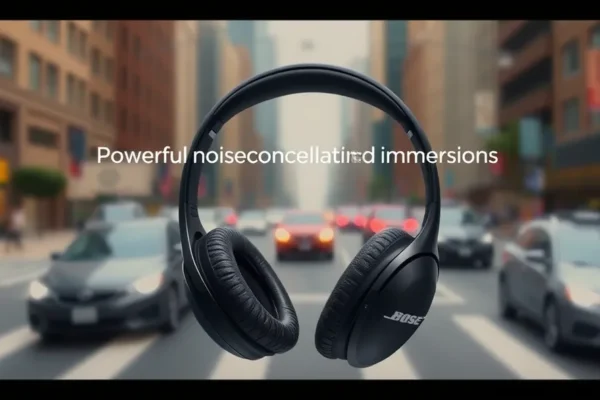
Finding Peace in a Noisy World
We have all been there. You are trying to focus on an important project at a busy coffee shop, but the sound of the milk steamer and the chatter around you is making it impossible. Or perhaps you are sitting on a plane, and the constant, low roar of the engine is making your headache worse. This is exactly the kind of daily frustration that the Bose QuietComfort Headphones (2nd Gen) review aims to address. These are not just another pair of gadgets; they are tools designed to give you back your personal space.
In plain terms, these are premium wireless over-ear headphones designed to do one thing better than almost anyone else: block out the world. They use advanced technology to “listen” to the noise around you and create an opposite sound wave that cancels it out. This makes your music clearer and your environment much quieter. Whether you are a student trying to study in a loud dorm or a professional working in an open-plan office, these headphones are built to create a little bubble of silence just for you.
Why should you care right now? Because our world is getting louder. Between remote work, travel, and urban living, the ability to control your acoustic environment is becoming a necessity for mental focus and relaxation. The Bose QuietComfort (2nd Gen) represents a refined version of a classic design, focusing on what users actually want: comfort and silence.
How You Will Actually Use These Headphones
It is easy to get lost in technical talk, but what do these headphones actually do for your Tuesday afternoon? Let’s look at how they fit into a normal day.
The Frequent Traveler: Imagine you are settling into a middle seat on a six-hour flight. Usually, this is when the engine drone starts to wear on your nerves. When you slip these on and engage the noise-canceling headphones feature, that engine hum doesn’t disappear entirely, but it transforms into a distant, much more tolerable whisper. It allows you to watch a movie or sleep without feeling like you are vibrating along with the plane.
The Focused Professional: If you manage a busy household or work in an office where people are constantly walking past your desk, these are a lifesaver. You can put them on, play some lo-fi beats or even just enjoy the silence, and suddenly the distracting clicks of keyboards and muffled conversations feel miles away. It is like having a “Do Not Disturb” sign for your ears.
The Daily Commuter: For those who use buses or trains, the chaos of public transit can be exhausting. These headphones help soften the screeching of brakes and the loud announcements, making your journey feel much more relaxed and less like a sensory assault.
Is This the Right Choice for You?
Because everyone’s ears and lifestyle are different, these headphones aren’t a perfect fit for every single person. Here is a quick guide to help you decide.
Best for
- The Comfort Seeker: If you wear headphones for four or five hours at a time, the headphone comfort on these is industry-leading. They feel light and don’t “clamp” your head too hard.
- The Frequent Flyer: If your main goal is to eliminate engine drone and travel noise, Bose is still the gold standard.
- The Simple User: If you want something that just works without needing to navigate a dozen tiny touch gestures, the physical buttons here are very reliable.
Good for
- Students: Great for creating a study zone in loud libraries or common areas.
- Office Workers: A solid way to reclaim focus in noisy environments.
Skip if
- You want high-tech bells and whistles: If you love touch-sensitive pads and “smart” features that pause music when you talk, you might find these a bit too traditional.
- You are on a strict budget: These are premium products, and you will pay a premium for that Bose name and performance.
- You want tiny headphones: These are over-ear, meaning they are bulky compared to earbuds.
How They Stack Up Against the Competition
When looking at competitor headphones, you are usually choosing between three big players: Bose, Sony, and Apple. Here is how a noise canceling comparison usually plays out.
Bose vs. Sony (The WH-1000XM series): Sony is often seen as the “tech” choice. They frequently offer more advanced app features and slightly better battery life. However, many users find that Bose offers superior headphone comfort for long sessions. While Sony might feel more “gadgety,” Bose feels more “natural.”
Bose vs. Apple (AirPods Max): Apple’s offering is incredibly stylish and integrates perfectly if you only use iPhones. However, the Apple headphones are much heavier and significantly more expensive. If you want something you can wear all day without feeling neck strain, the Bose QC 2nd Gen is the more practical choice.
The Value Factor: While the Bose QC price is higher than budget brands, you are paying for the reliability of the noise cancellation. A cheaper pair might claim to cancel noise, but they often leave you with a “hissing” sound or don’t catch the low-end rumbles as well as Bose does.
Setting Up and Getting Started
One of the best things about the Bose QC 2nd Gen features is that they don’t require a computer science degree to use. The setup is very intuitive.
To get started, you simply download the Bose Music app on your smartphone. The app guides you through the process of pairing the headphones via Bluetooth, which usually takes less than two minutes. Once paired, you can customize how the noise cancellation feels and update the software to ensure everything is running smoothly.
There is almost no learning curve here. The buttons are exactly where you expect them to be, and the controls are straightforward. You won’t find yourself accidentally pausing your music every time you try to change the volume. It is a “set it and forget it” kind of device.
The Real-World Wins
After using these in daily life, a few things stand out as genuine advantages:
- Cloud-like Comfort: The ear cushions are incredibly soft. Users consistently report that they can wear these for an entire workday without the usual ear fatigue or pressure.
- Reliable Silence: The noise-canceling headphones technology is incredibly consistent. It handles the “low” sounds (like an AC unit) and “mid” sounds (like people talking) with impressive ease.
- Simplicity of Design: Because they use physical buttons rather than finicky touch controls, they work every time, even if you are wearing gloves or your hands are a little sweaty.
- Quick Charging: If you realize they are dead right before a flight, a quick charge provides enough juice to get you through a significant portion of your trip.
The Drawbacks to Consider
No product is perfect. Here are the honest limitations reported by users and observed in real-world testing:
- Dated Aesthetics: While they are functional, they don’t look as “futuristic” as some of the newer competitors. They look like classic Bose headphones, which is fine, but not exactly a fashion statement.
- Average Battery Life: While it is plenty for a standard flight or workday (lasting roughly 20-24 hours depending on use), it doesn’t quite reach the marathon levels of some newer Sony models.
- Lack of “Smart” Features: You won’t find features like “speak-to-chat” (where the music pauses automatically when you speak) here. You have to manually interact with the headphones to change modes.
Price, Value, and Long-Term Thinking
As of current market trends, the Bose QC price typically sits in the $300 to $350 range. Is it worth it?
If you view these as a long-term investment in your productivity and mental peace, the answer is yes. Unlike cheap headphones that might need replacing in a year because the plastic cracks or the battery dies, Bose builds products intended to last. However, if you only need headphones for occasional video watching or casual listening at home, you can find much more affordable wireless over-ear options that will satisfy those basic needs without the premium cost.
For those on a tighter budget, brands like Soundcore offer decent noise cancellation for much less, though you will sacrifice that “magic” feeling of total silence that Bose provides.
The Final Verdict
So, should you buy the Bose QuietComfort Headphones (2nd Gen)?
Buy them if: You prioritize comfort above all else, you travel frequently, or you need a reliable way to block out noise to get work done. They are a “gold standard” for a reason.
Wait or look elsewhere if: You are a tech enthusiast who wants every possible smart feature, or if you are looking for the absolute cheapest way to listen to music.
Ultimately, these are a practical, high-performing tool for anyone who finds the modern world a little too loud. They don’t try to reinvent the wheel; they just make the wheel much, much quieter.
Common Questions About the Bose QuietComfort (2nd Gen)
Is the Bose QuietComfort (2nd Gen) worth the price?
If you value silence and long-term comfort, yes. You are paying for industry-leading noise cancellation and a design that won’t hurt your ears after an hour of use.
How good is the audio quality?
The sound performance is excellent for daily listening. It focuses on a balanced sound that makes voices clear and music feel rich, though it may not satisfy the most extreme “audiophile” listeners.
Can I use these for phone calls?
Yes, the microphones are designed to pick up your voice while minimizing background noise, making them great for taking calls in noisy environments.
How long does the battery actually last?
In real-world use, you can expect roughly 20 to 24 hours of playback on a single charge, which is plenty for a long international flight.
Are these headphones durable?
Bose is known for solid build quality. While they are made of high-quality plastics and materials, they are still electronic devices that require careful handling, especially the folding hinges.
Product prices and availability vary by region. Verify current pricing before purchase











