

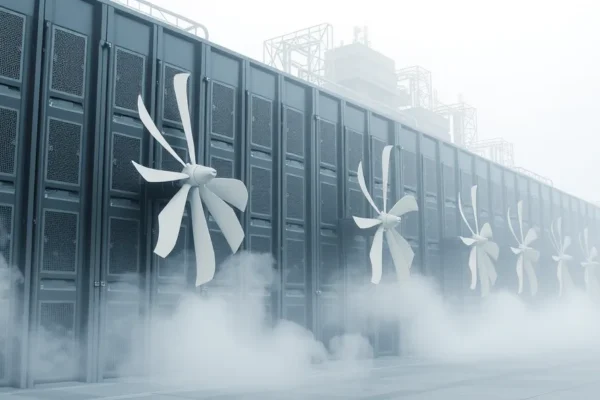
The High-Stakes Pivot in AI Energy Infrastructure
The rapid rise of artificial intelligence has created a massive, unexpected problem. While much of the public conversation focuses on how AI models think, a quieter and more critical struggle is happening behind the scenes: how to power them. AI models require an enormous amount of electricity, far more than a standard Google search or a social media post. This massive energy demand has sparked a race among tech companies to find new, reliable sources of power.
Recently, the industry saw a significant shift in this race. Crusoe, a company known for its work in digital infrastructure and energy management, has decided to abandon its ambitious $1.25 billion plan to use Boom turbines to power AI data centers. The original vision was to take the high-performance turbine technology from Boom Supersonic and repurpose it for use in stationary power plants. This would have provided a concentrated, high-output energy source specifically for the massive computing needs of the AI era.
This decision marks a notable moment in the landscape of tech investments. It highlights the extreme difficulty of repurposing specialized aerospace technology for industrial energy needs. While the idea was to create a new breed of energy innovation, the pivot suggests that the path to powering AI data centers may be more traditional, or at least more complex, than using jet engine technology. According to recent industry updates, this move allows both companies to refocus on their primary missions rather than attempting to bridge two very different engineering worlds.
Turning Flight Technology into Electricity
To understand why this plan was so ambitious, we must first understand how a turbine works. A turbine is essentially a machine that captures the energy of moving gas or liquid to create rotation. In a jet engine, this rotation provides the thrust needed to move an aircraft through the sky. The plan involving Crusoe and Boom Supersonic was to take that same principle of high-speed rotation and use it to generate electricity.
Think of it like a bicycle dynamo. When you pedal a bike, the movement of the wheel spins a small device that generates enough electricity to power a light. Now, imagine scaling that concept up to a massive level. Instead of a small light, the spinning turbine would power a giant generator, which in turn would supply electricity to a massive building full of AI servers. This is the core concept behind using Boom turbines for stationary power plants.
In this setup, the turbine would act as the heart of the power system. Rather than being mounted on a wing to provide movement, the turbine would be bolted to the ground in a dedicated facility. It would burn fuel to spin a shaft at incredibly high speeds, and that shaft would drive an electromagnetic generator to produce a steady stream of electricity. This concept was intended to provide a “burst” of high-density energy that could keep up with the intense, constant power requirements of modern data center infrastructure.
The Urgent Search for AI Power
The decision comes at a time when the demand for electricity is reaching levels that traditional power grids are struggling to meet. Most current AI data centers rely on the existing electrical grid, which is often a mix of renewable energy and fossil fuels. However, as companies like Microsoft, Google, and Meta build larger facilities, the grid is becoming a bottleneck.
Currently, the industry is in an early adoption phase regarding new power technologies. Most companies are still using standard utility connections, but they are increasingly looking for “behind the meter” solutions. This means generating power right on the site of the data center to avoid relying on the often-unreliable public grid. Companies like Crusoe have already been leaders in this space by using “flared gas”—excess gas from oil drilling that would otherwise be burned off—to create electricity for computing.
The maturity of turbine-based stationary power is high in the oil and gas industry, but using specialized supersonic-grade engines for this purpose was a much newer, unproven concept. While the technology to turn turbines into generators exists, the specific application of using high-performance aviation engines for AI data centers was a highly specialized approach that has now been stepped back from in favor of more proven methods.
Rivals in the Race for Constant Power
Crusoe and Boom Supersonic were looking for a unique way to stand out, but they face significant competition from several other directions. The race to power AI is not being fought by just one type of technology. Instead, there are several competing approaches, each with its own set of advantages and disadvantages.
First, there are the traditional giants. Companies like GE and Siemens have spent decades perfecting large-scale gas turbines used in stationary power plants. These are highly reliable and widely available, though they are often tied to fossil fuel consumption. For many data center operators, the reliability of these established players is a major advantage over newer, experimental technologies.
Second, there is the rise of Small Modular Reactors (SMRs). These are a type of next-generation nuclear technology designed to be smaller and safer than traditional nuclear plants. Many tech leaders are looking toward SMRs because they offer “carbon-free” baseload power, which means they provide constant energy without emitting greenhouse gases. This is a major draw for companies trying to meet environmental goals.
Third, renewable energy solutions like solar and wind, combined with massive battery storage, are the primary competitors for long-term sustainability. While solar and wind are intermittent—meaning they only work when the sun shines or the wind blows—advancements in battery technology are making them more viable for the constant load required by AI. Compared to the Boom turbines approach, these solutions are more widely integrated into current energy markets, though they face challenges with consistency.
The Economic Reality of Energy Innovation
The abandonment of the $1.25 billion plan has significant implications for how we view the economics of the AI boom. It serves as a reminder that while the software side of AI is moving at lightning speed, the physical hardware and energy infrastructure move much more slowly and at a much higher cost.
From a business perspective, this pivot illustrates the risks of massive tech investments in unproven hardware. Building a new supply chain for specialized turbines is an enormous financial undertaking. For Crusoe, focusing on more established or more direct renewable energy solutions may be a more stable way to grow. For the broader market, it signals that the “easy” ways to power AI are already being used, and the “hard” ways—like specialized turbine engineering—come with extreme capital risks.
Socially and economically, this reinforces the idea that the AI revolution is as much an energy revolution as it is a computing revolution. The demand for power will continue to drive job creation in the energy sector and stimulate new markets for grid management and storage. However, it also raises concerns about the sheer volume of resources required to sustain this growth, which may lead to higher electricity costs for the general public if not managed carefully.
Why Jet Engines Are Hard to Ground
While the idea of using supersonic engine technology was technically fascinating, it faced several massive hurdles. The first is the fundamental difference in engineering requirements. An engine designed for an aircraft is built to be as light as possible. Weight is the enemy of flight. Every ounce of metal matters.
In contrast, an engine designed for a stationary power plant is built for durability and heat management over years of continuous operation. When you take an engine designed to run for short bursts in a plane and ask it to run 24/7 in a data center, the wear and tear are exponentially higher. This creates a significant technical challenge: a turbine designed for flight might not have the lifespan required for industrial power generation without expensive and frequent rebuilds.
Cost is another major barrier. The high-performance materials required for supersonic flight—such as advanced ceramics and specialized alloys—are incredibly expensive. When you scale that up to a $1.25 billion project, the cost per kilowatt-hour of electricity produced might end up being much higher than what a data center operator is willing to pay. In the world of data centers, efficiency and predictable costs are often more important than having the most advanced technology available.
The Next Chapter of Data Center Power
The exit of the Crusoe and Boom Supersonic partnership does not mean the search for AI power is over; rather, it suggests the search is moving toward more practical, scalable solutions. We can expect the next few years to be defined by a “hybrid” approach to energy.
In the short term, we will likely see more data center infrastructure being built directly next to existing renewable energy sites or natural gas pipelines. The focus will be on minimizing the distance electricity has to travel and maximizing the use of whatever energy is locally available. We are also likely to see an increase in “microgrids,” where a data center and its power source operate as a single, self-contained unit.
Looking further ahead, the development of SMRs and long-duration battery storage will be the key milestones to watch. If these technologies can reach commercial maturity within the next decade, they could provide the steady, clean energy that AI requires. The trajectory of the industry suggests that the winner of the AI energy race will not necessarily be the company with the most exotic technology, but the one that can provide the most reliable, cost-effective, and scalable power.
Common Questions About the Energy Pivot
Is the AI energy crisis a real problem?
Yes, the energy demand for training and running large AI models is unprecedented. This demand is currently straining existing electrical grids and forcing companies to seek new, local power sources to ensure their data centers stay online.
Why did Crusoe abandon the Boom turbines plan?
The decision was likely driven by the immense engineering and economic challenges of repurposing aviation technology for stationary use. Transitioning from high-performance flight engines to long-term power generation involves significant technical and financial risks.
Will AI lead to higher electricity prices for everyone?
There is a risk that the massive demand from data centers could drive up prices if the grid cannot expand fast enough. However, the push for new energy innovation and more efficient power plants could also lead to a more robust and diverse energy supply.
What is the best alternative to using jet engines for power?
Currently, the most viable alternatives include traditional natural gas turbines, large-scale solar and wind paired with batteries, and the future potential of Small Modular Reactors (SMRs). These methods are more established and economically predictable.
Does this mean AI development will slow down?
Not necessarily. While the energy bottleneck is real, it is acting as a catalyst for innovation in the energy sector. The slowdown in one specific power method often leads to faster adoption and development of more practical alternatives.
Note: This report is based on current industry announcements and market trends. The technical viability of emerging energy solutions is subject to ongoing research and engineering developments.











