

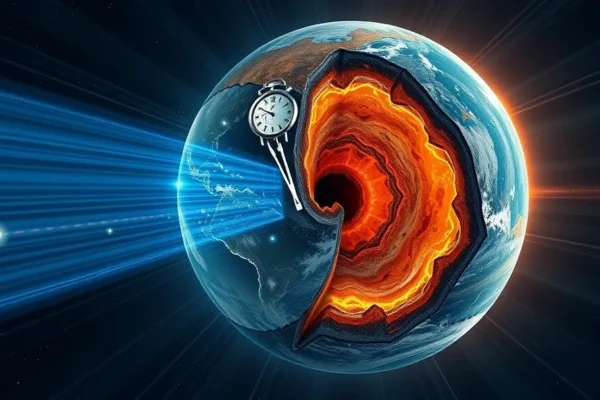
A Tug of War Beneath Our Feet
For most of us, time is a constant. We measure our days by the steady, rhythmic rotation of the Earth. However, beneath the ground we walk on, a complex scientific battle is unfolding that subtly alters the pace of our world. Researchers have recently identified that the Earth’s inner core, a solid ball of iron and nickel, is engaged in a gravitational tug of war with the surrounding mantle, the thick layer of hot rock that makes up most of the planet’s interior. This interaction creates fluctuations in the Earth’s rotation speed, occasionally causing the length of our days to shift by fractions of a millisecond.
This discovery, published in recent studies such as those from the University of Southern California and researchers at the Chinese Academy of Sciences, challenges our long-held assumption that the planet spins at a perfectly predictable rate. While these changes are not noticeable to the average person, they represent a significant breakthrough in geophysics. Understanding these geological forces is crucial because the accuracy of our global navigation systems, high-frequency trading platforms, and telecommunications infrastructure relies on precise timekeeping synchronized with the Earth’s rotation.
How Earth’s Internal Mechanics Influence Time
To understand why the length of days varies, it helps to visualize the Earth not as a solid marble, but as a multi-layered machine. Think of the planet like a spinning top that contains a smaller, independent spinning weight inside. The inner core is surrounded by the liquid outer core, which acts like a lubricant, allowing the inner core to rotate at a slightly different speed than the mantle and the crust.
The gravitational pull between the massive, dense inner core and the rocky, swirling mantle acts as a braking or accelerating force. When the inner core’s rotation slows down or speeds up relative to the mantle, the conservation of angular momentum requires the rest of the planet to compensate. If the inner core slows down, the mantle and the surface of the Earth might speed up slightly to maintain the balance. This shift is minimal, but it is enough to change the length of days by tiny increments. These adjustments are driven by the shifting mass of molten iron in the outer core and the thermal currents within the mantle, creating a dynamic system that is constantly recalibrating itself.
Tracking the Shift in Real Time
This technology is currently being used by international scientific bodies like the International Earth Rotation and Reference Systems Service (IERS). By using ultra-precise atomic clocks and very long baseline interferometry, which involves tracking distant quasars in space, scientists can measure the Earth’s rotation with incredible accuracy. These measurements are essential for the maintenance of Coordinated Universal Time, or UTC.
Currently, this research is primarily within the realm of academic institutions and government agencies tasked with keeping global time standards. There is no commercial application for the average consumer, as these changes are too small to affect daily life. However, for industries like satellite communications and global positioning systems (GPS), these updates are vital. If the Earth’s rotation speed drifts, the signals sent between satellites and ground receivers can become slightly misaligned, leading to errors in navigation and data transmission. These groups use the data on geological forces to apply “leap seconds” or other adjustments to keep our digital clocks perfectly synced with the physical reality of the planet.
The Scientific Competition to Map the Core
The study of Earth’s core is a crowded field of scientific inquiry. While the University of Southern California (USC) researchers have provided significant insight into the “backtracking” of the inner core, other teams around the globe are using different methodologies to track the same phenomenon. Scientists in China and Europe are deploying dense networks of seismometers to track how earthquake waves travel through the planet’s interior, acting as a form of “planetary ultrasound.”
The advantage in this landscape belongs to institutions that combine long-term historical data with modern satellite gravimetry, which measures the distribution of mass on Earth from orbit. While no single company has a monopoly on this knowledge, the global collaborative effort—such as the sharing of seismic data through the IRIS (Incorporated Research Institutions for Seismology) consortium—allows for a more nuanced understanding than any one entity could achieve alone. This collaborative approach distinguishes geophysical research from proprietary industrial technology, as it relies on open scientific data to build a consensus model of the planet.
Economic and Social Implications
The implications of understanding changes to Earth’s rotation extend well beyond theoretical physics. In the short term, our infrastructure is becoming increasingly dependent on sub-microsecond timing. Modern financial markets use algorithms that execute trades in nanoseconds, and any discrepancy between clocks can have massive economic consequences. As we rely more on automated transport and synchronized robotics, the stability of our time standards becomes a pillar of economic security.
Socially, this research encourages a better understanding of the natural volatility of our planet. It is a reminder that Earth is an active, evolving system rather than a static backdrop for human civilization. In the long term, these insights may help us better understand the magnetic field generated by the core, which protects the planet from solar radiation. Predicting how this field changes could eventually become a matter of planetary survival as we move toward a more electrified and space-faring global society.
Limitations and Remaining Bottlenecks
Despite the precision of modern sensors, we still face significant limitations. One of the biggest challenges is that we cannot directly observe the inner core. We are essentially “blind” scientists inferring the movement of a massive object by observing its indirect effects on the planet’s surface. Our models are based on seismic data, which can be interpreted in several ways, and there is still no universal consensus on the exact periodicity of the inner core’s rotation.
Furthermore, isolating the effects of the inner core from other factors—like the melting of polar ice caps, which shifts the Earth’s mass and slows its rotation—is technically difficult. The “noise” from surface-level changes can obscure the subtle signals coming from the center of the planet. Until we have higher-resolution seismic arrays and longer time-series data, these calculations will remain estimates rather than exact measurements, making it difficult to predict future shifts with complete certainty.
The Future of Planetary Monitoring
Looking ahead, the next decade of geological research will likely focus on integrating artificial intelligence into seismic data analysis. AI models are already showing promise in distinguishing between the various signals that impact Earth’s rotation, allowing scientists to separate the influence of the core from atmospheric and oceanic factors. We expect to see more accurate, near-real-time modeling of these gravitational interactions by the early 2030s.
Key developments to watch include the expansion of the Global Geodetic Observing System (GGOS), which aims to provide highly accurate monitoring of the Earth’s shape, gravity, and rotation. As we improve our ability to track these geological forces, we will be better prepared to handle the inevitable, albeit tiny, adjustments required to keep our global technological networks synchronized.
Frequently Asked Questions About Earth’s Rotation
Is the change in the length of days dangerous for humans?
No, the fluctuations in Earth’s rotation speed are extremely small, often measured in milliseconds, and pose no physical danger to people or property on the surface.
Does the inner core’s movement affect our daily lives?
While you won’t notice it, it does impact high-precision industries. GPS navigation, deep-space communication, and high-frequency financial trading systems must account for these changes to remain accurate.
Why is the core moving independently from the rest of the planet?
The inner core is solid, while the outer core is liquid. This liquid layer decouples the inner core from the mantle, allowing them to rotate at different speeds due to gravitational and magnetic forces.
Is this a new discovery?
The concept of a shifting core is not new, but recent studies have provided much stronger evidence regarding the specific cycles of this movement and how it correlates with the length of days on Earth.
How do we measure something we cannot see?
Scientists use seismic waves from earthquakes and highly sensitive measurements of the Earth’s orientation in space to map the internal structures, effectively using the planet as its own laboratory to observe its internal mechanics.
Can we stop the Earth’s rotation from changing?
No, these are natural planetary processes driven by massive geological forces. Our role is not to prevent these changes, but to observe and adapt our technology to stay synchronized with the planet.
Note: The research discussed in this article is based on geophysical observations and predictive modeling. Because direct physical access to the Earth’s inner core is impossible with current technology, these findings rely on indirect seismic, gravitational, and astronomical data. These models are subject to updates as observational technology and data interpretation techniques improve over time.











