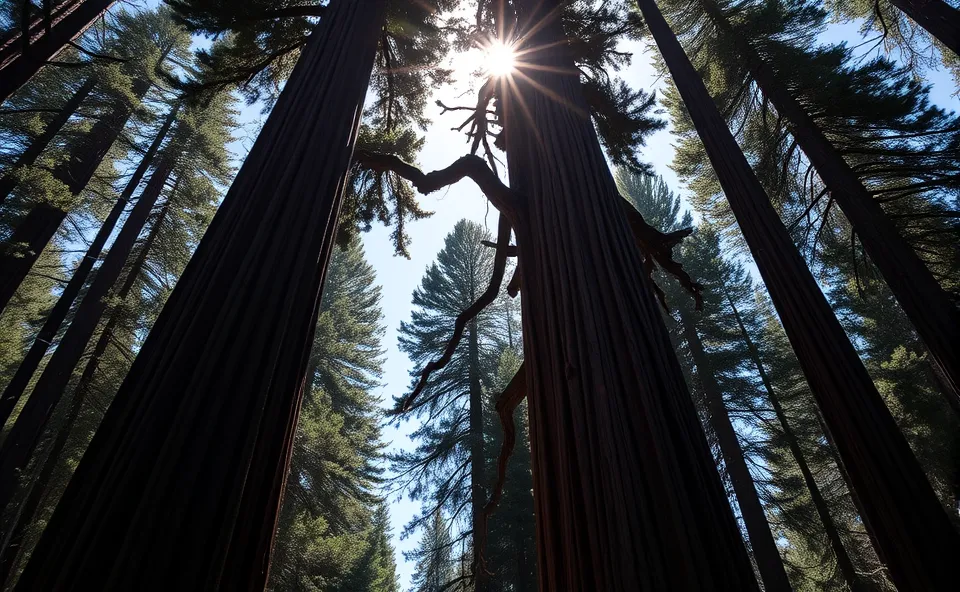
Understanding Redwood Heatstroke: A Climate Change Crisis for California’s Giants
The towering majesty of California’s redwood trees has long symbolized resilience and longevity. These ancient giants, the tallest living organisms on Earth, are now facing an unprecedented threat: heatstroke, driven by the accelerating impacts of climate change. Rising global temperatures, a direct consequence of ongoing warming trends, are pushing these iconic trees beyond their natural tolerance, affecting their fundamental biological processes and jeopardizing their long-term survival. This phenomenon, termed “redwood heatstroke,” is a critical indicator of ecosystem stress within redwood forests and a stark reminder of how global warming impact is altering even the most robust natural systems.
The problem is multifaceted. As temperatures climb, especially during prolonged heatwaves, redwoods, like all living organisms, experience physiological stress. While they possess remarkable adaptations for survival, including deep root systems and the ability to access moisture from fog, extreme heat coupled with potential drought conditions overwhelm these defenses. This stress directly impacts their ability to perform photosynthesis, the vital process by which trees convert sunlight into energy. The implications extend beyond individual tree health, threatening the very existence of these ancient redwood forests, which are integral to California’s unique climate and biodiversity.
This development is significant now because recent scientific studies are increasingly quantifying the extent of this damage. Researchers at institutions like the University of California, Berkeley, and the U.S. Forest Service have been meticulously tracking tree health and physiological responses, publishing findings that highlight a concerning trend of declining vitality in redwood populations exposed to increasingly severe heat events. Their work underscores the urgency of understanding and addressing this climate change challenge.
How Rising Temperatures Affect Redwood Physiology
At its core, redwood heatstroke is a consequence of trees being unable to cope with excessive heat. Think of a tree’s leaves as tiny solar panels that also “breathe” through small pores called stomata. These stomata open to take in carbon dioxide, essential for photosynthesis, but they also release water vapor. This process, known as transpiration, is how trees cool themselves.
However, during intense heatwaves, the environment becomes a double-edged sword. While trees need to transpire to cool down, the extreme heat can lead to an excessive loss of water. If the tree cannot draw up enough water from the soil to replace what is lost, its stomata begin to close. This closure is a survival mechanism to prevent dehydration, but it has a critical side effect: it also prevents the tree from taking in the carbon dioxide it needs for photosynthesis.
This leads to a “photosynthesis slowdown.” The rate at which the tree converts sunlight into energy dramatically decreases. Imagine a factory that has to shut down its production lines because it can’t get the raw materials or because operating at high temperatures risks damaging its machinery. For the redwood, this slowdown means less energy to fuel its growth, repair damage, and fend off diseases. Prolonged periods of this stress can weaken the tree significantly, making it more vulnerable to pests, pathogens, and eventually leading to widespread dieback within the redwood forests.
The environmental science behind this involves complex physiological responses. When temperatures exceed a certain threshold, enzymes crucial for photosynthesis can become denatured, essentially being destroyed by the heat. This further impairs the tree’s ability to function. Furthermore, extreme heat can damage the cellular structures within the leaves, leading to visible signs of stress such as browning and wilting.
Redwoods Under Pressure Today: Early Signs and Concerns
Currently, redwood heatstroke is not a widespread, uniform phenomenon across all redwood populations. However, it is a growing concern, particularly in areas experiencing more frequent and intense heatwaves, often exacerbated by drought conditions. While redwood trees are known for their drought resistance compared to many other tree species, prolonged and extreme heat can push even these hardy giants to their limits.
Observable signs of heat stress in redwoods include reduced growth rates, thinning of the canopy, and increased susceptibility to insect infestations. Researchers are actively monitoring these changes in established redwood forests. For example, studies published in journals like the Journal of Ecology have documented increased mortality rates in certain coastal redwood stands following severe heat events, especially when combined with below-average rainfall.
This is not yet a crisis demanding immediate, widespread intervention across all redwood parks, but it is a clear warning signal. The focus is on understanding the thresholds at which these trees begin to suffer and identifying vulnerable populations. Conservation organizations and governmental agencies in California are using this data to inform forest management strategies. This includes assessing the potential need for targeted watering in extreme drought scenarios or considering assisted migration for species in the most at-risk zones, though such interventions are complex and have their own challenges.
The Competitive Landscape of Climate Change Adaptation
When considering solutions or ways to understand and mitigate climate change impacts on ecosystems like redwood forests, it’s less about competing technologies and more about a diversity of scientific approaches and conservation strategies.
One “approach” is simply continued scientific observation and data collection. Organizations like the National Park Service and the California Department of Forestry and Fire Protection are critical players here, providing long-term data sets and field research. Their work forms the baseline for understanding the problem.
Another approach involves advanced modeling and predictive analytics. Researchers use sophisticated climate models to forecast future temperature and precipitation patterns, helping to identify areas where redwood forests are most likely to experience severe stress. This is akin to a weather forecast, but for ecological futures.
There’s also the domain of genetic research, exploring the natural variability within redwood populations. Some individual trees might possess genetic traits that confer greater heat or drought resistance. Identifying and potentially propagating these “champion” trees could be a long-term strategy, though it is a slow and complex process.
Rival approaches might include direct intervention, such as planting more drought-tolerant species in areas where redwoods are struggling, or focusing on enhancing soil moisture retention. However, the primary focus for redwoods remains on understanding their inherent resilience and minimizing stressors. The “competition” is essentially between nature’s adaptive capacity and the pace of climate change.
Implications: Reshaping Forests and Our Connection to Them
The implications of widespread redwood heatstroke are profound, extending far beyond the immediate impact on these iconic trees.
Economically, the redwood industry, which includes timber harvesting and tourism, could face significant disruption. Decline in tree health could affect timber yields, and the aesthetic appeal of struggling forests might impact tourism revenue. Furthermore, the ecological services provided by healthy redwood forests, such as carbon sequestration and watershed protection, could diminish, leading to broader economic consequences.
Socially, these forests are deeply ingrained in California’s cultural identity. Their decline would represent a significant loss of natural heritage and a spiritual blow to many. It would also impact recreational opportunities and the sense of place for communities living in and around these forests.
In the short term, we will likely see increased awareness and more targeted monitoring efforts. In the long term, if warming trends continue unabated, we could witness significant shifts in redwood forest composition and distribution. Entire ecosystems could be altered, impacting the diverse array of plant and animal life that depends on them. The concept of forest adaptation will become increasingly crucial, not just for redwoods but for ecosystems globally.
Challenges: The Intricacies of Tree Health and Climate Change
Addressing redwood heatstroke is fraught with challenges. Firstly, redwoods are exceptionally long-lived, meaning that generational changes and adaptations happen over centuries, not years. Climate change, however, is occurring at a pace that outstrips their natural evolutionary capacity.
Secondly, the precise thresholds for heat and drought stress vary greatly depending on factors like local climate, soil conditions, tree age, and overall tree health. It’s a complex web of variables, making it difficult to pinpoint exactly when and where a tree will suffer significant damage.
Thirdly, direct interventions are often difficult and expensive to implement on the vast scale of redwood forests. Mechanized interventions like widespread irrigation are impractical and ecologically disruptive. Even targeted efforts require significant resources and careful planning.
Finally, there’s the overarching challenge of global warming itself. Without significant global efforts to reduce greenhouse gas emissions, any local or regional adaptation strategies will only be temporary solutions. The fundamental driver of redwood heatstroke remains the escalating global temperature. This is a problem that requires a global solution to truly overcome.
The Future Trajectory: A Race Against Time
The future trajectory for redwood trees in the face of climate change is a subject of ongoing research and concern. Current scientific consensus suggests that without substantial global action to curb greenhouse gas emissions, redwood forests will continue to face increasing stress.
Key developments to watch include advancements in our understanding of tree physiology under extreme heat, the identification of more resilient redwood genotypes, and the development of innovative, low-impact forest management techniques. Researchers are also focusing on refining climate models to provide more precise predictions for regional impacts, allowing for better foresight in conservation planning.
It’s unlikely that redwoods will simply disappear. Nature is remarkably adaptable. However, the composition and health of redwood forests in the coming decades will likely be different. We may see a natural selection process favoring more resilient individuals and populations, and a shift in the geographic range where redwoods can thrive. The timeline for these changes is uncertain, but the trend is clear: the pressure on these ancient giants will continue to mount.
Key Questions and Answers about Redwood Heatstroke
Is redwood heatstroke a widespread phenomenon right now?
Not yet, but it is an increasing concern. While not all redwood trees are suffering significantly, scientists are observing more frequent and severe heat stress, particularly during prolonged heatwaves that can be exacerbated by drought. This indicates growing ecosystem stress.
What causes redwood heatstroke?
Rising temperatures cause heatstroke by overwhelming a redwood tree’s ability to cool itself through transpiration. When it loses too much water, its pores (stomata) close to conserve moisture. This closure prevents it from taking in carbon dioxide, leading to a slowdown in photosynthesis and weakening the tree.
How does climate change specifically impact redwood trees?
Climate change, characterized by rising global temperatures and more frequent extreme weather events like heatwaves and droughts, directly increases the risk and severity of redwood heatstroke. This global warming impact strains the trees’ natural resilience.
Who is researching redwood heatstroke and climate change impact on California redwoods?
Various institutions are involved, including the University of California, Berkeley, and the U.S. Forest Service. These researchers are vital for understanding the environmental science behind tree health and forest adaptation.
Are there any current applications or solutions being implemented for redwood heatstroke?
Current efforts primarily focus on monitoring tree health, conducting research, and informing conservation strategies. There are no widespread technological interventions currently in use, as managing vast redwood forests is complex. The focus is on understanding the problem and preparing for future challenges.
What are the long-term implications if redwood heatstroke worsens?
If heat stress continues to increase, it could lead to significant decline in redwood forest health, impacting biodiversity, tourism, and the ecological services these forests provide. It also poses a significant threat to the survival of these iconic California redwoods.
This article is based on current scientific understanding and ongoing research into the effects of climate change on redwood trees. The information presented reflects the latest findings from environmental science and related fields.