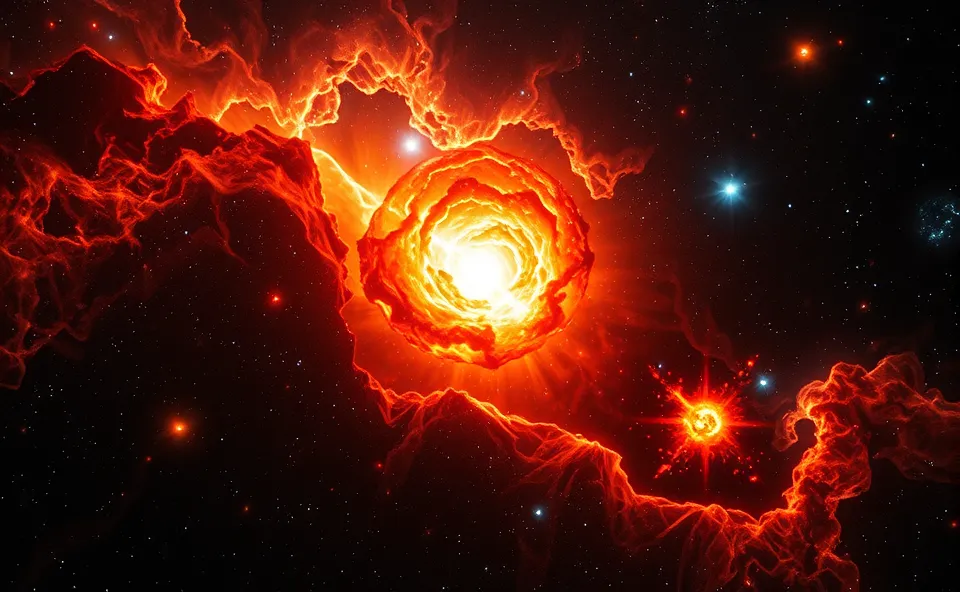
A Glimpse of Cosmic Fury: New High Definition Supernova Imaging Unlocks Stellar Secrets
Imagine capturing a celestial fireworks display so powerful it outshines entire galaxies, a supernova explosion, in breathtaking high definition. Recent advancements in deep space imaging are making this a reality, offering unprecedented views of these cataclysmic stellar explosions. This isn’t just about pretty pictures; it’s about deciphering the universe’s most dramatic events, bridging the gap between ancient observations and cutting-edge scientific discovery. By studying the intricate details of supernovae today, astronomers are not only witnessing incredible celestial spectacles but also learning about the life and potential death throes of stars, shedding light on our own cosmic history.
Peering into the Aftermath of a Stellar Cataclysm
At its heart, this innovation lies in the development of incredibly sensitive telescopes and advanced image processing techniques. Think of it like upgrading from a grainy old photograph to a crystal-clear 8K video of a fireworks show. Previously, our views of supernovae were limited by the resolution and light-gathering capabilities of our instruments. This new generation of deep space imaging allows us to resolve finer details within the expanding shell of gas and dust, much like seeing individual embers and shockwaves rather than just a bright flash.
The core mechanism involves sophisticated optics that can collect faint light from incredibly distant objects over extended periods. Coupled with adaptive optics, which counteract the blurring effect of Earth’s atmosphere (even for space telescopes, residual effects can be managed), these instruments capture photons with remarkable precision. These raw data points are then fed into powerful algorithms that reconstruct the image, enhancing contrast, sharpening edges, and revealing subtle variations in color and brightness that were previously invisible. This process is akin to a digital artist meticulously piecing together millions of tiny brushstrokes to create a vibrant and detailed masterpiece.
Witnessing Cosmic History in High Definition
The impact of this technology is already being felt in observatories around the globe and in space. The Hubble Space Telescope, and now its successor, the James Webb Space Telescope (JWST), are at the forefront of capturing these high definition supernova images. For example, JWST’s infrared capabilities allow it to peer through the dust that often obscures the remnants of these explosions, revealing intricate structures and the chemical composition of the ejected material. Projects like the Zwicky Transient Facility (ZTF) are also contributing by rapidly identifying new supernovae, allowing astronomers to target them with these advanced imaging capabilities for detailed study.
These observations are transforming our understanding of cosmic history. By analyzing the elements present in the nebula formed by a supernova, scientists can infer the type of star that exploded and its life cycle. This is crucial for understanding how heavier elements, essential for life, are forged in the universe. It also helps us understand the dynamics of star formation and galactic evolution. Currently, this technology is largely in the hands of professional astronomers and research institutions, but the data collected is often made publicly available, fueling further scientific discovery and inspiring public interest in space exploration.
A Universe of Competing Eyes on the Sky
The field of supernova observation is a competitive one, with various ground-based and space-based observatories vying for the best views. While Hubble has been a pioneer, JWST represents a significant leap forward in infrared observation, offering capabilities that complement and surpass its predecessor in certain areas. Ground-based telescopes like the Giant Magellan Telescope (GMT) and the Extremely Large Telescope (ELT), currently under construction, promise even greater light-gathering power and resolution, potentially rivaling and exceeding space-based platforms for certain types of observations.
Each approach has its advantages. Space telescopes like JWST are free from atmospheric distortion, offering unparalleled clarity. Ground-based telescopes, however, can be larger and more cost-effective to build and maintain, allowing for more frequent upgrades and specialized instrumentation. The key differentiator for this latest wave of high definition supernova imaging is the synergistic combination of enhanced optics, sophisticated atmospheric correction (for ground-based), and advanced data processing algorithms that extract maximum information from the collected light.
Unlocking the Secrets of Stellar Survival and Beyond
The implications of this enhanced imaging extend far beyond mere astronomical observation. By studying the aftermath of a stellar explosion, scientists can gain critical insights into the processes that lead to a star’s demise, and perhaps, its survival. For instance, understanding the shockwaves and energy dispersal can inform models of planetary system formation and stability. The composition of the star remnant provides clues about the building blocks of future stars and planets.
Economically, the demand for more powerful telescopes and advanced data analysis tools drives innovation in optics, sensor technology, and computing. This can have spin-off benefits for industries ranging from medical imaging to consumer electronics. Socially, these stunning images capture the public’s imagination, fostering greater interest in science, technology, engineering, and mathematics (STEM) education and encouraging support for space exploration. Long-term, a deeper understanding of supernovae could even inform our search for extraterrestrial life by helping us identify potentially habitable exoplanets and understand the cosmic conditions that favor life.
Navigating the Cosmic Challenges
Despite the remarkable progress, significant challenges remain. The sheer vastness of space means that even with advanced telescopes, collecting enough light from distant supernovae to achieve true high definition can take considerable time. This limits our ability to capture the very earliest moments of an explosion, when some of the most crucial physics occurs. Furthermore, interpreting the complex data generated by these observations requires sophisticated computational models and significant processing power.
Another limitation is the inherent rarity of observing specific types of supernovae at the right moment. While transient surveys are improving detection rates, scheduling telescope time for detailed follow-up observations can be a bottleneck. The cost of building and operating cutting-edge observatories is also a considerable barrier, requiring international collaboration and substantial funding. Distinguishing between different types of supernova events and their unique remnants also requires careful analysis to avoid misinterpretations.
The Ever-Expanding Frontier of Cosmic Vision
The future trajectory of supernova imaging is clear: larger, more powerful telescopes and even more sophisticated AI-driven data analysis. We can expect to see the development of even more specialized instruments designed to capture specific wavelengths of light or observe with even greater temporal resolution. The ongoing development of advanced adaptive optics and coronagraphy will further enhance our ability to see faint details emerge from the glare of the explosion.
Projects like the Vera C. Rubin Observatory, scheduled to begin full operations in the coming years, will conduct an unprecedented survey of the night sky, discovering millions of new transient events, including supernovae. This will provide a wealth of data for researchers to study. In the longer term, concepts for future space telescopes, such as the Habitable Worlds Observatory, aim to push the boundaries even further, enabling detailed imaging of exoplanets and the interstellar medium. We can anticipate a timeline where observing a supernova in exquisite detail becomes more routine, allowing for a comprehensive understanding of its entire lifecycle.
Frequently Asked Questions about High Definition Supernova Imaging
What exactly is a supernova?
A supernova is a powerful and luminous stellar explosion. It is the largest explosion that takes place in space, marking the death of certain types of stars.
How does “high definition” apply to observing a supernova?
High definition in this context refers to the ability of new telescopes and imaging techniques to capture incredibly fine details within the expanding debris of a stellar explosion, revealing structures and variations that were previously undetectable.
Can anyone access these high definition supernova images?
While the primary users are professional astronomers, data from major observatories like JWST are often made publicly available through archives like the Mikulski Archive for Space Telescopes, allowing the public and citizen scientists to explore these celestial spectacles.
What secrets can supernovae reveal about stellar survival?
By studying the remnants and the way material is ejected, astronomers can learn about the extreme conditions inside stars and the forces at play during their final moments. This helps refine our understanding of how stars evolve, what triggers their explosions, and the survival of planets in their vicinity.
Are there limitations to current high definition supernova imaging?
Yes, limitations include the time required to collect enough light from distant events, the computational power needed for data analysis, and the challenge of observing the earliest, most dynamic phases of an explosion.
When can we expect even more advanced supernova imaging capabilities?
The next generation of ground-based telescopes like the ELT are expected to offer significant advancements in the coming decade, while space missions are continuously being planned to push observational boundaries further.
This article discusses cutting-edge astronomical observation techniques. While these technologies represent significant advancements, the interpretation of data and the full understanding of complex cosmic phenomena are ongoing areas of scientific research.