

The Next Big Leap: Jeff Bezos and the $100 Billion AI Manufacturing Bet
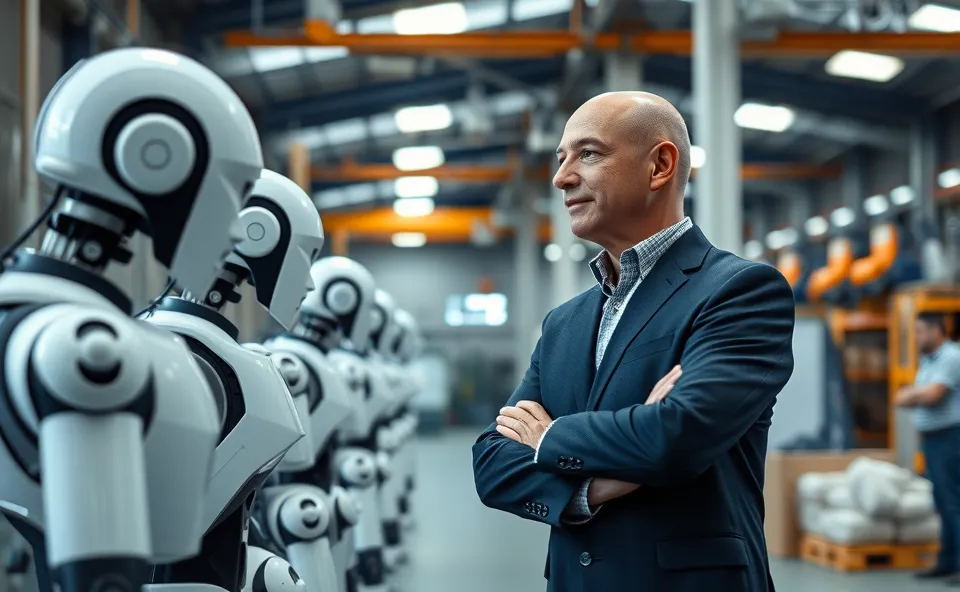
Imagine an old factory, maybe one that’s been around for decades, humming with the familiar sounds of machinery but perhaps a little tired, a little dusty. Now, imagine that same factory, but with its gears whirring smarter, its assembly lines moving with unprecedented precision, and its entire operation guided by an invisible, intelligent hand. That’s the vision Jeff Bezos is reportedly chasing with a staggering $100 billion initiative. It’s not just about buying companies; it’s about a complete overhaul, a deep dive into AI manufacturing, transforming traditional industrial sites into powerhouses of efficiency and innovation.
This isn’t a passive investment; it’s an active, hands-on play to acquire existing manufacturing firms and infuse them with cutting-edge artificial intelligence and advanced robotics. The goal is clear: take the backbone of our economy – physical production – and supercharge it for the 21st century. It’s a massive commitment, reflecting a belief that the future of production isn’t just digital, but digitally enhanced physical goods.
Why Everyone’s Talking About This Industrial Transformation Now
You might be wondering why this particular move by Jeff Bezos is generating so much buzz right now. It’s not just the sheer scale of the $100 billion fund, though that certainly catches the eye. The timing is incredibly significant. For years, we’ve heard whispers about the potential of AI, but now, its practical applications are becoming undeniable. We’re seeing AI move beyond software and into the physical world, making everything from logistics to design more efficient.
There’s also a growing global conversation around supply chain resilience and the desire for more localized production. Recent world events have highlighted the fragility of long, complex supply chains, sparking renewed interest in domestic manufacturing capabilities. By focusing on industrial transformation through AI, Bezos is not only eyeing future profits but also tapping into a strategic imperative for many nations – the need to modernize and secure their manufacturing base. This initiative offers a compelling vision for economic revitalization and a path to bringing jobs and sophisticated production back home, making the concept of AI manufacturing incredibly relevant.
From Online Books to Industrial AI: Bezos’ Legacy of Disruption
To truly understand the weight of this new venture, it helps to look at where Jeff Bezos comes from. As the Amazon founder, he didn’t just sell books online; he fundamentally reshaped retail, logistics, and even cloud computing with Amazon Web Services (AWS). His genius has always been in identifying inefficiencies in massive, established industries and then applying technology and relentless customer focus to disrupt them.
Think about it:
- He built an unparalleled e-commerce empire by digitizing shopping.
- He created AWS by recognizing that Amazon’s internal tech infrastructure could be a service for others, becoming a leader in cloud computing.
- He pushed the boundaries of logistics and delivery with highly automated warehouses and innovative shipping solutions.
Each of these ventures was an enormous tech investment that paid off by transforming entire sectors. Manufacturing, despite its vital role, has often been slow to adopt the most radical technological changes. It’s an industry ripe for the kind of disruptive thinking Bezos excels at. This $100 billion fund for manufacturing innovation isn’t a departure; it’s a natural extension of his long-standing strategy of identifying fundamental industries, investing heavily in technology, and fundamentally changing how they operate. He’s bringing his proven playbook of efficiency, scale, and automation to the world of physical production.
The Ripple Effect: How AI Manufacturing Could Change Everything
This ambitious AI investment by Jeff Bezos isn’t just about tweaking factory floors; it has the potential to send ripples across multiple sectors, impacting everything from how products are made to where people work. The scale of this industrial transformation is truly significant.
For Businesses:
- Increased Efficiency: Factories powered by AI will be able to optimize production schedules, predict maintenance needs, reduce waste, and improve quality control with unprecedented precision. This means lower costs and faster production cycles.
- Customization at Scale: AI and advanced robotics could make it feasible to produce highly customized products without the traditional cost penalties of bespoke manufacturing, opening new markets and possibilities.
- Supply Chain Resilience: By making manufacturing more agile and potentially more local, businesses could become less vulnerable to global disruptions, leading to more stable supply chains.
For Workers:
- Evolving Roles: While some fear job displacement, the reality is often a shift in roles. Routine, repetitive tasks will likely be handled by factory automation and AI, while human workers will be needed for oversight, maintenance, problem-solving, and more complex, creative tasks.
- Reskilling and Upskilling: There will be a massive demand for workers skilled in robotics, data analysis, AI maintenance, and digital manufacturing. This initiative will likely drive significant investment in training programs to equip the workforce for the future of production.
For Technology:
- Acceleration of AI and Robotics: A huge influx of capital and real-world application will accelerate the development and refinement of industrial AI, machine learning algorithms, and next-generation robotics. We’ll see faster innovation in vision systems, collaborative robots, and predictive analytics.
- Integration Challenges and Solutions: Integrating cutting-edge AI into legacy manufacturing systems isn’t easy. This initiative will likely spur new solutions and best practices for bridging the gap between old infrastructure and new technology.
This isn’t just about tech for tech’s sake; it’s about solving real-world problems and creating tangible value through smart, automated production.
What’s Next for the Future of Production?
So, what happens after an entrepreneur like Jeff Bezos commits such a colossal sum to reshaping an industry? It’s not an overnight flip of a switch, but rather a methodical, long-term strategy. The immediate future will likely involve a flurry of activity focused on acquisition and initial transformation. We can expect to see the careful selection of manufacturing firms that offer both potential for growth and a suitable environment for significant AI integration.
The process of implementing AI manufacturing and factory automation is complex. It involves:
- Pilot Projects: Starting with specific lines or processes to demonstrate the capabilities and iron out the kinks of new AI systems and advanced robotics.
- Data Infrastructure: Building robust data collection and analysis systems, as AI thrives on vast amounts of high-quality data.
- Workforce Development: Investing heavily in training existing employees and hiring new talent with specialized skills in AI, robotics, and data science.
Looking further out, if successful, this initiative could set a new global standard for how goods are made. We might see a proliferation of highly efficient, adaptable factories that can quickly retool to meet changing market demands or produce entirely new types of products. This billion-dollar fund could spark a domino effect, pushing other companies to invest in similar manufacturing innovation to remain competitive. The long-term vision is a re-imagined industrial landscape where manufacturing is not just faster and cheaper, but also smarter, more sustainable, and more responsive to the needs of the world. It’s an exciting, albeit challenging, path toward the true future of production.
Decoding the Future: FAQs on Industrial AI
What is Jeff Bezos’ AI manufacturing initiative all about?
It’s a huge strategic move where Jeff Bezos is reportedly investing $100 billion to acquire traditional manufacturing firms. The core idea is to transform these older factories by integrating advanced artificial intelligence and advanced robotics to make them hyper-efficient, smart production centers. It’s a bold bet on the power of industrial AI to revitalize the physical production sector.
How will this affect job markets and factory automation?
This initiative is likely to lead to a significant shift in the types of jobs available in manufacturing. While some manual, repetitive tasks might become fully automated through factory automation, there will be a strong demand for new skills in areas like AI oversight, robotics maintenance, data analytics, and system integration. It’s about creating new roles that work alongside smart machines, driving an economic revitalization focused on high-tech skills.
Is this solely an AI investment, or something broader?
While artificial intelligence is at its heart, this is much broader than just a software play. It’s a comprehensive industrial transformation that involves physical assets (factories), cutting-edge hardware (advanced robotics), data infrastructure, and a complete re-thinking of production processes. It’s an integrated AI investment aimed at revolutionizing the entire value chain of manufacturing.
What kind of industrial transformation can we expect?
We can expect factories to become much more agile, data-driven, and capable of higher levels of customization. Predictive maintenance, intelligent quality control, and optimized supply chains will likely become standard. This isn’t just about efficiency; it’s about creating a smarter, more resilient, and more responsive manufacturing ecosystem, leading to significant manufacturing innovation.
How does this relate to Bezos’ past as an Amazon founder?
As the Amazon founder, Jeff Bezos built a legacy on using technology to disrupt established industries and achieve unprecedented scale and efficiency. From e-commerce to cloud computing (AWS), his playbook involves heavy tech investment and a long-term vision. This new venture into AI manufacturing follows the same pattern: identifying a massive, fundamental industry ripe for technological disruption and committing substantial resources to reshape its future of production.











