

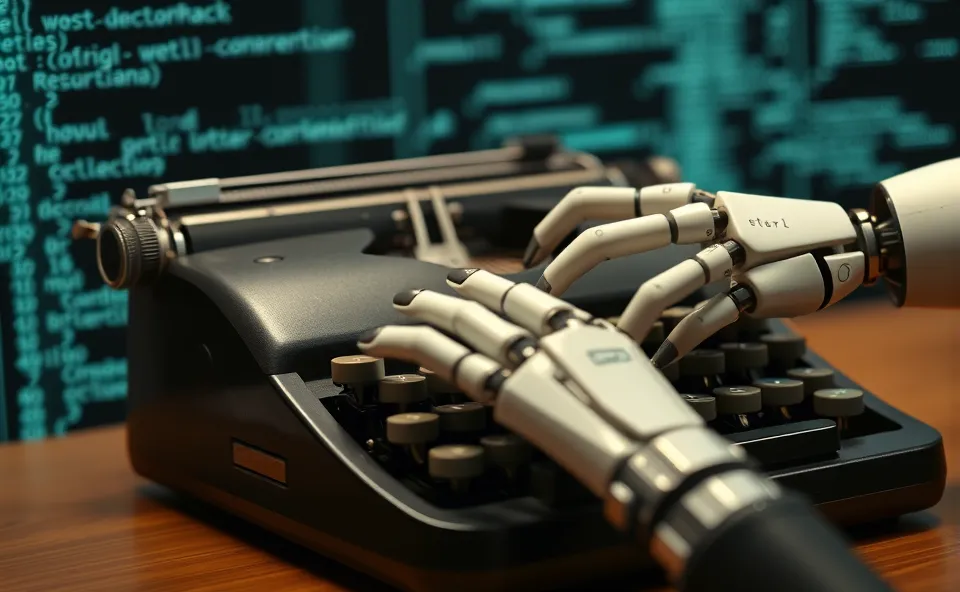
The Bots Are Taking Over the Typewriter, or Are They?
Imagine this: a news story is born not from a journalist’s late-night caffeine-fueled scribbling, but from an algorithm. That’s the reality unfolding in newsrooms everywhere. AI writing tools are stepping out of the shadows and into the daily workflow, helping to churn out articles, summarize information, and even suggest headlines. It’s a big shift, and it’s got everyone talking about what it means for the future of news.
Why Are We Talking About AI Writing in Newsrooms Right Now?
The buzz around AI writing, especially in newsroom settings, has exploded recently. Why the sudden surge in interest? Well, AI technology has gotten incredibly sophisticated. Tools that were once clunky and basic can now produce text that’s remarkably human-like, coherent, and even creative. This leap in capability means that news organizations are actively exploring and implementing these tools. They see the potential for speed, efficiency, and perhaps even reaching new audiences. Plus, with the constant demand for fresh content, AI writing offers a tempting solution to keep the presses – or rather, the webpages – rolling.
A Look Back: From Typewriters to Today’s Algorithms
For decades, the image of a newsroom involved clacking typewriters, overflowing ashtrays, and passionate reporters chasing leads. Then came computers, word processors, and the internet, revolutionizing how stories were gathered and published. But the core of content creation remained human. Now, AI writing tools are the latest evolution. Think of it as a super-powered intern. Early AI efforts in text generation were often simplistic, producing nonsensical sentences or repetitive phrases. However, with advancements in machine learning and natural language processing, these systems have learned to understand context, grammar, and even stylistic nuances. This background growth has paved the way for AI’s current prominent role in content creation, not just for news, but across many industries.
The Double-Edged Sword: AI’s Impact on News Creation
The impact of AI writing in newsrooms is multifaceted, presenting both exciting possibilities and significant challenges. For the reader, this could mean faster access to breaking news, more personalized content, and potentially a wider range of topics covered. News organizations can leverage AI-assisted writing to:
- Generate routine reports like financial summaries or sports scores quickly.
- Draft initial versions of articles that human journalists can then refine and add depth to.
- Translate content into multiple languages more efficiently.
- Analyze large datasets to identify trends and stories that might otherwise be missed.
This efficiency doesn’t come without its trade-offs. The most pressing concerns revolve around ethical considerations and the unique value of human creativity. When AI handles article drafting, what happens to the nuanced storytelling, the investigative depth, and the ethical judgment that human journalists bring? There’s a fear that over-reliance on AI could lead to a homogenization of news, where stories lack the personal touch, the critical analysis, and the original voice that readers have come to expect from trusted sources. The AI might get the facts right, but can it capture the human element, the empathy, or the critical questioning that makes journalism so vital?
For human writers, the impact is perhaps the most profound. While AI can certainly assist, there’s a delicate balance to strike. The goal isn’t to replace journalists, but to augment their abilities. However, the line can blur. Will AI-assisted writing lead to fewer opportunities for entry-level writers? Will the pressure to produce content at scale diminish the time and space for in-depth, original reporting? These are critical questions that newsrooms and writers are grappling with as they navigate this new technological landscape. The future of news likely involves a collaborative approach, where AI handles the heavy lifting of data processing and initial drafting, freeing up human journalists to focus on what they do best: deep dives, original investigations, and insightful commentary.
What Lies Ahead for AI in the Newsroom?
Looking forward, the integration of AI writing in newsrooms is only set to deepen. We’ll likely see AI tools become even more sophisticated, capable of not just drafting but also fact-checking and even suggesting editorial angles. The relationship between AI and human journalists will continue to evolve. Rather than a hostile takeover, it’s more probable that we’ll see a symbiotic relationship develop. AI could become an indispensable partner, handling repetitive tasks and providing data-driven insights, allowing human journalists to elevate their work. The focus will need to remain on maintaining journalistic integrity and fostering human creativity. News organizations will need to develop clear guidelines on AI usage, ensuring transparency with their audiences about when and how AI is employed in content creation. The future of news is probably a blend of human intuition and artificial intelligence, working together to deliver information more effectively and engagingly.
Frequently Asked Questions About AI Writing in Newsrooms
What is AI writing in a newsroom context?
AI writing in newsrooms refers to the use of artificial intelligence tools and algorithms to assist in or automate the creation of news content. This can range from drafting simple reports to summarizing complex information and even suggesting headlines, making it a form of AI-assisted writing.
How does AI writing change the role of human journalists?
AI writing can change the role of human journalists by freeing them from routine tasks, allowing them to focus on more in-depth reporting, investigation, and analysis. It acts as a tool for content creation, augmenting human capabilities rather than entirely replacing them.
Are there ethical concerns with AI-generated news content?
Yes, there are significant ethical concerns, including the potential for bias in algorithms, the risk of spreading misinformation if not properly supervised, and questions about accountability for AI-produced content. Transparency about AI involvement in content creation is also a key ethical consideration.
Can AI truly replace human creativity in journalism?
While AI can mimic creativity to a degree, it often struggles to replicate the nuanced understanding, emotional intelligence, and original insight that define human creativity in journalism. The unique perspective and critical thinking of human writers remain invaluable.
What is the future outlook for AI writing and the newsroom?
The future outlook suggests a continued integration of AI writing tools, leading to a more collaborative relationship between AI and human journalists. The focus will likely be on optimizing efficiency while upholding journalistic standards and preserving the essential human elements of storytelling.











