

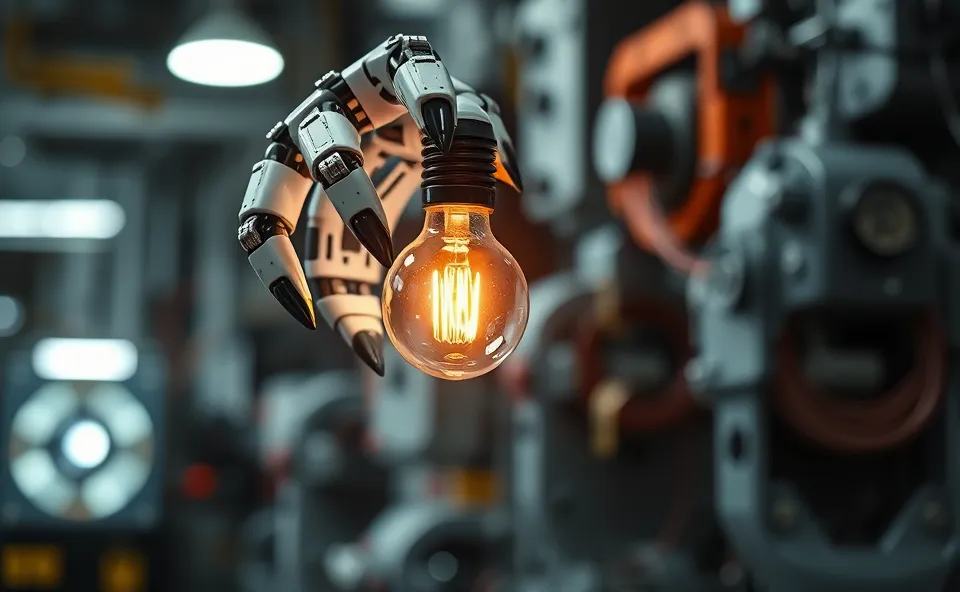
A New Kind of Touch for Machines
Imagine a robot that does not just move a part from point A to point B because it was told exactly where that part is. Instead, imagine a robot that can feel, adjust, and handle objects it has never seen before, much like you do when you reach into a bag to find your keys. This is the core of what the Eka robotic claw brings to the table.
For a long time, robots were great at repeating the same motion a thousand times without stopping. However, they were terrible at dealing with the chaos of the real world. If a box was tilted slightly to the left, a traditional robot might crash into it or miss it entirely. The Eka robotic claw changes this. It uses advanced AI to understand the physical world in real time.
This claw is not just a piece of metal. It is a system that combines sensors and smart software. It allows the robot to perceive the shape, weight, and texture of an object. When the claw touches something, it processes that data instantly. If the object starts to slip, the claw tightens its grip. If the object is fragile, it applies just enough pressure to hold it without breaking it.
This is a huge shift. We are moving away from robots that follow a script and moving toward robots that can actually think through a physical task. This level of dexterity is what makes the Eka system a breakthrough. It is the difference between a machine that follows a map and a machine that can actually see where it is going.
Why This Feels Like the ChatGPT Moment for Robotics
You might be wondering why everyone is suddenly talking about a robotic claw. To understand this, we have to look at what happened when ChatGPT arrived. Before that, AI was mostly used for specific things, like recommending a movie or filtering spam emails. Then, ChatGPT showed the world that AI could handle general language. It could write poems, code software, and have a conversation. It was a general purpose tool that could be applied to almost any text based task.
The Eka robotic claw is attempting to do the same thing for the physical world. For years, automation was specialized. You had one robot for welding and another for painting. You could not simply tell a welding robot to start folding laundry. The Eka system represents a move toward general purpose physical AI.
People are excited because this solves the biggest bottleneck in robotics. We already have the brains. We have AI that can plan, strategize, and analyze. But those brains were trapped in screens. They had no way to interact with the world around them in a meaningful way. By giving AI a sophisticated robotic claw, we are giving the brain a hand.
This is the moment where the digital intelligence of AI meets the physical capability of robotics. When people call this a ChatGPT moment, they mean that we are seeing the birth of a tool that can be used in a million different ways, rather than just one. It is the bridge between a chatbot and a helpful physical assistant.
Where Robots Used to Struggle
To appreciate how far we have come, we need to look at how industrial robots worked in the past. For decades, the gold standard for automation was precision. In a car factory, everything is perfect. The chassis is always in the exact same spot. The bolt is always the same size. In that environment, a robot does not need to think. It just needs to be precise.
But the real world is not a car factory. The real world is messy. Things are stacked unevenly. Objects are made of different materials, like plastic, glass, or fabric. Traditional robotic claws were essentially just clamps. They could open and close, but they had no sense of touch. If you asked an old school industrial robot to pick up a strawberry, it would likely crush it. If you asked it to pick up a slippery piece of metal, it would probably drop it.
The struggle was always about perception and adaptation. Engineers tried to solve this by writing millions of lines of code to cover every possible scenario. They tried to predict every mistake the robot might make. But you cannot code for every single possibility in the physical world.
This is where machine learning changed the game. Instead of telling the robot exactly how to move, researchers started letting robots learn through trial and error. They used simulations to let the robot try to pick up an object millions of times in a virtual world. By the time the AI was put into the Eka robotic claw, it had already experienced more failures and successes than a human could in a lifetime. It learned the physics of gripping and sliding on its own.
How This Changes the Way We Work and Live
The impact of this innovation reaches far beyond a single piece of hardware. When robots can handle objects with human like flexibility, the entire landscape of automation shifts.
In the world of logistics and warehousing, this is a game changer. Right now, many warehouses still rely on humans to pick and pack items because the items are too varied for robots. A robot might be able to move a pallet, but it cannot easily grab a tube of lipstick and a heavy textbook in the same session. With a smart robotic claw, automation can move into the final stages of the supply chain. This means faster shipping and lower costs for consumers.
Beyond the warehouse, think about the future of work in healthcare. We are seeing an aging global population that needs more care. Robots that can gently hold a hand, help someone move, or organize medication require a soft and intelligent touch. The precision of the Eka system opens the door for robots to assist in hospitals and homes without being dangerous to the people they are helping.
For businesses, this means a shift in strategy. Automation is no longer just for the giants with massive factories. Smaller businesses could eventually use flexible robots to handle custom packaging or intricate assembly tasks that previously required a human touch.
We also have to consider the shift in job roles. The future of work will likely involve humans managing fleets of these intelligent robots. Instead of doing the repetitive picking and sorting, people will oversee the AI, teaching it new tasks and ensuring the systems run smoothly. The focus moves from manual labor to technical oversight.
The Road Toward Truly Helpful Machines
So, where do we go from here? We are unlikely to see a robot butler in every home tomorrow, but the path is becoming clear. The next logical step is the integration of large language models with these physical systems.
Imagine a robot that you can talk to. You tell it, “Please find the blue mug and put it in the dishwasher.” To do this, the robot needs three things. First, it needs to understand your language. Second, it needs to recognize what a blue mug looks like. Third, it needs a robotic claw that can grasp a ceramic handle without breaking it.
We already have the first two. The Eka breakthrough provides the third. As these technologies merge, we will see the rise of general purpose robots that can move through a house or an office and perform a variety of tasks. They will not be programmed for one job. They will be trained to learn any job.
We will also likely see a push toward more sensitive materials. The current innovation is about the intelligence of the grip, but the next step is the material of the grip. We can expect to see synthetic skins and soft robotics that mimic human flesh, making the interaction between humans and robots feel more natural and safe.
The goal is not to replace humans, but to remove the drudgery of physical labor. By mastering the physical world, AI is moving out of the cloud and into our actual lives.
Your Questions Answered
How is the Eka robotic claw different from older robots?
Older robots followed a strict set of rules and worked best in controlled environments. The Eka robotic claw uses AI and machine learning to adapt to new objects and environments in real time, allowing it to handle items of different shapes and textures without needing a new program for every task.
Does this mean AI is now controlling physical robots?
Yes, that is exactly what is happening. While AI has lived mostly in software and screens, innovations in robotics are giving AI the ability to interact with the physical world. The AI acts as the brain, and the robotic claw acts as the hand.
Will this technology replace human workers in warehouses?
It will likely change the nature of the work. While robots will take over more of the repetitive picking and sorting tasks, humans will be needed to maintain the systems, program the AI, and handle complex problems that robots still cannot solve.
Can these robots handle fragile objects?
One of the main goals of the Eka system is dexterity. Because it uses sensors to feel how much pressure it is applying, it is designed to handle fragile objects much more safely than the heavy, rigid clamps used in older industrial robots.
What is the connection between ChatGPT and these robots?
ChatGPT was a breakthrough in general purpose language AI. The Eka robotic claw is seen as a similar breakthrough for general purpose physical AI. Both represent a shift from tools that do one specific thing to tools that can be adapted for many different uses.











