

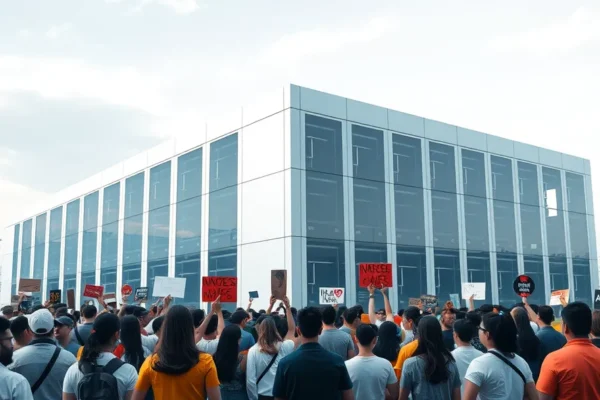
The Growing Pains of AI Infrastructure: Bridging the Divide Between Data Centers and Communities
The rapid advancement of Artificial Intelligence (AI) is fueling an unprecedented demand for powerful computing resources. At the heart of this computational engine lie AI data centers, vast complexes of servers and specialized hardware designed to process and store the immense datasets that AI models require to learn and operate. These facilities are the physical backbone of the AI revolution, enabling everything from sophisticated language models to advanced scientific research. However, the aggressive expansion of AI data centers is increasingly clashing with local communities, leading to significant opposition. This tension highlights a critical need for greater transparency and a re-evaluation of corporate secrecy, particularly the pervasive use of Non-Disclosure Agreements (NDAs), to foster public trust and pave the way for sustainable AI growth.
What’s Driving the Data Center Boom?
The current explosion in AI data center construction is directly linked to the exponential growth in AI capabilities and adoption. Technologies like generative AI, exemplified by models such as OpenAI’s GPT series and Google’s LaMDA, require colossal amounts of processing power and memory. These AI models are trained on trillions of data points, a task that demands specialized hardware like Graphics Processing Units (GPUs) and Tensor Processing Units (TPUs) working in concert within these data centers. Companies are investing billions to build and expand these facilities to keep pace with the insatiable appetite for AI-driven innovation. For instance, major tech players like Microsoft, Amazon, and Google have announced significant multi-billion dollar investments in AI infrastructure over the past year, signaling a clear commitment to scaling up their AI capabilities.
Inside the AI Data Center: A Behind-the-Scenes Look
At its core, an AI data center is a highly optimized environment for computation. Think of it like a massive, super-powered brain for computers. Instead of biological neurons, it houses thousands, even millions, of interconnected computer processors – the aforementioned GPUs and TPUs. These processors are incredibly efficient at performing the complex mathematical calculations that AI models rely on. When an AI model “learns,” it’s essentially adjusting the connections between millions of virtual neurons within its software, a process that requires an immense volume of data to be fed through these processors at high speed. Data centers also need robust cooling systems to prevent the hardware from overheating, as all this processing generates a significant amount of heat. Reliable power supply and high-speed network connections are also paramount to ensure continuous operation.
Where AI Data Centers Are Powering Our Digital World
AI data centers are the silent engine behind many of the digital services we use daily. Companies are deploying these facilities globally to support a wide range of applications. For example, cloud computing providers like Amazon Web Services (AWS), Microsoft Azure, and Google Cloud Platform offer access to AI infrastructure, allowing businesses of all sizes to develop and deploy their own AI solutions without building their own data centers. This is crucial for industries like healthcare, where AI is used for medical imaging analysis and drug discovery; finance, for fraud detection and algorithmic trading; and retail, for personalized recommendations and supply chain optimization. The maturity level of AI data centers is already quite advanced, with significant deployment across major tech hubs and increasingly in more distributed locations to reduce latency for end-users.
The Competitive Arena for AI Infrastructure
The race to build and maintain leading AI data centers is fierce, with a few dominant players shaping the landscape. Major cloud providers—AWS, Azure, and Google Cloud—are not only building their own extensive data center networks but also offering these services to third parties. Beyond these giants, specialized AI companies and even traditional hardware manufacturers are investing in or partnering for AI infrastructure. For instance, NVIDIA, a leading provider of GPUs, is a critical enabler for AI data centers, and their partnerships with hyperscalers are central to the ecosystem. The competitive advantage often lies in economies of scale, access to cheap and reliable energy, sophisticated cooling technologies, and the ability to secure specialized hardware like the latest AI chips. Alternatives to massive centralized data centers are also emerging, such as edge computing, which involves processing data closer to where it’s generated, but for the most intensive AI training and inference, large-scale data centers remain indispensable.
The Ripple Effects: How Data Centers Reshape Our World
The expansion of AI data centers has profound implications, both positive and challenging. Economically, they create high-skilled jobs in construction, engineering, and maintenance, and attract significant investment into local economies. They are the bedrock for new AI-powered businesses and services, potentially driving innovation and economic growth across various sectors. Socially, they enable advancements in fields like healthcare, education, and scientific research, promising to improve quality of life. However, the scale of these facilities also raises concerns. Their substantial energy consumption contributes to carbon footprints, and their demand for water for cooling can strain local resources. The noise and visual impact can also affect quality of life for nearby residents. The timeline for these impacts is immediate and ongoing, with current construction projects and operational facilities already influencing local environments and economies.
Navigating the Hurdles: Challenges in Data Center Expansion
Despite the rapid growth, AI data centers face significant challenges. The sheer energy demand is a major bottleneck, often requiring dedicated power substations and raising questions about reliance on fossil fuels. Water usage for cooling is another critical concern, especially in water-scarce regions. The cost of building and maintaining these highly specialized facilities is astronomical, requiring immense capital investment. Furthermore, the public perception and acceptance of these large industrial complexes can be a significant hurdle. Communities often express concerns about environmental impact, traffic, and the aesthetic disruption to their neighborhoods. Overcoming these challenges will require innovative solutions in energy efficiency, renewable energy sourcing, and water management.
The Path Forward: Transparency as a Bridge to Trust
The growing tension between AI data center expansion and community opposition underscores a critical need for enhanced transparency and a re-evaluation of corporate NDAs. Often, details about the scale of operations, energy consumption, water usage, and even the specific technologies being deployed are shielded by these agreements, leaving communities feeling uninformed and powerless. Removing or significantly reducing the reliance on NDAs, particularly in areas affecting public resources and community well-being, could serve as a vital bridge for public trust.
When companies are more open about their planned or existing data center operations, communities can engage in more informed discussions about potential impacts and collaboratively seek solutions. This might involve joint efforts to identify renewable energy sources, implement advanced water conservation strategies, or mitigate noise pollution. Local government policies that mandate greater disclosure from data center developers, even when they are not directly public entities, could also be crucial. Fostering a culture of open communication, where companies proactively share information and engage with residents, is essential for ensuring that the vital infrastructure for AI growth can be developed responsibly and with community support. The future of sustainable AI growth depends not just on technological innovation, but also on building and maintaining robust public trust.
Frequently Asked Questions About AI Data Centers and Community Relations
What exactly are AI data centers?
AI data centers are specialized facilities that house powerful computing hardware, like servers equipped with graphics processors (GPUs) and other accelerators, designed to handle the massive computational needs of artificial intelligence and machine learning tasks, such as training complex AI models.
Why is there opposition to AI data centers?
Opposition often stems from concerns about the significant environmental impact, including high energy consumption and water usage for cooling, as well as potential noise pollution, increased traffic, and the aesthetic effect on local landscapes.
How can transparency help resolve data center opposition?
Transparency, by allowing communities to understand the specifics of a data center’s operations, energy needs, and environmental mitigation plans, fosters informed dialogue, builds trust, and enables collaborative problem-solving between developers and residents, moving beyond speculation and fear.
Are corporate NDAs a major obstacle to transparency?
Yes, the extensive use of NDAs by technology companies often limits the information available to the public and local governments about data center projects, hindering open discussion and making it difficult for communities to assess potential impacts and voice their concerns effectively.
What are some examples of LSI keywords related to this topic?
Related terms include AI infrastructure, public trust, data center moratoriums, community relations, tech transparency, environmental impact, local government policy, corporate NDAs, and sustainable AI growth, all of which are interconnected with the expansion of AI data centers.
How can local governments address data center concerns?
Local governments can address concerns by implementing clear zoning regulations, requiring comprehensive environmental impact assessments, mandating public disclosure of operational data (energy, water use), and actively facilitating dialogue between developers and community stakeholders.
This article discusses emerging technological developments. While efforts have been made to ensure accuracy, the rapidly evolving nature of AI and data center technology means that some information may be subject to change. The views and interpretations presented here are based on publicly available information and expert analysis.



