

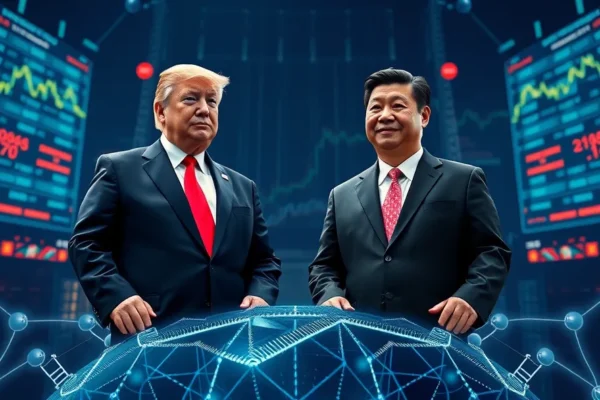
Navigating the AI Storm: Investor Strategies in a US-China Tech Divide
The landscape of Artificial Intelligence (AI) investment is becoming increasingly complex, shaped by escalating geopolitical tensions between the United States and China. The dynamic between leaders like President Trump and President Xi has amplified existing trade tensions, creating a significant AI divide. Investors are now compelled to develop sophisticated strategies to navigate this evolving tech rivalry, seeking opportunities while mitigating risks in a climate of market uncertainty. This analysis explores how global investors are approaching AI investment amidst this backdrop, considering the semiconductor war, policy implications, and the quest for innovation funding.
US-China AI Divide: The Strategic Pivot for Investors
The core development prompting this strategic re-evaluation is the intensifying technological competition between the US and China, particularly in the advanced field of AI. This isn’t a single announcement but an ongoing series of policy shifts, trade restrictions, and strategic investments by both nations. For instance, the US government’s export controls on advanced semiconductor technology to China, initiated under the Trump administration and largely continued, have directly impacted the supply chains essential for AI development. Similarly, China’s stated ambition to become a global leader in AI by 2030, backed by substantial government funding and domestic market development, signals a strategic counter-move. These actions, often framed within the broader context of the Trump Xi meeting and their ensuing dialogues, have created a bifurcated market where technology can no longer flow freely across borders. Investors, therefore, face a crucial decision: to bet on one side of the divide or attempt to play both sides, albeit with increased complexity.
The Rationale Behind Investor Adjustments
The primary driver for investor strategy shifts is the need to adapt to increased regulatory risk and the potential for further economic decoupling. Geopolitical friction, exemplified by the prolonged trade tensions between the US and China, creates uncertainty around the long-term viability of cross-border AI collaborations and market access. Companies that once relied on global supply chains and international markets now face the prospect of national restrictions. For investors, this translates to a higher risk profile for investments tied to globalized operations. The strategic rationale for adjusting AI investment strategies is multifaceted. Firstly, it’s about risk mitigation: protecting capital from sudden policy changes, export bans, or retaliatory measures. Secondly, it’s about capturing growth in distinct ecosystems: recognizing that the US and China are building increasingly self-sufficient AI capabilities. Investors are therefore looking to identify companies that can thrive within these separate spheres or those with a resilient, diversified strategy. The pursuit of innovation funding also plays a role; as governments pour resources into domestic AI champions, investors are keen to align with these national priorities, understanding that significant opportunities lie in supporting the declared strategic objectives of either superpower.
Competitive Dynamics in the Tech Rivalry
The US-China AI divide inherently reshapes the competitive landscape. Companies operating predominantly in the US are increasingly focused on domestic innovation and supply chain resilience, often benefiting from government incentives for onshoring or “friend-shoring” production. Conversely, Chinese AI firms, bolstered by domestic capital and a large internal market, are pushing forward with their own technological advancements. For example, companies like Nvidia, a key player in AI chip manufacturing, face scrutiny in both markets. While their advanced GPUs are crucial for US AI development, their sales to China are increasingly restricted, impacting revenue. On the Chinese side, companies like Baidu and Tencent are accelerating their AI research and development, aiming to reduce reliance on foreign technology. Investors who previously sought broad global exposure now must choose where to focus. Those backing US-centric AI stocks might see slower growth due to stricter export controls on cutting-edge technology to China but benefit from strong domestic innovation funding and government support. Investors in Chinese AI firms, however, face significant regulatory overhangs from US actions and internal policy shifts but tap into a vast and rapidly expanding domestic market. This bifurcated market presents a win for companies that can establish strong positions within either the US or Chinese ecosystem, while global players face the challenge of navigating these increasingly divergent paths.
Industry Trends and the Road Ahead for AI
This geopolitical dynamic signals a broader trend toward technological nationalism and the fragmentation of global supply chains, particularly in critical sectors like semiconductors and AI. The “semiconductor war” is a clear manifestation of this, with both the US and China investing heavily in domestic chip production and research to reduce reliance on international dependencies. This fragmentation is likely to accelerate innovation within national boundaries but could also lead to duplication of efforts and slower overall global progress. Industry peers are already responding by re-evaluating their global footprint and supply chain strategies. Many multinational tech companies are exploring options to diversify their manufacturing and research facilities, moving away from single-country dependencies. This trend of economic decoupling, while potentially increasing short-term market uncertainty, could foster the growth of regional AI hubs. The pressure is on companies to demonstrate adaptability and resilience. Investors will be closely watching which companies can successfully navigate these shifting alliances and capitalize on the growth within burgeoning national AI ecosystems. The future of AI innovation may not be a single, unified global effort but a series of powerful, albeit somewhat isolated, national or regional advancements.
Financial and Operational Realities for AI Investors
The financial and operational impacts of this AI divide are significant and varied. For US-based AI companies, reliance on Chinese markets for sales may decrease, potentially impacting revenue growth. However, increased domestic investment in AI, spurred by government initiatives and a focus on national security, could offset these losses. For instance, the CHIPS and Science Act in the US aims to boost domestic semiconductor manufacturing, a critical component for AI. This could lead to increased investment in US-based chipmakers and AI hardware companies. Conversely, Chinese AI firms might see their access to advanced US technology, like high-end chips, severely restricted. This could slow the pace of their most advanced AI development in the short to medium term, forcing them to rely more heavily on domestic innovation and alternative solutions. Operationally, companies are being forced to restructure their supply chains, often at considerable cost. Diversifying manufacturing and research facilities to reduce single-country reliance, or “friend-shoring” to politically aligned nations, can increase operational complexity and costs. The long-term financial impact will depend on the success of these strategic realignments and the ability of companies to tap into growing domestic markets and innovation ecosystems. Market uncertainty, fueled by ongoing trade tensions and policy unpredictability, will likely continue to affect AI stock valuations.
Execution Risks and Strategic Challenges
Despite the strategic imperatives, executing these adjusted investment strategies is fraught with challenges. A primary risk is the uncertainty of policy execution. Government policies, especially in areas as dynamic as tech geopolitics, can change rapidly, making long-term planning difficult. For companies pursuing a strategy of building independent domestic capabilities, the risk lies in the pace and quality of domestic innovation. Can national champions truly replicate or surpass the advancements made in a globally collaborative environment? In China, for example, the reliance on domestic chip production, while a strategic goal, faces significant technical hurdles and a long development timeline. In the US, the push for reshoring manufacturing faces challenges related to labor costs, skilled workforce availability, and established global supply chain efficiencies. Historical precedents show that such large-scale industrial policy shifts are complex and often take longer and cost more than anticipated. For instance, efforts to onshore critical manufacturing have faced numerous setbacks in the past. Organizational challenges, such as adapting to new regulatory environments and managing diversified operational footprints, also pose significant risks. Market risks, including shifts in consumer demand and competitive responses, can further complicate execution.
Stakeholder Implications in a Fragmented AI World
The ramifications of this US-China AI divide extend to various stakeholders. For employees, it may mean shifts in job opportunities, with potential growth in domestic R&D and manufacturing roles in both countries, but also job displacement in areas reliant on globalized operations. Customers might face higher prices or limited choices as companies navigate supply chain disruptions and localized production. The quality and accessibility of AI services could also be impacted. Partners, particularly those deeply embedded in global supply chains, face the difficult task of reconfiguring their business relationships to align with national interests and regulatory requirements. For investors, the implication is a need for greater diligence and a nuanced understanding of geopolitical risks alongside technological potential. Market sentiment towards AI stocks could become more volatile, influenced by policy pronouncements and geopolitical developments. Culturally, this divide could foster a sense of national pride in domestic technological achievements but also create an environment of suspicion and reduced international collaboration, potentially hindering the free flow of ideas that has historically driven innovation.
Outlook and Next Steps for AI Investment
If these evolving investor strategies prove successful, the next steps will involve the consolidation of AI capabilities within distinct national or regional blocs. We can expect to see increased investment in domestic semiconductor foundries and AI research labs in both the US and China. Key milestones to watch include significant breakthroughs in domestic chip manufacturing, the successful commercialization of indigenous AI platforms, and the expansion of AI applications within each nation’s economy. For instance, the US might see a surge in AI-powered advanced manufacturing and defense technologies, while China could lead in AI applications for its vast consumer market and smart city initiatives. Indicators of success will include sustained revenue growth for companies focused on specific ecosystems, demonstrable progress in closing the technology gap in critical areas like advanced chip design and manufacturing, and the formation of robust domestic innovation pipelines. The timeline for truly measurable outcomes will likely span several years, with short-term impacts visible in supply chain adjustments and medium-term impacts in innovation speed and market share shifts.
Key Questions and Answers for AI Investors
Will this investor strategy of navigating the US-China AI divide succeed?
Success will depend on the ability of investors to accurately assess geopolitical risks, identify companies with strong domestic ecosystems, and adapt to rapidly changing policies. It’s a strategy that prioritizes resilience and focused growth over broad global diversification.
Why are investors separating AI investment strategies based on national divides?
The Trump Xi meeting and subsequent geopolitical tensions have highlighted the risks of globalized tech supply chains. Investors are separating strategies to mitigate the impact of trade restrictions and economic decoupling, focusing on national champions and localized innovation.
What are the primary risks for AI investment in this environment?
Key risks include sudden policy changes, escalating trade wars, difficulties in achieving domestic technological parity, and the potential for market uncertainty impacting AI stocks. Execution risk in building new supply chains and fostering independent innovation is also significant.
How will the semiconductor war affect AI investment?
The semiconductor war directly impacts the availability of advanced chips essential for AI development. Investors are shifting focus to companies that can secure chip supplies within their chosen market or those investing heavily in domestic chip manufacturing and design capabilities.
What are the long-term implications of this tech geopolitics for global AI investment?
The long-term outlook suggests a more fragmented global AI landscape, with distinct US and Chinese AI ecosystems. This could lead to parallel innovation paths but potentially slower overall progress and increased costs due to duplicated efforts.
How long until we see tangible results from these new investor strategies?
Tangible results, such as companies achieving self-sufficiency in critical technologies or significant market share gains within their chosen ecosystems, are likely to take several years. Short-term impacts will be seen in financial reporting and supply chain adjustments.
This analysis highlights the complex strategies investors are employing to navigate the US-China AI divide. It is crucial to remember that business outcomes are subject to execution risk and the unpredictable nature of geopolitical events.











