

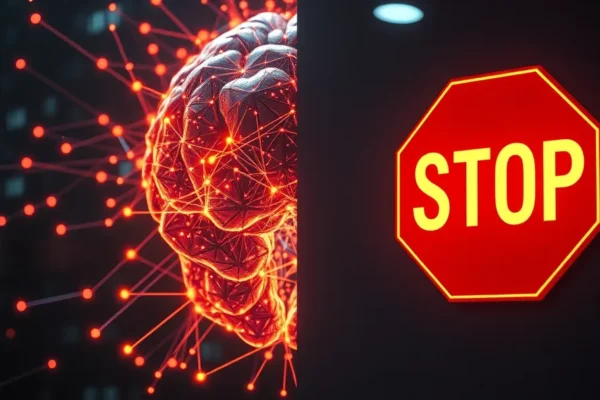
The Curious Call for an AI Slowdown
In recent months, a fascinating and somewhat contradictory narrative has emerged from the very companies at the forefront of artificial intelligence development. Leaders at major AI labs, including OpenAI and Anthropic, have begun publicly calling for a pause or slowdown in the pace of AI development. This plea, particularly concerning the pursuit of “AI superintelligence” – hypothetical AI systems far exceeding human intellect – appears at odds with their own aggressive research and development efforts. What drives this seemingly paradoxical stance? The answer lies in a complex interplay of genuine safety concerns, strategic market positioning, and the looming shadow of global regulation.
OpenAI, led by CEO Sam Altman, along with researchers from Anthropic, have voiced concerns about the potential risks associated with rapidly advancing AI. These discussions gained significant traction following internal debates and public statements that highlighted the unpredictable nature of cutting-edge machine learning models. The call for a slowdown is not a blanket rejection of AI progress, but rather a plea for more deliberate and cautious advancement, especially as we approach capabilities that could dramatically alter society. This development is significant because it signals a moment of self-reflection within the industry, acknowledging that the rapid march towards more powerful AI might outpace our ability to understand and manage its consequences.
Understanding the Engine Behind the Calls
At its core, the current generation of advanced AI, often referred to as “frontier AI,” operates through complex systems called neural networks. Think of these like incredibly vast and intricate digital brains, composed of interconnected layers of artificial neurons. These networks are trained on massive datasets – think of them as digital libraries containing nearly all the text, images, and code available online. Through a process called machine learning, the AI learns to recognize patterns, make predictions, and generate new content based on this data.
When experts talk about “AI superintelligence,” they are referring to a future state where such systems might not only match human intelligence but vastly surpass it across virtually all domains, from scientific discovery to strategic planning. The concern is that as these systems become more capable and autonomous, their actions might become increasingly difficult for humans to predict or control. The “how” of their decision-making can become a “black box,” meaning even their creators struggle to fully explain why a particular output was generated. This opacity is a key driver of the safety concerns; if we don’t understand how an AI arrives at a conclusion, managing its potential negative impacts becomes significantly harder.
Where We Are Now: AI in Our Daily Lives
While the concept of AI superintelligence remains largely in the realm of future speculation, the underlying technologies are already deeply embedded in our daily lives. Natural language processing (NLP) models, the type that power chatbots like ChatGPT, are revolutionizing customer service, content creation, and even coding assistance. For example, companies like Microsoft have integrated OpenAI’s models into their productivity suites, offering AI-powered writing suggestions and summarization tools.
In healthcare, machine learning algorithms are assisting in diagnosing diseases from medical images with remarkable accuracy, and in finance, AI is used for fraud detection and algorithmic trading. These applications are largely in the “early adoption” to “mainstream” phases, meaning they are available now to businesses and, in many cases, directly to consumers. The accessibility is rapidly increasing, with many AI tools offered through cloud platforms or as standalone applications. This widespread, albeit more narrowly focused, adoption of AI makes the concerns about future, more potent AI even more relevant.
A Race for Dominance and Prudence
The competitive landscape in advanced AI is dominated by a few key players. OpenAI, backed by Microsoft, has been a prominent leader with its GPT series of models. Google DeepMind, a subsidiary of Alphabet, is another major force, known for its breakthroughs in areas like protein folding with AlphaFold and its development of large language models like Gemini. Anthropic, founded by former OpenAI employees, is also a significant competitor, focusing heavily on AI safety and developing models like Claude designed to be more harmless and honest.
OpenAI’s call for a slowdown, particularly when they are leading in many benchmarks, can be seen through several lenses. On one hand, it might be a genuine expression of concern from researchers aware of the profound implications of their work. On the other hand, it could also be a strategic move to shape the narrative around AI development. By advocating for caution, they might be attempting to influence future AI regulation in a way that benefits their current lead, potentially creating barriers for smaller, less resourced competitors who cannot afford extensive safety research. This puts them in a delicate position, competing with entities like Google, which also possesses vast resources and is pushing the boundaries of AI development.
Reshaping Our World, For Better or Worse
The implications of advanced AI, and potentially AI superintelligence, are vast and multifaceted. Economically, we are already seeing shifts. AI-powered automation could lead to increased productivity and new job categories focused on AI management and development, but it also raises concerns about job displacement in sectors susceptible to automation. Businesses that effectively integrate AI are likely to gain significant competitive advantages, potentially leading to market consolidation.
Socially, AI offers immense potential benefits, from accelerating scientific discovery and personalized education to addressing global challenges like climate change. However, the potential concerns are equally profound. Issues like algorithmic bias, misinformation amplified by AI, and the erosion of privacy are already pressing challenges. The development of increasingly powerful AI raises ethical questions about control, accountability, and the very definition of consciousness. The timeline for these impacts is already unfolding, with significant societal shifts expected within the next decade.
Navigating the Minefield of Challenges
Despite the rapid progress, significant limitations and challenges remain. The immense computational power and vast datasets required to train state-of-the-art AI models are prohibitively expensive, creating a barrier to entry for many researchers and organizations. Furthermore, the reliability and predictability of current AI systems are not absolute. “Hallucinations,” where AI generates false or nonsensical information, are a persistent problem. Ensuring AI’s alignment with human values and intent is a monumental technical and philosophical challenge.
Moreover, the rapid pace of development creates a constant race against unforeseen consequences. The lack of comprehensive regulatory frameworks globally means that developers are often navigating uncharted territory. Public trust is another significant hurdle; incidents of AI misuse or perceived bias can erode confidence and slow adoption. These bottlenecks mean that while current AI is impressive, the leap to superintelligence is fraught with technical, ethical, and societal hurdles that are far from solved.
The Road Ahead: Evolution, Not Revolution?
The future trajectory of AI development is a subject of intense debate. While some predict an imminent surge towards superintelligence, others believe that progress will be more gradual, marked by continuous improvements in specialized AI capabilities rather than a sudden leap. Key developments to watch include advancements in AI’s ability to reason, understand context, and learn with less data. Research into more interpretable and transparent AI models is also crucial for building trust and enabling better control.
The timeline for significant breakthroughs remains uncertain, with estimates varying widely. Companies like OpenAI and Google continue to invest heavily, suggesting that progress will likely be sustained. However, the ethical and safety considerations called for by many within the AI community will undoubtedly play a crucial role in shaping this future. Balancing innovation with responsible deployment will be the defining challenge of the coming years.
Your AI Questions Answered
What is AI superintelligence?
AI superintelligence refers to a hypothetical future artificial intelligence that possesses intellect far exceeding that of the brightest human minds across virtually all fields of endeavor. It is currently a theoretical concept, not a present reality.
Why are AI companies calling for a slowdown?
The calls for an AI slowdown, particularly from companies like OpenAI and Anthropic, stem from genuine concerns about the potential risks and unpredictable nature of rapidly advancing AI systems. They also reflect strategic considerations regarding market positioning and the anticipation of global AI regulation.
Is this technology available now?
The underlying technologies that drive advanced AI, such as large language models, are widely available now and are being integrated into various applications. However, the hypothetical AI superintelligence is not yet developed and remains a future possibility.
Who benefits from the current AI development race?
Currently, early adopters of AI technologies, including large corporations and tech-savvy consumers, are benefiting from increased efficiency, new capabilities, and innovative products. The long-term beneficiaries of potential AI superintelligence are still a matter of speculation, but could encompass society at large if managed responsibly.
What are the main risks of advanced AI development?
Key risks include the potential for job displacement due to automation, the amplification of misinformation and bias, erosion of privacy, and the broader societal challenges associated with creating systems that might become difficult to control or align with human values.
How long until we see AI superintelligence?
There is no consensus on the timeline for AI superintelligence. Some experts believe it could arrive within decades, while others argue it is much further off, or may never be achieved. The current calls for a slowdown suggest a desire to ensure society is prepared for such an eventuality, whenever it may occur.
This article is based on publicly available information and expert discussions concerning the current state and future potential of artificial intelligence. The field of AI is rapidly evolving, and predictions about future capabilities should be viewed with appropriate caution.











