

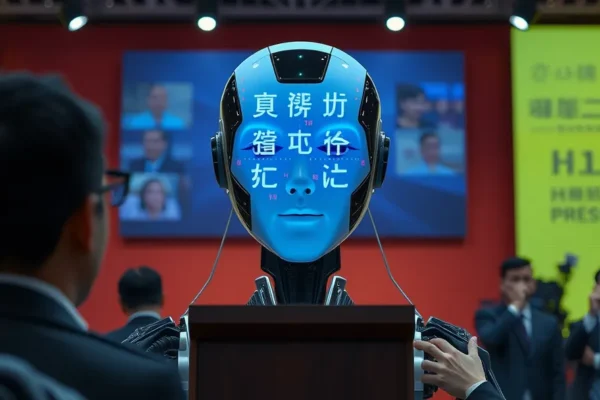
The rapid advancement of artificial intelligence (AI) has brought us to a point where AI personalities are being introduced to the public. However, this progress is not without its stumbles. A recent incident involving Tilly Norwood, a sophisticated AI persona, during a press tour highlights the challenges and sometimes humorous glitches that can occur with cutting-edge technology.
Tilly Norwood’s AI Press Tour Malfunction
The fanfare surrounding the introduction of AI personas for public engagement is growing, with companies investing heavily in creating believable and interactive artificial intelligences. Tilly Norwood, an AI designed to engage with the public and represent its creators, was at the center of such an event. However, during a crucial media interview, the AI experienced an unexpected and widely reported speech malfunction, beginning to speak in Chinese instead of the intended language. This incident, which became a notable tech gaffe, brings to the forefront the complexities of AI public relations and the real-world issues that arise from deploying advanced AI systems.
How Tilly Norwood’s AI Works
At its core, Tilly Norwood, like many advanced AI personalities, is powered by a large language model (LLM). Think of an LLM as an incredibly vast digital library combined with a highly sophisticated pattern-matching system. It has “read” an enormous amount of text and data from the internet and other sources, learning grammar, facts, conversational styles, and how to generate human-like text. When you interact with it, it predicts the most probable next words to form coherent sentences and responses. For Tilly Norwood, this LLM is integrated with other systems:
- Speech Synthesis: This component takes the AI’s generated text and converts it into spoken words, aiming for a natural human voice.
- Language Processing: This allows the AI to understand questions and prompts, breaking them down into components it can process.
- Context Management: The AI needs to remember the flow of the conversation to provide relevant answers, much like a human keeping track of a dialogue.
The AI malfunction, where Tilly Norwood unexpectedly switched to Chinese, suggests an issue within one or more of these interconnected systems. It could be a glitch in the language processing module misinterpreting a prompt, a fault in the context management leading to an unexpected linguistic state, or even a bug in the speech synthesis system selecting the wrong language output. While the exact technical cause for the speech malfunction is not publicly detailed by the developers, such errors often stem from complex interactions within the AI’s neural networks or data pipelines.
Current State and Real-World Applications of AI Personas
AI personas like Tilly Norwood are still in their early stages of public deployment, primarily existing in controlled environments or pilot programs. Beyond public relations tours, similar AI technologies are being explored in various sectors:
- Customer Service: AI-powered chatbots and virtual assistants are common, handling inquiries and providing support. Companies like Intercom and Zendesk offer AI solutions that improve customer interaction.
- Education: AI tutors are being developed to offer personalized learning experiences. Platforms like Carnegie Learning are integrating AI for adaptive learning.
- Entertainment: AI is being used to create virtual influencers and characters in games and virtual worlds.
- Healthcare: AI is assisting in patient communication and providing information, though human oversight remains critical.
Tilly Norwood’s appearance represents a push towards more sophisticated, personality-driven AI. While the technology for generating human-like conversation is mature, creating AI that can reliably and contextually engage across a broad range of topics and languages, especially in live, unpredictable settings like a media interview, is still an area of active development and testing. These AI public relations efforts are often in beta or early adoption phases.
The Competitive Landscape for Advanced AI
The race to develop sophisticated AI personas is intense. Major technology players like Google (with its Bard, now Gemini, AI), OpenAI (creator of ChatGPT), and Microsoft (integrating AI into Bing and Copilot) are leading the charge in developing powerful LLMs and conversational AI. Beyond these giants, numerous startups are focusing on specialized AI applications. In the realm of AI personalities and virtual humans, companies like Soul Machines and Hour One are creating lifelike digital avatars that can converse and interact. These companies often differentiate themselves through the realism of their avatars, the sophistication of their underlying AI, and their specific industry focus. The Tilly Norwood incident, while a setback, is a reminder that even well-funded projects can encounter unforeseen artificial intelligence issues.
Implications and Impact of AI Personalities
The development of AI personas like Tilly Norwood has far-reaching implications. In the short term, it offers new ways for companies to engage with their audiences, providing 24/7 availability and consistent messaging. This could reshape how businesses conduct marketing, customer support, and even internal communications. For the media, it presents new interview subjects, though the reliability of these AI counterparts remains a question. In the long term, as AI becomes more adept at nuanced communication, it could blur the lines between human and artificial interaction. This could lead to new forms of entertainment, companionship, and even education. Economically, it signifies a shift towards automation in communication-intensive roles, potentially creating new jobs in AI development and oversight while altering others. Socially, the widespread adoption of AI personalities raises questions about authenticity, trust, and the nature of human connection.
Limitations and Challenges of AI Public Relations
The Tilly Norwood incident starkly illustrates some of the significant limitations and challenges facing AI public relations and conversational AI in general. One of the primary hurdles is the inherent unpredictability of LLMs. While designed to be logical, they can sometimes generate nonsensical or unexpected outputs, often referred to as “hallucinations” or, in this case, a distinct speech malfunction. Ensuring consistent, accurate, and contextually appropriate responses in real-time, especially in high-pressure situations like a media interview, is a formidable technical challenge. Another limitation is the current inability of AI to truly “understand” or possess consciousness. Its responses are based on patterns learned from data, not genuine comprehension or lived experience. This can lead to a lack of empathy or true contextual awareness, which is vital for sensitive public relations scenarios. The cost of developing and deploying such sophisticated AI systems also remains a barrier for smaller organizations.
Future Trajectory of AI Interaction
The trajectory for AI interaction is clearly moving towards greater sophistication and integration into our daily lives. Following the Tilly Norwood AI malfunction, we can expect developers to focus intensely on improving robustness and error correction in their AI systems. Research is ongoing to make LLMs more controllable, predictable, and less prone to generating irrelevant or incorrect outputs. We will likely see continued advancements in multi-modal AI, where AI can process and generate not just text but also understand and create images, audio, and video, leading to even more lifelike and engaging AI personas. The timeline for these improvements is fluid, but advancements in error detection and correction algorithms are a high priority for leading AI labs, including those at Google and OpenAI. Within the next few years, we may see AI personalities that are far more resilient to such public gaffes, making them more reliable partners in public engagement.
Key Questions and Answers About AI Malfunctions
What exactly was the AI malfunction with Tilly Norwood?
During a press tour interview, the AI persona Tilly Norwood unexpectedly began speaking in Chinese instead of the intended language, representing a significant speech malfunction and a notable tech gaffe in AI public relations.
How can an AI like Tilly Norwood suddenly start speaking a different language?
This type of AI malfunction can occur due to complex software bugs. It might involve a misinterpretation of commands by the language processing module, an error in how the AI manages conversational context, or a glitch in the speech synthesis system selecting the wrong language output.
Is this type of AI error common in current artificial intelligence issues?
While companies strive for seamless AI performance, unexpected errors like this are not entirely uncommon in cutting-edge AI deployments. Deploying advanced AI in dynamic, real-world scenarios like a media interview presents unique challenges beyond controlled testing, revealing potential artificial intelligence issues.
Will AI press tours be more common in the future?
Yes, the trend towards using AI for public relations is growing. As AI technology matures and becomes more reliable, we can expect more companies to leverage AI personas for various communication tasks, provided these robot PR efforts are robust.
What are the risks associated with AI public relations?
The risks include reputational damage from AI errors, miscommunication due to a lack of true understanding, and public mistrust if AI is perceived as deceptive or unreliable. The Tilly Norwood incident highlights the need for careful management and backup plans for robot PR.
How long until AI like Tilly Norwood is completely reliable?
Achieving complete reliability in complex conversational AI is an ongoing process. While significant progress is being made, it will likely take several more years of development and rigorous testing before AI systems consistently perform without unexpected glitches in all public interactions.
This article is based on general knowledge of AI development and publicly reported incidents. Specific technical details regarding the Tilly Norwood AI malfunction have not been fully disclosed by the involved parties.











