

Understanding Market Capitalization: How Big is a Company?
Imagine you want to buy a small local bakery. You’d look at how much it’s worth. You’d count the ovens, the ingredients, the cash in the register, and maybe even how many people like their cakes. That’s a bit like understanding a company’s value. In the world of big businesses, especially giants like Apple, we use a concept called market capitalization.
Market capitalization, often shortened to “market cap,” is essentially the total value of a company as determined by the stock market. Think of it as the price tag for the entire company if you were to buy all of its shares at once. It’s a crucial number because it gives us a quick way to understand the size and significance of a company in the grand scheme of the economy.
Why should you care about market cap? It helps you grasp the scale of businesses you hear about daily. When you hear about Apple being a “$4.85 trillion company” (a figure that fluctuates), it means its market cap reached that astronomical number. This tells you it’s not just a small outfit; it’s a massive entity that impacts many parts of our economy, from the jobs it creates to the products we use. Understanding market cap helps you interpret financial news and understand the economic power wielded by these tech giants.
How Market Capitalization is Calculated and Applied
Calculating market cap is surprisingly straightforward, though the numbers can be huge. Here’s the simple formula:
Market Capitalization = Current Share Price × Total Number of Outstanding Shares
Let’s break that down:
- Current Share Price: This is the price of one single share of the company’s stock on the stock market at any given moment. Stock prices change throughout the trading day based on supply and demand.
- Total Number of Outstanding Shares: This is the total number of shares that the company has issued and are currently held by investors (like you, if you owned a piece of the company) and insiders.
So, if a company has 1 million shares, and each share is trading for $10, its market cap is $1 million × $10 = $10 million. If another company has 1 billion shares, and each share is trading for $10, its market cap is 1 billion × $10 = $10 billion.
Imagine you’re comparing two lemonade stands. Stand A sells 10 cups for $1 each, and its total “shares” (let’s say, ownership stakes) are 10. Stand B sells 100 cups for $1 each, and it has 100 ownership stakes. If Stand A’s stake is worth $5, its market cap is 10 stakes × $5/stake = $50. If Stand B’s stake is worth $5, its market cap is 100 stakes × $5/stake = $500. Stand B is clearly a much larger operation in this analogy.
Market cap is a primary way investors categorize companies:
- Large-Cap Companies: Typically have a market cap of $10 billion or more. These are often well-established, stable companies.
- Mid-Cap Companies: Usually range from $2 billion to $10 billion. They are growing but might be more volatile than large-caps.
- Small-Cap Companies: Generally between $300 million and $2 billion. They often have high growth potential but also higher risk.
These categories help investors make decisions based on their risk tolerance and investment goals. For instance, Apple is firmly in the mega-cap or ultra-large-cap category.
Why Apple’s Market Capitalization Matters to Everyone
When we talk about Apple’s journey to becoming a company with a market capitalization in the trillions of dollars, it’s not just an abstract number for Wall Street. It has real-world implications for everyday people and the broader economy.
For your personal finances: If you invest in the stock market, directly or through a retirement fund, chances are you own a piece of Apple or companies that do business with it. Apple’s financial performance and its massive market cap can significantly influence the value of your investments. A strong Apple often means a stronger market overall, which can be good for your savings.
For the economy: A company with a $4.85 trillion market cap is a major economic engine.
- Job Creation: Apple directly employs hundreds of thousands of people globally and indirectly supports millions more through its supply chain and app developers.
- Innovation and Consumer Choices: Its success drives further investment in research and development, leading to new technologies and consumer electronics that shape our lives. Think of the revolutionary impact of the iPhone.
- Global Brand Influence: Apple’s financial might allows it to influence global trade, manufacturing standards, and even consumer trends.
However, the dominance of such large companies can also raise concerns. For example, smaller competitors might find it harder to compete, and there can be discussions about market power and consumer pricing.
Apple’s 50-Year Journey to a Trillion-Dollar Giant
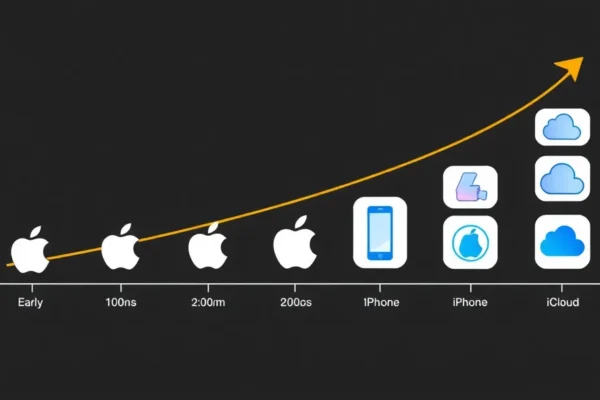
Apple Inc.’s story is one of remarkable growth and transformation, stretching back to its founding in 1976. What started as a vision by Steve Jobs, Steve Wozniak, and Ronald Wayne in a garage in California has evolved into one of the most valuable and influential companies in the world. Its journey is a testament to consistent innovation, strategic pivots, and robust revenue growth.
Early Days and the Mac Revolution: Apple’s initial success came with the Apple II, one of the first mass-produced microcomputers. However, it was the introduction of the Macintosh (Mac) in 1984 that truly cemented Apple’s reputation for user-friendly design and graphical interfaces. While the Mac was revolutionary, Apple faced challenges and management changes throughout the 1990s.
The Comeback Kid: The iPod and iTunes: The late 1990s saw Steve Jobs return to Apple, initiating a dramatic turnaround. The launch of the iPod in 2001, coupled with the iTunes Music Store in 2003, transformed the digital music industry. This period marked significant revenue growth and re-established Apple as a leader in consumer electronics.
The iPhone Era: A Game Changer: The most significant milestone in Apple’s history arrived in 2007 with the introduction of the iPhone. This device didn’t just change the smartphone market; it reshaped communication, entertainment, and how we access information. The iPhone became Apple’s primary revenue driver, propelling its financial performance to unprecedented heights. The subsequent development of the App Store further solidified its ecosystem and created a new economy for developers.
Expansion into Services: Recognizing the power of its vast user base, Apple has increasingly focused on its services division. This includes the App Store, Apple Music, iCloud, Apple TV+, and AppleCare. Services now represent a substantial and growing portion of Apple’s revenue, offering a more recurring and predictable income stream compared to hardware sales alone. This diversification has been key to its sustained financial performance and its journey towards becoming a multi-trillion dollar tech giant.
Reaching Trillion-Dollar Milestones: In August 2018, Apple became the first publicly traded U.S. company to reach a market capitalization of $1 trillion. It later surpassed $2 trillion and has since touched $3 trillion at its peak, with its market cap hovering around $4.85 trillion as of recent reports (figures are subject to daily market fluctuations). This growth is a result of consistent innovation, strong brand loyalty, and the synergistic success of its hardware, software, and services.
Thinking About Apple’s Growth in Your Financial Life
Understanding Apple’s trajectory offers several practical insights for how you might think about your own financial planning and investment decisions.
The Power of Innovation and Adaptation: Apple didn’t just stick with the Mac; it innovated with the iPod, then revolutionized the world with the iPhone, and then built a robust services business on top of its hardware success. This highlights the importance of adaptability and continuous innovation in business. For individuals, this can translate to continuous learning and skill development in your career.
Diversification is Key: While the iPhone has been a star performer, Apple’s increasing reliance on its services revenue demonstrates the benefit of having multiple income streams. This is a core principle in personal finance: don’t put all your eggs in one basket. Diversifying your investments across different asset classes (stocks, bonds, real estate) and even within those classes can help mitigate risk.
Long-Term Investing Perspective: Apple’s growth has occurred over decades. This reinforces the idea that wealth building often requires a long-term perspective. While short-term market fluctuations are normal, focusing on the long-term potential of well-chosen investments can lead to significant growth. Many people who invested in Apple early on have seen substantial returns over time.
Common Misconception: A common misconception is that simply buying stock in a highly successful company like Apple guarantees riches. While Apple has been a stellar performer, past performance is not indicative of future results. Investing always carries risk, and market conditions can change.
What to Watch For: When you see news about companies reaching new market cap milestones, consider what’s driving that growth. Is it sustained innovation, a strong services division, or something more speculative? This can inform your understanding of economic trends and the health of the tech giant sector.
Connecting Apple’s Growth to Broader Financial Concepts
Apple’s remarkable journey is intertwined with several fundamental financial and economic concepts:
Revenue Growth: This refers to the increase in a company’s sales over time. Apple’s consistent revenue growth, particularly driven by the iPhone and its expanding services, is a primary reason for its increasing market capitalization. Understanding how to read a company’s revenue reports is crucial for any investor.
Profitability: Beyond revenue, a company’s ability to turn those sales into profit (earnings) is vital. Apple’s efficient operations and high-margin products have led to substantial profits, which in turn make its stock more attractive and drive up its market cap.
Consumer Electronics Market: Apple operates within the competitive global consumer electronics market. Its success is a measure of its ability to capture market share and satisfy consumer demand in this dynamic sector.
Stock Market Valuation: Market capitalization is a key metric in stock market valuation. It helps investors compare the relative size and value of different companies.
Economic Moats: Apple has built what economists call an “economic moat” – a sustainable competitive advantage. This could be its strong brand loyalty, its integrated ecosystem of hardware and software, or the network effects of its App Store. Understanding economic moats helps identify companies with long-term potential.
Frequently Asked Questions About Apple and Market Capitalization
What is Apple’s current market capitalization?
As of recent reports, Apple’s market capitalization has been around $4.85 trillion. However, this figure changes daily as its stock price fluctuates on the market.
How does the iPhone contribute to Apple’s market cap?
The iPhone is Apple’s flagship product and has been its primary revenue and profit generator for years, directly and significantly boosting its overall market capitalization through strong sales and high demand.
What is the difference between market cap and revenue?
Revenue is the total income a company makes from its sales, while market capitalization is the total value of the company based on its stock price and number of shares outstanding.
Can an individual investor directly influence Apple’s market cap?
No, an individual investor cannot directly influence the market cap of a company as large as Apple. However, collective buying and selling by millions of investors determine the stock price, which in turn affects the market cap.
What are the risks associated with investing in a large tech giant like Apple?
Risks include intense competition, changing consumer preferences, regulatory challenges, supply chain disruptions, and a slowdown in innovation. While Apple has a strong history, its future growth is not guaranteed.
How does Apple’s history of innovation affect its financial performance?
Apple’s consistent history of innovation, from the Mac to the iPhone and its services, has driven its revenue growth, profitability, and customer loyalty, directly contributing to its impressive financial performance and market cap.
Disclaimer: This article is for educational purposes only and does not constitute financial advice. Investment decisions should be based on your own research, financial goals, and risk tolerance. Financial situations vary, and it is always recommended to consult with a qualified financial professional for personalized advice.











