

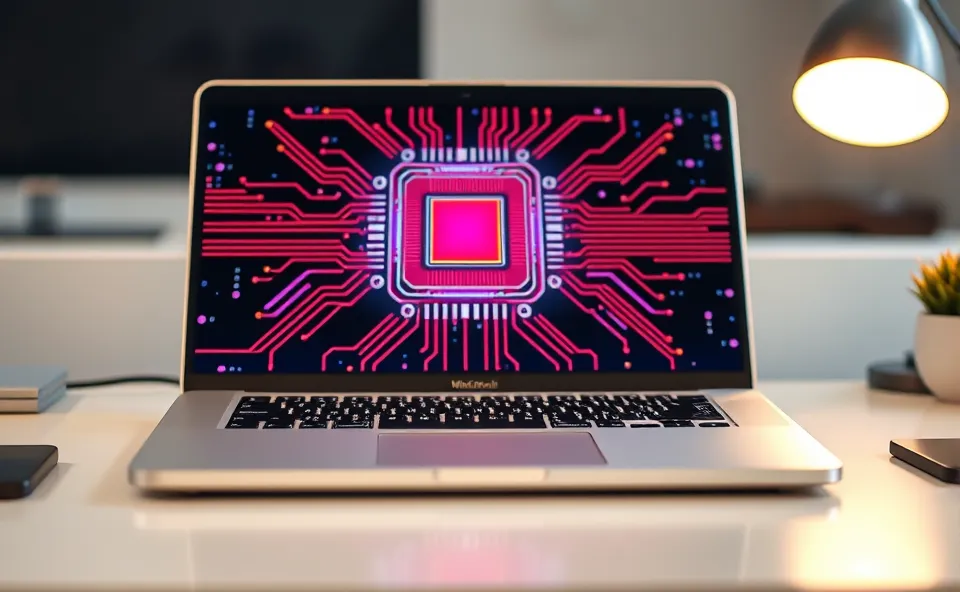
Apple Just Levelled Up the MacBook Pro
Apple has officially entered a new era of computing with the launch of the Apple M3 chip. If you have been following the tech world, you know that Apple likes to iterate, but this is more than just a small tweak. The new MacBook Pro is now powered by a family of chips that are designed to handle everything from basic emails to heavy 3D rendering without breaking a sweat.
At its core, the M3 series is about making things faster while using less power. Apple used a new 3 nanometer process to build these chips. To put that in simple terms, they managed to fit more transistors into a smaller space. This is a big deal because it allows the computer to think faster and execute tasks more efficiently. Whether you are using the standard M3, the M3 Pro, or the heavy hitting M3 Max, the goal is the same: give the user more power without draining the battery in two hours.
The new MacBook Pro isn’t just about raw speed, though. It is about how that speed feels in your hands. We are seeing improvements in how the laptop handles graphics and how it manages heat. This means you get a machine that stays cool and quiet, even when you are pushing it to the limit with professional software.
Why the M3 Chip Is Creating Such a Buzz
You might wonder why people are so excited about a piece of silicon you cannot even see. The reason is simple. For a long time, there was always a trade off in the laptop world. You could either have a thin, light laptop with great battery life, or a thick, heavy workstation that could actually handle professional work. You rarely got both.
The Apple M3 chip is trending because it continues to bridge that gap. People are searching for it now because the demand for laptop performance has shifted. We are no longer just browsing the web. We are editing 4K videos, running complex code, and using AI tools that require massive amounts of computing power. Users want a machine that can keep up with these demands without needing to be plugged into a wall outlet all day.
There is also a lot of curiosity surrounding the M3 chip performance in gaming. Historically, Macs were not the first choice for gamers. However, with new graphics features like hardware accelerated ray tracing and mesh shading, the conversation is changing. People want to see if the Mac can finally compete in the gaming space while maintaining its reputation for productivity.
How We Got to This Point With Apple Silicon
To understand why the M3 is important, we have to look back at where we started. For years, Apple relied on Intel processors. While those chips were powerful, they had a major flaw: they generated a lot of heat. This led to the infamous loud fans and the feeling that your laptop was becoming a space heater on your lap.
Everything changed when Apple introduced Apple Silicon. The first M1 chip was a shock to the system. It proved that a chip based on ARM architecture, which is similar to what we find in smartphones, could outperform traditional desktop processors while using a fraction of the energy. It was a paradigm shift that redefined Mac performance.
The M2 chip followed, refining the formula and adding more muscle. But the M3 is where the advanced architecture really shines. By moving to the 3nm process, Apple is not just making the chip smaller. They are changing the way electrons move through the circuits. This evolution is the result of years of vertical integration, where Apple designs the hardware, the software, and the chip itself to work in perfect harmony.
What This New Power Actually Means for You
So, what does all this tech talk mean for the average person or a business owner? It comes down to three main things: time, mobility, and capability.
First, let’s talk about time. If you are a creative professional, you know that rendering a video or exporting a large project can take hours. The Apple M3 chip slashes those wait times. This means you spend less time staring at a progress bar and more time actually creating. For a business, this translates to higher productivity and faster turnaround times.
Second is mobility. The energy efficiency of the M3 is perhaps its most impressive trait. Because the chip is so efficient, it doesn’t waste energy as heat. This allows the battery to last significantly longer. Imagine taking your MacBook Pro to a coffee shop or on a long flight and knowing you can work a full day without hunting for a power socket. That freedom is a huge win for digital nomads and executives on the move.
Third is capability. The new GPU architecture introduces something called Dynamic Caching. In the past, the GPU would allocate a set amount of memory for a task, even if it didn’t need all of it. Dynamic Caching allows the chip to allocate exactly the amount of memory needed in real time. This makes a massive difference in:
- Complex 3D modeling and rendering.
- High resolution video editing in 8K.
- Running multiple virtual machines for software development.
- Heavy multitasking with dozens of resource hungry apps open.
What Comes After the M3 Era
Looking forward, the trajectory is clear. Apple is moving toward a future where the line between a tablet, a laptop, and a desktop completely disappears. We can expect future chips to lean even harder into AI and machine learning. The Neural Engine inside the M3 is already fast, but as AI becomes a part of every app we use, that part of the chip will become the most important piece of the puzzle.
We will likely see further improvements in energy efficiency, potentially pushing battery life into the realm of several days rather than hours. As the advanced architecture matures, we might see these Pro level features trickle down into the more affordable MacBook Air models, making professional grade power accessible to everyone.
The goal will be a seamless ecosystem where your device knows exactly when to use high power for a big task and when to sip energy for a small one. The M3 is not the destination, but it is a very powerful step toward a world where our tools no longer limit our imagination.
Quick Answers About the New Hardware
Is the Apple M3 chip worth the upgrade from M1?
If you use your MacBook Pro for basic tasks like web browsing and documents, the M1 is still great. However, if you do professional video work, 3D design, or heavy coding, the jump in M3 chip performance is significant. You will notice faster render times and much better battery life.
How does the M3 improve energy efficiency?
The M3 uses a 3 nanometer process. This means the components are smaller and more efficient, requiring less power to perform the same tasks. This results in a cooler laptop and a battery that lasts longer under heavy loads.
What makes the new MacBook Pro better for gaming?
The new MacBook Pro features hardware accelerated ray tracing. This allows the laptop to simulate light and shadows more realistically, which is a key feature in modern high end games. Combined with Dynamic Caching, the graphics are smoother and more detailed.
What is the difference between M3, M3 Pro, and M3 Max?
The base M3 is perfect for students and general users. The M3 Pro is designed for developers and photographers who need more cores and memory. The M3 Max is a powerhouse built for 3D artists and film editors who need the absolute maximum Mac performance available.
Does the Apple Silicon architecture help with software compatibility?
Yes. Because Apple controls both the chip and the operating system, the software is optimized to run perfectly on Apple Silicon. While some old apps used a translation tool called Rosetta, almost all modern professional apps are now built specifically for these chips to get the best speed.











