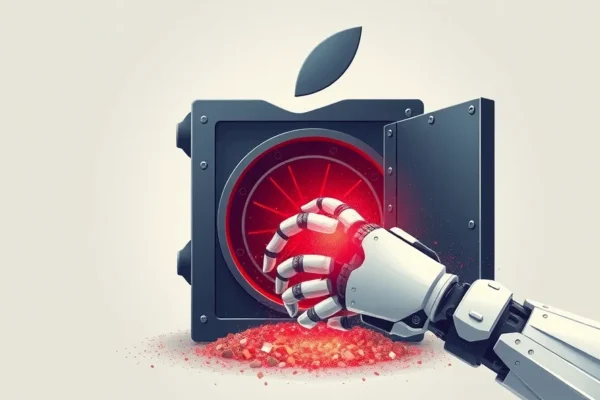
Apple Claims OpenAI Is Destroying Evidence in Trade Secrets Lawsuit
In a rapidly escalating legal battle, Apple is accusing OpenAI, the creator of ChatGPT, of destroying crucial evidence in their ongoing trade secrets lawsuit. The tech giant claims that a former OpenAI employee, Chang Liu, allegedly took proprietary Apple information to OpenAI, where it may have been used to develop advanced AI models. This accusation has now led to a dramatic demand from Apple for what’s known as expedited discovery, essentially asking a judge to force OpenAI to preserve and hand over data immediately.
The Core of the Legal Dispute
At the heart of this matter is Apple’s allegation that OpenAI has benefited from stolen trade secrets. Trade secrets are confidential pieces of information that give a business a competitive edge. Think of them like a chef’s secret recipe for a popular dish; it’s closely guarded because it’s what makes that dish unique and successful. In this case, Apple believes that proprietary information related to its AI development may have been illicitly transferred to OpenAI.
The company is particularly concerned about a former employee, identified as Chang Liu, who reportedly worked on Apple’s AI initiatives before joining OpenAI. Apple contends that Liu may have downloaded sensitive Apple data onto a personal MacBook before leaving. Their fear is that this data could have been instrumental in the development of OpenAI’s influential AI devices and services, including ChatGPT.
Why the Urgency: The Allegation of Destroying Evidence
Apple’s request for expedited discovery stems from a serious accusation: that OpenAI is actively destroying evidence. When a lawsuit is filed, parties are generally expected to preserve all relevant information. This process, known as legal hold, prevents data from being deleted or altered. However, Apple claims that OpenAI has failed to adequately preserve data, specifically relating to the MacBook allegedly used by Chang Liu.
The concern is that if this data is not secured promptly, it could be permanently lost. This would severely hamper Apple’s ability to prove its case. Imagine trying to prove someone copied your secret recipe if all copies of that recipe have been shredded. Expedited discovery is a legal mechanism used when there’s a risk of evidence disappearing before the normal legal process can gather it. Apple is essentially sounding an alarm, stating that without immediate action, key pieces of the puzzle in their trade secrets lawsuit against the ChatGPT-maker could vanish forever.
How Expedited Discovery Works
Expedited discovery is a shortcut in the legal process. Normally, gathering evidence can take months or even years. It involves formal requests for documents, depositions (sworn testimony outside of court), and interrogatories (written questions requiring written answers). However, when there’s a risk of evidence destruction, one party can ask the court for permission to start this process much earlier and more urgently.
Think of it like this: if your house is on fire, you don’t wait for the usual fire department procedures. You need immediate intervention to save what you can. Similarly, Apple is arguing that the potential loss of digital evidence is like a fire, requiring immediate action. They want the court to order OpenAI to preserve all data associated with Chang Liu’s former work at the company, especially any data that might have originated from Apple. This could involve seizing or imaging the specific MacBook in question and requiring OpenAI to maintain all relevant internal communications and project files.
The Legal Battle: Apple vs. OpenAI Intensifies
This is not the first time major tech companies have found themselves in legal disputes over intellectual property and trade secrets. The rapid advancements in artificial intelligence have created a highly competitive landscape, where innovation is paramount. Companies invest billions in research and development, making their proprietary knowledge incredibly valuable.
The trade secrets lawsuit filed by Apple against OpenAI is a stark illustration of the stakes involved. The core accusation suggests that a foundational element of OpenAI’s success—its advanced AI models—might have been built, in part, on stolen intellectual property. Apple is seeking to protect its innovations, while OpenAI is defending its development processes. The demand for expedited discovery, driven by the fear of evidence destruction, signals a significant escalation in this legal battle. It suggests Apple believes it has strong reasons to suspect that crucial evidence might be on the verge of disappearing, a claim that OpenAI will likely contest vigorously.
This article discusses a developing legal situation. All claims and allegations are made by the involved parties in a legal proceeding and are subject to proof and judicial review.