

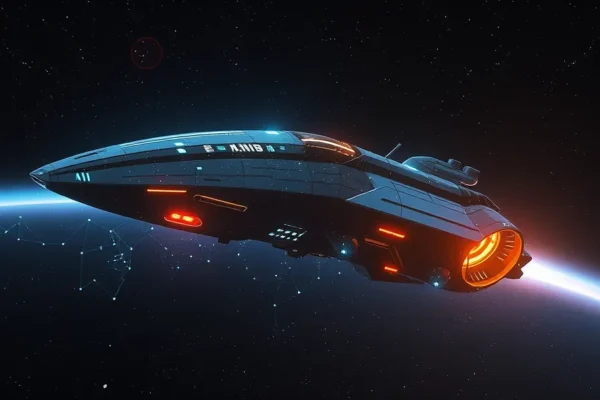
AstroForge Embraces AI for Smarter Space Exploration
The quest for resources beyond Earth has taken a significant leap forward with AstroForge’s pioneering integration of advanced artificial intelligence into its spacecraft. The company is notably incorporating a transformer-based AI model into its Autonomy-1 probe, a development poised to revolutionize how we navigate and operate in the harsh environment of space. This move signals a broader trend in the aerospace industry towards greater autonomy and intelligent decision-making in missions that are increasingly complex and remote.
AstroForge’s innovation addresses a critical challenge in space exploration: the immense distances and communication delays that make real-time control of spacecraft impractical. By empowering probes like Autonomy-1 with sophisticated AI, AstroForge aims to enable them to make independent decisions, adapt to unforeseen circumstances, and efficiently execute complex tasks, such as orbital operations and potential space mining. This development, announced by AstroForge in recent technical briefings and detailed in their company communications, represents a significant step in making ambitious space missions more feasible and cost-effective.
The Brains Behind the Mission Transformer-Based AI
At the heart of this advancement lies a transformer-based AI model. To understand this, think of traditional AI like a dog that can be trained to perform specific tricks based on clear commands. A transformer-based AI, however, is more like a seasoned explorer who can understand a complex map, anticipate environmental changes, and adapt their route on the fly, even if they encounter unexpected obstacles. Unlike older AI systems that process information in a linear fashion, transformers excel at understanding context and relationships within data, much like how humans process language. This makes them exceptionally well-suited for complex tasks that require interpreting vast amounts of sensor data and making nuanced decisions.
For Autonomy-1, this means the space probe can process information from its sensors—like cameras and navigation systems—and use the AI to plan its trajectory, avoid collisions, and manage its systems without constant input from mission control on Earth. This is crucial for missions involving extended travel times or operations in areas with intermittent communication. The AI acts as an intelligent co-pilot, constantly analyzing the situation and making the best possible choices to ensure the mission’s success. This capability is fundamental to enabling more advanced orbital operations and ultimately, the complex logistics of space mining.
Autonomy-1 Leading the Charge in AI-Powered Spacecraft
Currently, the integration of transformer-based AI into a dedicated space probe like Autonomy-1 is at the cutting edge of aerospace technology. While AI has been used in space for decades in more rudimentary forms (e.g., for automated fault detection), the sophistication of transformer models represents a new frontier. AstroForge’s Autonomy-1 is positioned as an early adopter of this advanced AI for practical, mission-critical functions. This AI-powered spacecraft is being developed with the goal of demonstrating autonomous navigation and operational capabilities in a space environment, laying the groundwork for future missions focused on space mining and resource utilization.
The practical applications are vast. Imagine a probe autonomously identifying a valuable asteroid, calculating the safest and most efficient way to approach it, and then managing the complex maneuvers required for orbital rendezvous or even initial extraction attempts. This level of autonomy drastically reduces the need for constant human oversight, which is both time-consuming and expensive, especially considering the communication delays inherent in space exploration.
A Competitive Field of Intelligent Space Systems
AstroForge is not alone in recognizing the potential of AI in space. Major aerospace players and ambitious startups are all investing heavily in autonomous systems and AI for space exploration and operations. Companies like SpaceX, with its Starship program, are developing highly automated launch and landing sequences. NASA has also been a long-time proponent of increasing spacecraft autonomy for deep space missions, using AI for tasks like celestial navigation and scientific data analysis on probes such as the Mars rovers.
What differentiates AstroForge’s approach with Autonomy-1 and its transformer-based AI is the explicit focus on enabling complex, independent decision-making for resource-focused missions. While many are developing AI for navigation and basic operations, AstroForge appears to be pushing the envelope towards AI that can handle more strategic planning and execution, particularly in the context of future space mining endeavors. The advantage lies in their focused application of this technology to a specific, high-value domain.
Reshaping Space Exploration and the Economy
The implications of AI-powered spacecraft like Autonomy-1 are profound. For space exploration, it means missions can venture further, stay longer, and undertake more ambitious scientific and commercial objectives. The ability for probes to operate autonomously will dramatically lower the operational costs of space missions, making activities like asteroid prospecting and eventual space mining more economically viable. This could lead to the creation of entirely new industries and markets, potentially unlocking vast reserves of resources beyond Earth, from rare metals to water ice.
Economically, this could foster a new space race focused not just on prestige, but on tangible resource acquisition. It might also create new job sectors in AI development for aerospace, robotic operations, and space resource management. Socially, while the immediate benefits are commercial and scientific, the long-term prospect of off-world resource availability could have significant implications for global resource management and sustainability here on Earth. The timeline for widespread adoption remains a few years out, with initial demonstrations crucial for validating these advanced AI capabilities.
Navigating the Hurdles of Autonomous Spaceflight
Despite the immense promise, significant limitations and challenges remain. The reliability and robustness of AI in the unpredictable and unforgiving environment of space are paramount. A glitch or error in an AI system millions of miles from Earth can be catastrophic, with no easy recourse for repair. Developing AI that can handle unforeseen events—beyond what it has been trained on—is a major technical hurdle.
Furthermore, the computational power required for sophisticated AI models can be a constraint on spacecraft due to power and thermal limitations. Ensuring the security of these AI systems against potential cyber threats in space is another critical concern. Regulatory frameworks for autonomous operations in space are also still in their nascent stages, which could pose adoption barriers. The cost of developing and validating these advanced AI systems for space-grade reliability is also substantial.
The Road Ahead for Intelligent Space Probes
The future trajectory for AI in space exploration is clear: increasingly sophisticated autonomy. We can expect to see AI models not only handling navigation and operations but also playing a greater role in scientific discovery, data analysis, and even mission planning. Developments to watch include advancements in AI’s ability to learn and adapt in real-time, improved sensor fusion (combining data from multiple sources), and the miniaturization of AI hardware for smaller, more agile spacecraft.
AstroForge’s work with the transformer-based AI on Autonomy-1 is a significant indicator of this trend. While specific milestones for future breakthroughs are often proprietary, the general consensus among experts is that fully autonomous deep-space missions capable of complex tasks will become more common within the next decade, with early demonstrations like Autonomy-1 playing a vital role in paving the way.
Frequently Asked Questions
What is AstroForge’s primary goal with the Autonomy-1 probe?
AstroForge’s primary goal with the Autonomy-1 probe is to demonstrate advanced autonomous navigation and orbital operations, utilizing a transformer-based AI model to enable intelligent decision-making in space. This is a crucial step towards their broader objective of space mining.
How does transformer-based AI help with space navigation and operations?
Transformer-based AI, unlike older AI systems, excels at understanding context and relationships within data. For space missions, this means the AI can process vast amounts of sensor information to make complex, real-time decisions about trajectory, collision avoidance, and system management without constant human intervention, crucial for long-duration or remote missions.
Is AstroForge’s AI-powered spacecraft technology currently available or in development?
The integration of this advanced transformer-based AI into the Autonomy-1 probe is currently in development and testing phases. It represents an early adoption of sophisticated AI for practical, mission-critical functions in space, not yet a widely available commercial product.
What are the main challenges for AI in space exploration?
The main challenges include ensuring the extreme reliability and robustness of AI in the harsh space environment, developing AI that can handle unforeseen events, managing computational power and thermal constraints on spacecraft, and establishing clear regulatory frameworks for autonomous space operations.
How does this approach to AI in space differ from other companies?
While many companies are integrating AI into spacecraft, AstroForge’s focus on using advanced transformer-based AI for complex decision-making specifically in support of future space mining operations distinguishes its approach. This targeted application aims to unlock new economic potential beyond basic mission execution.
What is the potential long-term impact of AI-powered spacecraft on the space industry?
AI-powered spacecraft have the potential to significantly lower operational costs for space missions, enabling more ambitious scientific endeavors and the commercial viability of activities like space mining. This could lead to the development of new space-based economies and industries.
This article discusses emerging technologies and future applications. While AstroForge is making significant strides, the full capabilities and timeline for widespread adoption of these advanced AI systems in space are subject to ongoing research, development, and testing.











