

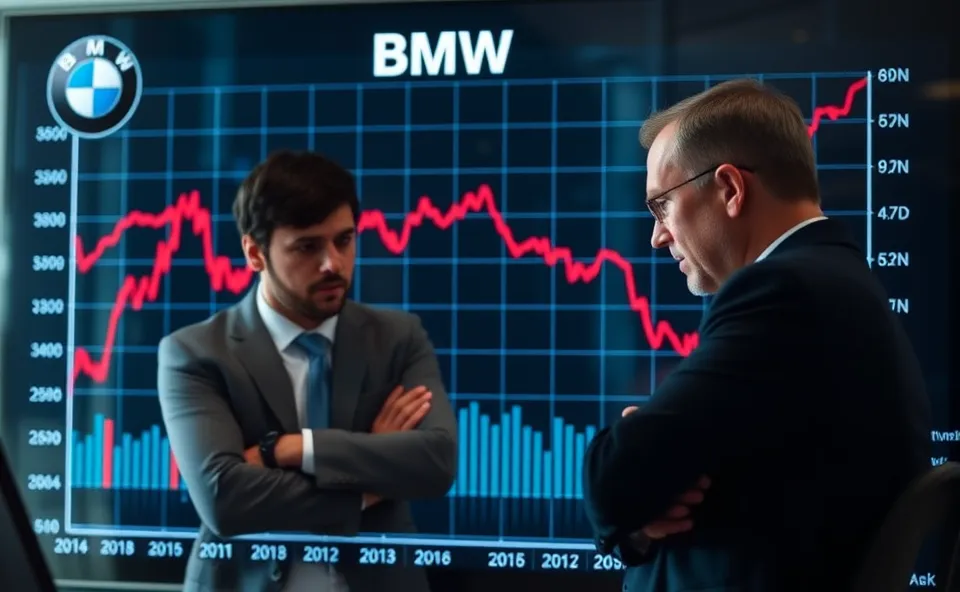
The Strange Case of the BMW Discount
Imagine walking into a store and seeing a high end luxury watch. The price tag says it is half off. Then, you find out that the store owner is actually giving away a pile of cash to whoever buys the watch. In the world of finance, that is essentially what is happening right now with BMW stock. We are seeing a significant BMW stock dip that has created a very weird mathematical situation known as negative enterprise value.
To put this in simple terms, negative enterprise value happens when a company has more cash and short term investments on its balance sheet than the total value of its stock market price plus its debt. It is a rare occurrence. Usually, it signals that a company is incredibly undervalued. On paper, it looks like you are being paid to own the company. If you bought every single share and paid off all the loans, you would still have cash left over in the bank.
Normally, this would trigger a buying frenzy. Investors love a bargain, and a negative enterprise value is the ultimate bargain. However, instead of a rush to buy, there is a noticeable investor hesitation. People are staring at the discount but refusing to jump in. They are wondering if there is a catch, and in the current market, there usually is.
Why the Buzz Around the BMW Stock Dip
You might wonder why this is trending now. For years, the buy the dip strategy was the golden rule of investing. If a great company’s price fell, you bought more because you trusted the brand to bounce back. But the rules of the game have changed. People are searching for investment analysis BMW because the traditional logic is failing.
The automotive world is currently in the middle of its biggest transformation in a century. We are not just talking about a new model or a different engine. We are talking about a total shift from internal combustion to electricity and software. When investors see a BMW stock dip, they are no longer just looking at the current profit. They are questioning if the company can survive the transition without losing its soul or its profit margins.
The conversation is trending because it highlights a clash between two different types of investing. On one side, you have the value investors who see the BMW valuation and think it is a steal. On the other side, you have the growth investors who fear that the old way of making cars is dying. This tension is exactly why everyone is talking about it.
A Luxury Giant Facing a New Reality
To understand why people are nervous, we have to look at the history. BMW has always been the gold standard for driving dynamics and luxury engineering. They built a massive empire on the back of the ultimate driving machine. For decades, their formula was simple: make a better engine, wrap it in a beautiful body, and sell it to people who value performance.
But the landscape has shifted. The rise of electric vehicles changed the definition of a luxury car. Suddenly, it was not about the roar of the engine but about the size of the screen and the efficiency of the battery. BMW did not ignore this. They launched a wide range of electric models and invested billions into their factories. However, the transition is proving to be more expensive and slower than many hoped.
There is also the geographical factor. For a long time, China was the primary engine of growth for German luxury cars. But the market there has changed. Local Chinese brands are now producing high tech electric cars that appeal to younger buyers. This means BMW is fighting a two front war: they are trying to move away from gasoline while simultaneously fighting off aggressive new competitors in their most important market.
What This Means for the Automotive Sector
The hesitation surrounding BMW shares is not just about one company. It is a signal about stock market sentiment for the entire automotive sector investing landscape. When a company with a negative enterprise value remains unattractive to buyers, it suggests a deep fear of a value trap.
A value trap is a stock that looks cheap based on financial metrics but stays cheap because the business is fundamentally declining. If investors believe that the luxury car market is shrinking or that the costs of switching to electric are too high, then the low price is not a discount. It is a warning.
This situation impacts a few key areas:
- Manufacturer Confidence: Other car makers are watching BMW. If the market does not reward BMW for its cash reserves, other companies may change how they manage their own finances.
- Tech Integration: The focus is shifting from hardware to software. The market now values a car company more like a tech company. Since BMW is still viewed primarily as a hardware company, its valuation suffers.
- Risk Appetite: It shows that investors are currently prioritizing growth and certainty over deep value. They would rather pay more for a company that is growing fast than pay very little for a company that is struggling to pivot.
Looking Ahead at the Road Forward
So, what happens next? It is unlikely that BMW will simply disappear. They have too much brand equity and too much cash to fail quickly. The real question is whether they can turn that negative enterprise value into a launchpad for future growth.
The company is pursuing a flexible strategy. Unlike some rivals who went all in on electric vehicles very quickly, BMW is keeping a foot in both worlds. They are producing electric, hybrid, and combustion engines on the same assembly lines. This allows them to pivot based on what customers actually buy, rather than what the industry predicts.
If the financial news BMW reports start showing that their software integration is improving and their market share in China is stabilizing, the investor hesitation will likely vanish. The dip will be seen as a great entry point in hindsight. However, if the transition to electric becomes a race to the bottom on price, the stock may stay suppressed for a long time.
The most likely scenario is a slow recovery. As the market stabilizes and the hype around pure electric vehicles settles into a more realistic pace, the actual value of the company’s assets and its massive cash pile will become more attractive again.
Common Questions About BMW Investment
Why is the BMW stock dip happening now?
The dip is mainly caused by a combination of slowing demand in the Chinese market and the high costs associated with switching from gasoline engines to electric power. Investors are worried that these pressures will eat into future profits.
What is negative enterprise value explained in simple terms?
It means the company has more cash and liquid assets than the total cost to buy the company and pay off its debts. Essentially, the business is trading for less than the cash it has in the bank, which usually suggests the stock is very undervalued.
Why is there investor hesitation if the stock is so cheap?
Investors fear a value trap. They worry that while the numbers look good today, the long term business model is under threat from new electric vehicle competitors and changing consumer habits.
How does BMW valuation compare to other car companies?
BMW often looks cheaper than tech focused EV companies because it is valued as a traditional manufacturer. Its valuation is based on physical assets and dividends rather than future explosive growth projections.
Is the buy the dip strategy working for BMW shares?
For some long term investors, yes. But for many, the strategy is on hold because the automotive sector is facing structural changes that make traditional valuation metrics less reliable than they used to be.











